

More importantly, financial independence for the People's Councils at the commune level.
During the discussion, many National Assembly deputies pointed out a paradox: the People's Council is the representative body of the people, but its supervisory power, especially at the grassroots level, is being restricted. I strongly agree with the opinions of National Assembly deputies Vu Hong Luyen (Hung Yen) and Siu Huong (Gia Lai) who argued that the supervisory authority of the People's Council delegations must be clearly defined. Only when the supervisory authority of the People's Council delegations is legalized can the spirit of "being close to the people" be ensured, especially when we are implementing a two-tiered local government system. Otherwise, the most effective and people-friendly supervisory channel will be left vacant. As Deputy Siu Huong suggested, the draft law should more clearly define the responsibility of the Standing Committee of the People's Council in assigning tasks and monitoring the results of the People's Council delegations' supervision, ensuring that this activity is not merely a formality," shared Mr. Pham Van Hien, a voter from Hai Van ward, Da Nang City.
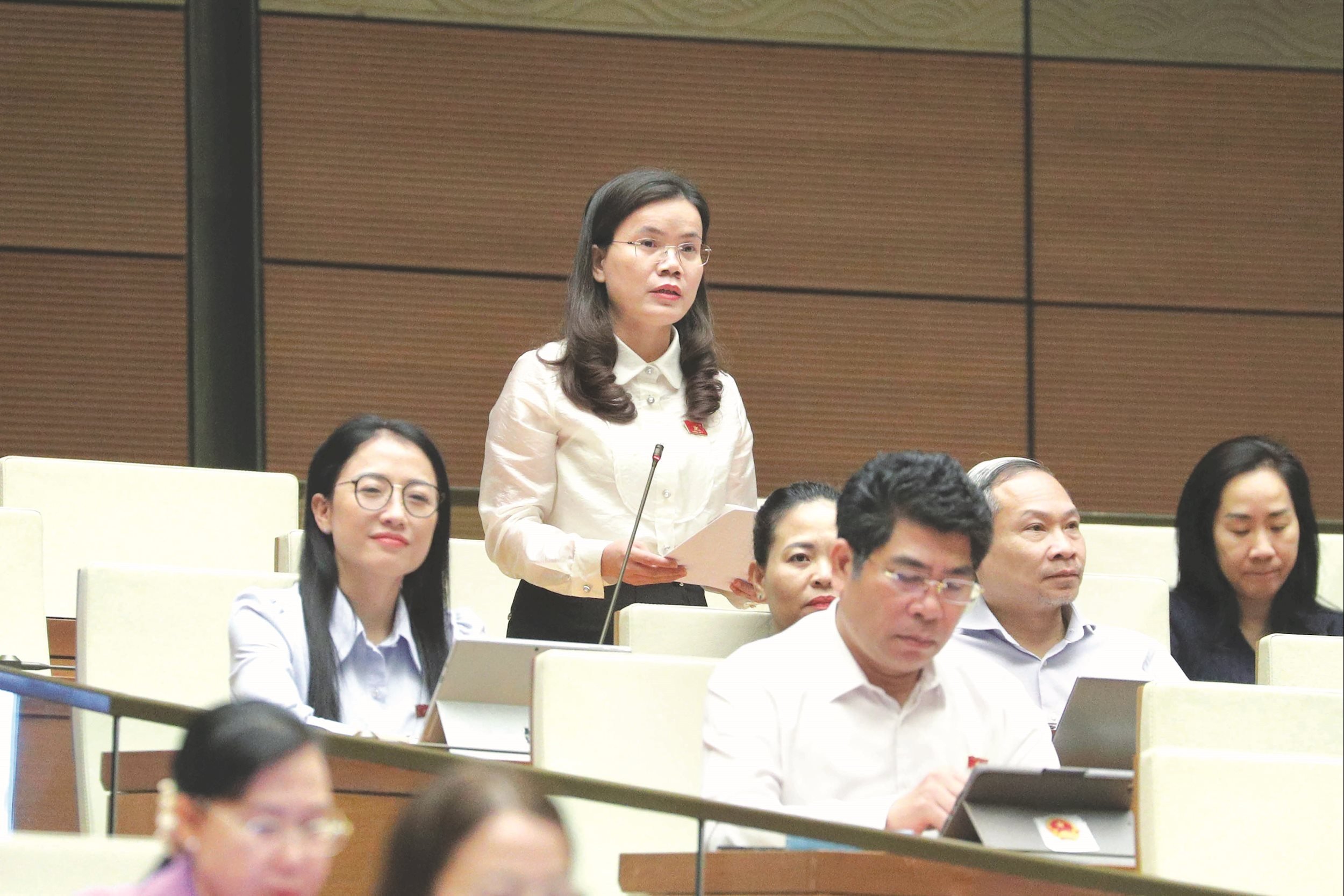
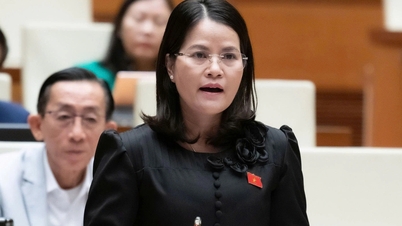
National Assembly Deputy Vu Hong Luyen ( Hung Yen ) speaks in the assembly hall. Photo: Ho Long
Mr. Kieu Quang Ha, a voter from Bac Hong Linh ward, Ha Tinh province, frankly stated: Legalizing the supervisory authority of the People's Council delegation is necessary, but more importantly, it requires financial independence for the People's Council at the commune level. Currently, when conducting supervision, funding has to be requested from the very agency being supervised, how can objectivity be ensured? If this "bottleneck" isn't removed, supervision will be ineffective. Therefore, regulations on ensuring supervisory activities should more clearly stipulate the mandatory provision of resources and the guarantee of financial independence for the People's Council.
This opinion pointed out the biggest "bottleneck" in grassroots supervision – the financial dependence on the supervised agency itself. Therefore, many argue that the regulation of having only one account holder, the Chairman of the People's Committee at the commune level, as in the previous three-tiered local government model, should not be maintained. Instead, adjustments should be considered to allow the People's Council at the commune level to have its own account holder, ensuring independence in its activities, especially supervision. This is because the commune level now has a significantly expanded scope, scale, and nature of activities compared to the past.
In many localities, agencies and businesses such as electricity companies, water supply companies, environmental sanitation units, regional tax offices, People's Courts, People's Procuratorates, etc. – although directly serving the people – are not under the management of the commune. When problems arise, the commune People's Council lacks the authority to supervise them. Voters ask: If the commune People's Council cannot supervise them, then who will? This is precisely why voters expect the draft law to expand the scope of supervision, not only "according to administrative levels" but also according to residential areas and areas of people's lives. When the commune People's Council can supervise all agencies and units operating in its area, the law will truly be closer to the people and touch their lives.
Post-monitoring - "the final destination that needs to be completed"
Monitoring should not stop at "detecting problems," but must lead to "post-monitoring changes." However, this is currently a major "gap" in practice. "I agree with the viewpoint of Representative Nguyen Thi Suu (Thua Thien Hue delegation) when she frankly stated: The current law does not bind the responsibility to implement recommendations after monitoring, leading to a situation where monitoring is considered complete once it's finished. Therefore, it is essential to clearly stipulate sanctions in the Law to ensure the implementation of monitoring recommendations – this is the factor that affirms the effectiveness of this activity," Mr. Ngo Duc Thai, a voter from Hung Nguyen commune, Nghe An province, expressed his hope.
In reality, many monitoring conclusions are "shelved" by administrative agencies, with delayed reports, perfunctory responses, or even no concrete feedback at all. Voters agree with the delegates' discussion and add: it is time for clear "post-monitoring" procedures. Each monitoring recommendation should be a "political order"—with someone responsible, a deadline for implementation, and a public report. The National Assembly Standing Committee could periodically publish a list of agencies and localities that are slow or fail to implement monitoring conclusions, as a "soft but effective" sanction. The pressure for transparency will force the administrative system to truly move forward.
During the discussion, many delegates also raised another important point: the supervisory body must also be supervised. The People's Council and its committees cannot simply "assign tasks and then leave them unattended." The results of each supervision must be made public, their effectiveness evaluated, and they must be held accountable to the voters. Only when the People's Council dares to examine itself will its supervisory activities have depth and build trust.
Monitoring for change - not just for knowing.
Supervision is not just a right, but a measure of trust. The essence of supervision in a socialist rule of law state lies not in "who supervises whom," but in what the ultimate goal of supervision is. Supervision must bring about change and compel action, not merely detect wrongdoing and then close the case.
Many voters believe that it is time to view oversight as a closed four-step process: selecting the right issues; conducting thorough and objective oversight; drawing clear conclusions with assigned responsibilities; and monitoring and urging the implementation of results. Only when all four steps are completed can oversight become a driving force for regulating public behavior. At that point, the commune People's Council will not only "listen to the people," but also "urge the government to act"; elected representatives will not only be those who reflect but also those who create change.
As Deputy Speaker of the National Assembly, Lieutenant General Tran Quang Phuong, concluded the session: no opinion was left unheard and addressed. This is not only a commitment of the National Assembly, but also a reminder for all levels of government to reflect on themselves – so that supervision does not stop at the parliamentary chamber, but permeates every locality and every aspect of life. When supervision truly becomes a capacity to control power, is legalized, and is guaranteed by an independent and transparent mechanism, each supervisory conclusion will be a commitment of the State to the People. And only then will the People truly feel that they are listened to, respected, and protected – not just by promises, but by actions.
Source: https://daibieunhandan.vn/du-thao-luat-hoat-dong-giam-sat-cua-quoc-hoi-va-hdnd-sua-doi-de-quyen-luc-nhan-dan-duoc-thuc-thi-tron-ven-10392843.html
![[Photo] Prime Minister Pham Minh Chinh holds a phone call with the CEO of Russia's Rosatom Corporation.](/_next/image?url=https%3A%2F%2Fvphoto.vietnam.vn%2Fthumb%2F1200x675%2Fvietnam%2Fresource%2FIMAGE%2F2025%2F12%2F11%2F1765464552365_dsc-5295-jpg.webp&w=3840&q=75)


![[Photo] Closing Ceremony of the 10th Session of the 15th National Assembly](/_next/image?url=https%3A%2F%2Fvphoto.vietnam.vn%2Fthumb%2F1200x675%2Fvietnam%2Fresource%2FIMAGE%2F2025%2F12%2F11%2F1765448959967_image-1437-jpg.webp&w=3840&q=75)



































![[OFFICIAL] MISA GROUP ANNOUNCES ITS PIONEERING BRAND POSITIONING IN BUILDING AGENTIC AI FOR BUSINESSES, HOUSEHOLDS, AND THE GOVERNMENT](https://vphoto.vietnam.vn/thumb/402x226/vietnam/resource/IMAGE/2025/12/11/1765444754256_agentic-ai_postfb-scaled.png)


























![[Photo gallery] Long Thanh Airport 'lights up' ready to welcome its first flight](https://vphoto.vietnam.vn/thumb/402x226/vietnam/resource/IMAGE/2025/12/11/1765467251707_bia_20251211222704.jpeg)














Comment (0)