

From the forgotten “oasis”…
About 50km from the center of Ho Chi Minh City, Can Gio has remained peaceful for many years with mangrove forests, pristine beaches and the familiar Binh Khanh ferry - a place often overloaded with traffic. Can Gio island has 4 communes (Binh Khanh, Can Gio, An Thoi Dong, Thanh An), an area of about 704.22km² but the population is only about 80,000 people, the lowest in Ho Chi Minh City.

A corner of Can Gio with sparse infrastructure and population. Photo: TK.
The special geographical location, separated by rivers, makes Can Gio, despite its great potential for marine economy , tourism and ecology, unable to develop accordingly. In the urban planning of Ho Chi Minh City, this place has long been considered a "traffic depression", separated from the main development axis.
To get to Can Gio, residents and tourists still have to rely almost entirely on the Binh Khanh ferry or the high-speed waterway. On holidays, Tet or weekends, traffic jams stretching for kilometers at the ferry area become a "familiar refrain", making the 50km journey from the city center difficult.
Not only isolated from Ho Chi Minh City, Can Gio also lacks connection with neighboring provinces. The distance of only 15km by sea to Ba Ria - Vung Tau is a golden opportunity to form a coastal tourism chain, but currently the only option is still the Can Gio - Vung Tau sea ferry. This type of transport is potentially risky when encountering big waves and strong winds, and often has to temporarily stop operations.
It is these infrastructure "bottlenecks" that have hindered the development of the land known as the "green lung" of Ho Chi Minh City for decades.

Binh Khanh ferry is the only way to travel from the mainland of Ho Chi Minh City across the Soai Rap River to Can Gio. The ferry trips will only end their "historic mission" when the Can Gio bridge is completed and put into operation. Photo: Nguyen Hue .
To the "billion dollar gateway" to the world
Can Gio is attracting the attention of large corporations, including Vingroup, with many notable large-scale project proposals. Not only stopping at tourism real estate, Vingroup also shapes an overall development strategy, linked with international-level infrastructure and logistics.
The centerpiece of this plan is the Can Gio coastal tourism urban area mega-project – Vinhomes Green Paradise, with an area of nearly 2,870 hectares and a total investment of more than 10 billion USD. The project is oriented to develop into a large-scale resort, tourism and housing urban area. If implemented on schedule, the project can contribute to promoting the marine economy and expanding urban space to the south of Ho Chi Minh City.
The proposal to build a 108-storey tower in the project is also attracting attention. If approved and implemented, this project will be one of the tallest buildings in Vietnam.

Can Gio coastal tourism urban area – Vinhomes Green Paradise. Photo: Vingroup
To solve the traffic bottleneck, Vingroup has proposed a series of large-scale infrastructure projects. Notably, the metro line with a speed of up to 350km/h, operating continuously, will help shorten the travel time from Phu My Hung to the project to 12 minutes. The project has a total capital of about 4 billion USD, connecting Can Gio directly with the center of Ho Chi Minh City, and is expected to shorten travel time, ending the waiting for ferries and congestion.
At the same time, the group also proposed to study the Can Gio - Vung Tau sea route, connecting two tourist centers only 15km apart through Ganh Rai Bay, helping to shorten travel time to about 10 minutes, opening a safe and smooth year-round sea tourism - economic corridor, replacing the current sea ferry.
In addition to business projects, Ho Chi Minh City is also accelerating many key projects. In particular, Can Gio Bridge is considered an important infrastructure project to improve the connectivity of this area with the center of Ho Chi Minh City, reducing the load on Binh Khanh ferry. This project is expected to start construction in 2026 with 4 lanes for motor vehicles and 2 lanes for mixed vehicles, a total route length of 7.3km, and a cost of more than 11,000 billion VND.

In addition to the Sac Forest route, residents and tourists from the center of Ho Chi Minh City will soon be able to take the high-speed metro train to Can Gio in just 12 minutes. Photo: TK.
In addition, the Sac Forest – Ben Luc – Long Thanh expressway route is also planned to connect Can Gio directly with Long Thanh International Airport and the Western provinces. When completed, this route will help Can Gio become an important link in the Southeast region’s traffic network.
Not only developing tourism, Can Gio is also being studied to build Can Gio International Transit Port, a project that could attract billions of dollars in investment. If successful, this port will become a strategic cargo transit point on the global maritime route, competing directly with major ports in the region.
Along with that, the Can Gio coastal area is also planned to develop logistics industry, maritime services, logistics and international trade and tourism center, forming a closed marine economic value chain.
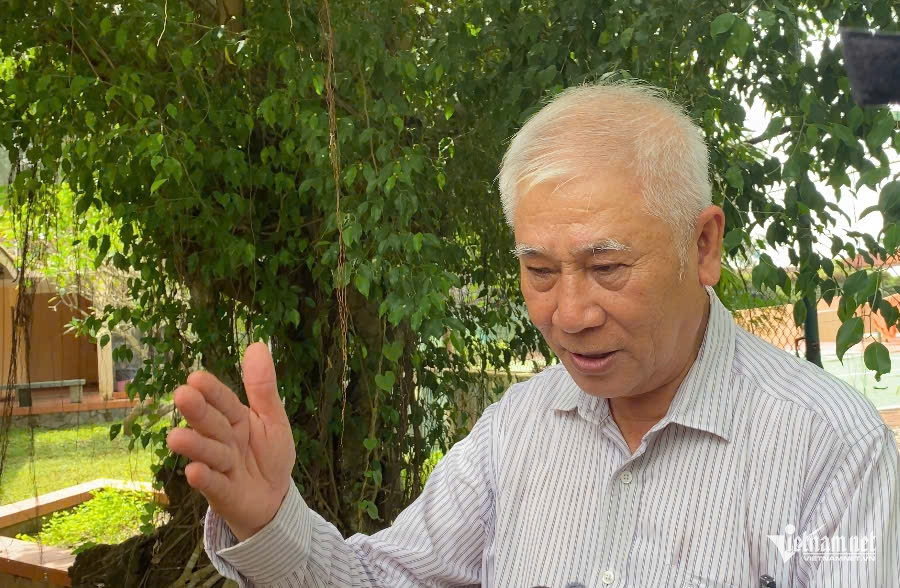
Architect Khuong Van Muoi, former Chairman of the Ho Chi Minh City Association of Architects. Photo: TK
According to architect Khuong Van Muoi, former Chairman of the Ho Chi Minh City Association of Architects, Can Gio is no longer the "wild, isolated land" of the past. With the influx of billion-dollar projects and a synchronous infrastructure strategy, this place is strongly entering a period of historical "awakening".
This transformation is a spectacular transformation: Can Gio is positioning itself to become an 'Eco-Smart-Sustainable Urban Area' of international stature. The goal is not just to be a new destination, but to be a "magnet" attracting up to 40 million visitors/year to Ho Chi Minh City.
“In the near future, tourists from Vung Tau to Can Gio by sea will only take 10 minutes, from the center of Ho Chi Minh City to Can Gio will only take 10 minutes by high-speed rail. Thus, people from the center of Ho Chi Minh City to Vung Tau will choose to go through Can Gio; from the western coast to Ho Chi Minh City and Vung Tau will also go through Can Gio, instead of having to go around like now,” he shared.
The rise of Can Gio is not only a change in appearance, but also an expansion of living space and strategic development for Ho Chi Minh City, helping the city reach out to the East Sea and integrate more deeply into the global economic chain. From an isolated "oasis", Can Gio is now moving straight towards the goal of becoming Ho Chi Minh City's "billion-dollar gateway", a place where tourism, seaports, urban areas and international trade converge.
Vietnamnet.vn
Source: https://vietnamnet.vn/can-gio-lot-xac-tu-vung-trung-giao-thong-den-cua-ngo-ty-do-vuon-ra-the-gioi-2455891.html























![[Video] The craft of making Dong Ho folk paintings has been inscribed by UNESCO on the List of Crafts in Need of Urgent Safeguarding.](https://vphoto.vietnam.vn/thumb/402x226/vietnam/resource/IMAGE/2025/12/10/1765350246533_tranh-dong-ho-734-jpg.webp)














































Comment (0)