

Silk threads of vibrant colors embroidered in Vietnamese style.
In the tranquil setting of Tu Thi Temple, No. 2 Yen Thai Street, Hoan Kiem District, Hanoi , the art residency combined with a workshop titled "Shiny Silk - Natural Colors, Embroidery and Dyeing - Past and Present" offers the public the opportunity to admire ancient embroidered paintings, natural dye palettes, and directly observe the artists at work. Using colored threads and traditional materials such as Do paper and cotton fibers, artist Pham Ngoc Tram skillfully highlights the figures of two fighting roosters, with lines and colors that evoke a bygone era, vibrant and lifelike on the fabric.
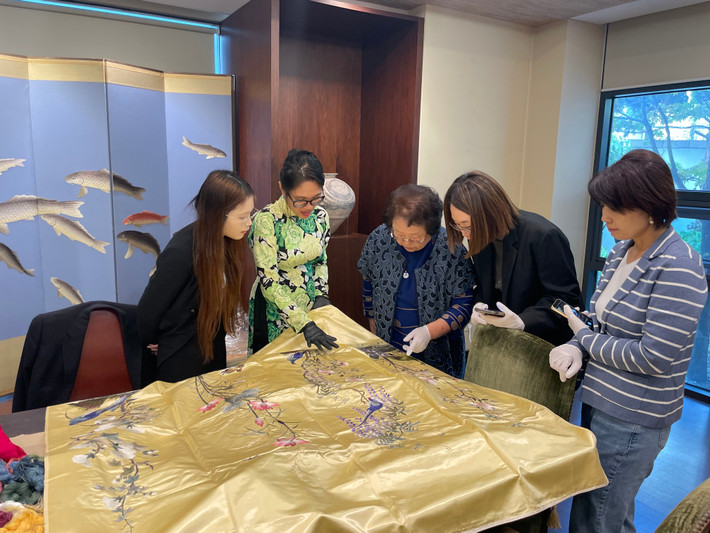 Artist Pham Ngoc Tram (wearing an ao dai) shares about the heritage of Vietnamese embroidery with international experts.
The artist residency program at the shrine of the founder of embroidery, Le Cong Hanh - part of the "Stories of Temples in the City" project (curated by Nguyen The Son) - is implemented as a way for contemporary artists to connect with tradition and tell the story of the glorious past of Vietnamese embroidery, which has now been obscured by time and is little known.
Although not born in a traditional embroidery village, Ngoc Tram learned the art of hand embroidery from a young age through her grandmother and mother. She spent many years researching and practicing this art, drawing inspiration from traditional techniques, materials, and the local natural environment. The exquisite beauty and stories told through ancient embroidery captivated her, prompting her to explore traditional embroidery techniques in greater depth. Her trips to once-famous embroidery villages also left her with a sense of unease, as the technique of naturally dyeing embroidery threads gradually faded into oblivion, leaving many exquisite embroidery designs lying dormant in storage...
In 2023, Ngoc Tram accidentally discovered embroidery patterns and tools belonging to artisan Vu Thanh Long, who had founded a famous embroidery workshop in Saigon-Gia Dinh. In 1954, due to historical upheavals, he returned to the North, leaving behind intact archives of tools, embroidery patterns, and workshop documents in Saigon, which were later brought back to his hometown in Ninh Binh .
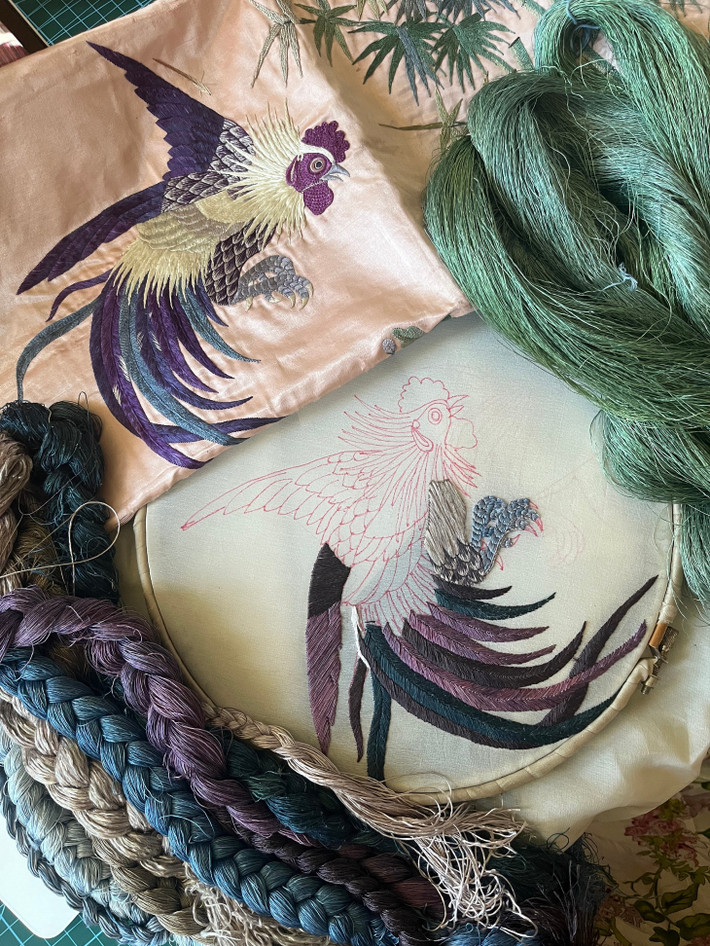 Artist Pham Ngoc Tram copied ancient embroidery patterns using naturally dyed threads.
“When I recounted my research into the ancient art of embroidery, the son of artisan Vu Thanh Long, Mr. Vu Thanh Luan, was moved to tears as he brought items from the warehouse, revealing embroidery patterns – including the dragon pattern that I am currently using as inspiration to draw and embroider – along with tools from the past… I was fortunate to have Mr. Luan's family allow me to photocopy and store that document for research. While tracing the origins of ancient embroidery, quite by chance, I came across an old book printed in 1939 in Saigon – “Le Broderie Annamite” (The Annamite Embroidery) by Gabrielle Dain – which contained the following message: Annamite girls studying at Western schools learned Western-style lace and fringe embroidery, and they found it very enjoyable. But I would also like to remind you that “the Annamite embroidery of our sisters is very beautiful and very interesting in every way: the needlework is exquisite, the colors are wonderful, and the techniques are unique,” and “the duties of our sisters should not be overlooked” if they do not preserve their skills. "The incredibly wonderful embroidery of our ancestors will one day disappear. And indeed, to this day, that heritage has faded with time," artist Pham Ngoc Tram recounted.
Embroidery, a craft with a long tradition in Vietnam, remains quite developed today, but it has received little research and preservation from a heritage perspective. Many documents and artifacts are scattered or damaged over time. A conversation with Ms. Young Yang Chung, a leading expert on the history of textiles and silk embroidery in East Asia, and the founder of the Chung Young Yang Embroidery Museum, who also researches embroidery and has published works such as *The Art of Oriental Embroidery * (1979) and * Silken Threads: A History of Embroidery in China, Korea, Japan, and Vietnam * (2005), left a deep impression on Ngoc Tram.
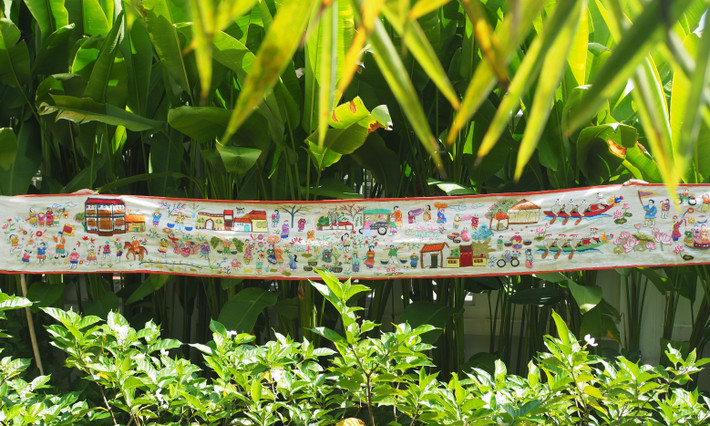 Embroidery painting "Village Festival", 2019
“She urged me to research and preserve the embroidery heritage of Vietnam, otherwise it would be too late. Her words from 3-4 years ago moved me deeply, and I wanted to contribute to the preservation and research of Vietnam's embroidery heritage. Having traveled to many countries, I feel truly fortunate to have been born in a land rich in heritage, yet to have not yet exploited that treasure. The story of how to move from its roots to the contemporary is truly fascinating, something I observed in Korea.” This involves systematic research, honoring embroidery as a heritage and an integral part of national visual arts; organizing embroidery and sewing art fairs; and having many contemporary artists delve into this field to shift perspectives on traditional crafts and elevate them to a new level.
The door to unlimited creativity.
“I remember the time I came across old Vietnamese embroidery paintings, some expensive, some cheap. I bought the cheaper ones, even the tattered ones, because they allowed me to see the back of the embroidered fabric, to analyze the technique, materials, and stitches of the embroiderers from that era,” said Pham Ngoc Tram, introducing the four-season embroidery painting hanging on the left side of Tu Thi communal house, with a corner of the painting lifted so that everyone could see the stitches behind it.
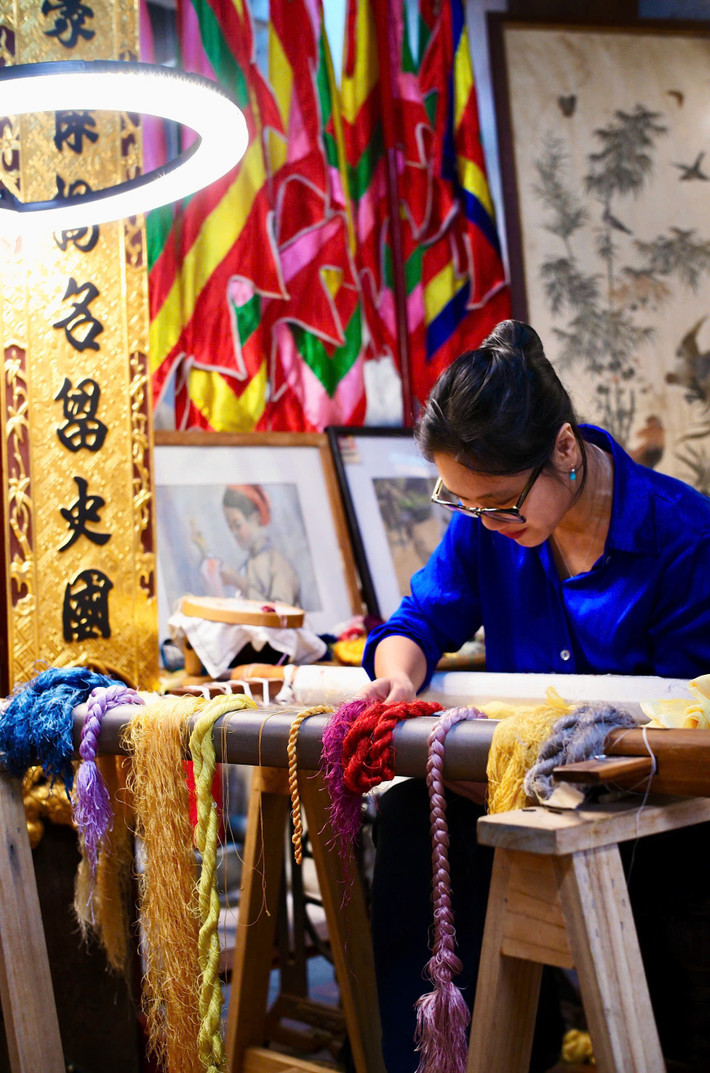 Artist Pham Ngoc Tram at Tu Thi communal house. Photo: Nguyen Huy Khanh
Through studying documents and embroidery from the Indochina period, Pham Ngoc Tram recognized this as a turning point in the development of Vietnamese embroidery, as the French quickly recognized the skill and value of embroidery and placed orders. Previously, embroidery villages mainly produced traditional handicrafts such as robes, archways, flags, and fans, and embroidered on court costumes that were traditionally formal and structured. However, the interaction with Western art opened up boundless creative possibilities. Fine art embroidery, with its diverse themes and free-spirited style, became a unique phenomenon, affirming the position of Vietnamese embroidery.
What makes Indochina-era embroidery unique is its purely Vietnamese materials. From soft silk fabrics to embroidery threads dyed with natural colors from plants, skilled artisans created vibrant works that realistically depicted Vietnamese village life, recreating ancient stories, or images of village festivals, weddings, and rustic nature with chickens, ducks, bamboo groves, lotus flowers, and more.
“During this period of cultural exchange, traditional embroidery art experienced a clash and revealed hidden subtleties. I was fascinated and realized there was a whole body of heritage I could learn from. The Indochina period has enough specimens, evidence, and fairly solid historical documents for research. Examining the embroidery heritage, one can uncover many aspects of culture, history, people, society, and women… I hope there will be collectors of embroidered paintings who will allow me access to further research the threads and embroidery techniques of this period.”
Driven by a desire to create a unique color palette, she dedicated considerable time to researching and practicing silk dyeing techniques, drawing upon traditional natural dyeing methods passed down through generations. She also learned how to spin threads to create embroidery threads of varying thickness and texture. In 2023, she perfected her natural dyeing palette, from which a series of embroidered paintings inspired by folk culture were created.
Beyond practicing as an embroidery artist, the female artist also harbors plans to research and explore the embroidery heritage of Vietnam, as well as that of the region and the world. This will serve as a foundation for publishing a book on Vietnamese embroidery heritage and establishing a museum dedicated to Vietnamese embroidery and needlework in the near future. This will not only contribute to the preservation of the country's embroidery heritage but also provide inspiration for contemporary art, where tradition is continued and subtly blended with new creativity.


































































Comment (0)