

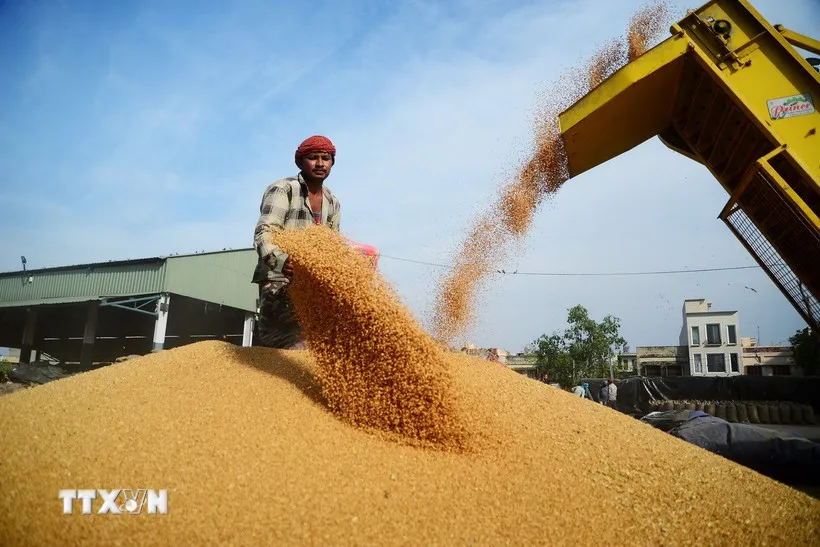
Wheat after being harvested in Jalandhar, India. (Source: ANI/VNA)
The United Nations Food and Agriculture Organization (FAO) said world food prices have fallen for the third consecutive month, with most major commodities except grains declining.
The FAO reported that the Food Price Index – reflecting fluctuations in the globally traded basket of food commodities – averaged 125.1 points in November 2025, down from a revised 126.6 points in October 2025 and its lowest level since January 2025.
The agency said the November 2025 average was 2.1% lower than the same period last year and down 21.9% from the record high in March 2022.
The FAO noted that sugar prices in November 2025 fell 5.9% compared to October 2025, reaching their lowest level since December 2020 due to the prospect of abundant global supply.
The milk price index fell 3.1% for the fifth consecutive month as milk production and export supplies increased.
According to the agency, vegetable oil prices fell 2.6% and hit a five-month low as prices for most products, including palm oil, declined across the board, outweighing the increase in soybean oil.
The FAO reported that meat prices fell by 0.8%, with pork and poultry experiencing the sharpest declines. Beef prices remained generally stable thanks to the lifting of import tariffs in the US, which helped to cool down the recent upward trend.
Conversely, the FAO reported that the cereal price index rose 1.8% compared to the previous month. Wheat prices increased due to the possibility of increased Chinese purchases and geopolitical tensions in the Black Sea region, while corn prices were supported by export demand from Brazil and weather conditions disrupting farming in South America.
In its separate report on cereal supply and demand, the FAO raised its forecast for global cereal production in 2025 to a record 3.003 billion tonnes from the 2.990 billion tonnes forecast last month, mainly due to an upward revision in wheat production.
The FAO also raised its forecast for world grain reserves at the end of the 2025-2026 crop year to a record high of 925.5 million tonnes, thanks to increased wheat reserves in China and India, along with increased coarse grain reserves in exporting countries.
Source: https://vtv.vn/fao-gia-luong-thuc-the-gioi-giam-thang-thu-ba-lien-tiep-100251206095951492.htm























![[Photo] Reception to welcome General Secretary and President To Lam and his wife on their State visit to the Philippines](https://vphoto.vietnam.vn/thumb/1200x675/vietnam/resource/IMAGE/2026/06/01/1780295488620_vna-potal-chieu-dai-chao-mung-tong-bi-thu-chu-tich-nuoc-to-lam-va-phu-nhan-tham-cap-nha-nuoc-toi-philippines-8798060-7855-jpg.webp)








































































Comment (0)