

Is it unusual that Garena Vietnam's profit margin is nine times lower than the global average for game companies?
During the Covid-19 pandemic, many economic sectors suffered heavy losses due to government social distancing policies. However, according to Ernst & Young Switzerland, the gaming industry witnessed an unprecedented boom during this period. Although the boom has now passed and life has returned to normal, the profit margins of the gaming industry remain impressive.
Statistics from EY Parthenon show that the average profit margin of the world's top 26 gaming companies in 2020 was 24.9%. This figure decreased to just 23.5% in 2021 and further to only 18.1% in 2022.
In Vietnam, statistics on the profit margin of game companies only reach about 2-5%, not to mention loss-making projects. Compared to the average profit margin of the top 26 game companies in the world above, this number is strangely low.
Garena Vietnam's profit margin in 2022 was nine times lower than the average of the world's 26 largest game companies (Photo: TL).
In reality, game companies in Vietnam primarily publish foreign games. This means they have to purchase game licenses for distribution and incur relatively high publishing fees. These costs, such as licensing fees, intermediary payment gateway fees, and marketing expenses, are cited by publishers as the reasons that erode almost all of the game industry's revenue.
For the most practical example, Garena Vietnam, a game publisher that owns a series of popular games such as: Lien Quan Mobile, Free Fire, FIFA online... achieved a record revenue of 6,900 billion VND in 2022, an increase of 14% over the same period last year.
Compared to its revenue in 2017, Garena's revenue has increased fourfold. However, the company's profits have fluctuated erratically.
After-tax profit reached a record of VND143 billion in 2020 but then decreased by 27% in 2021 before increasing again to VND115 billion in 2022. The profit level in 2022 is equivalent to a net profit margin of only 2%. Compared to the average profit margin of the group of large game companies in the world as given by EY Parthenon, it is only 1/9.
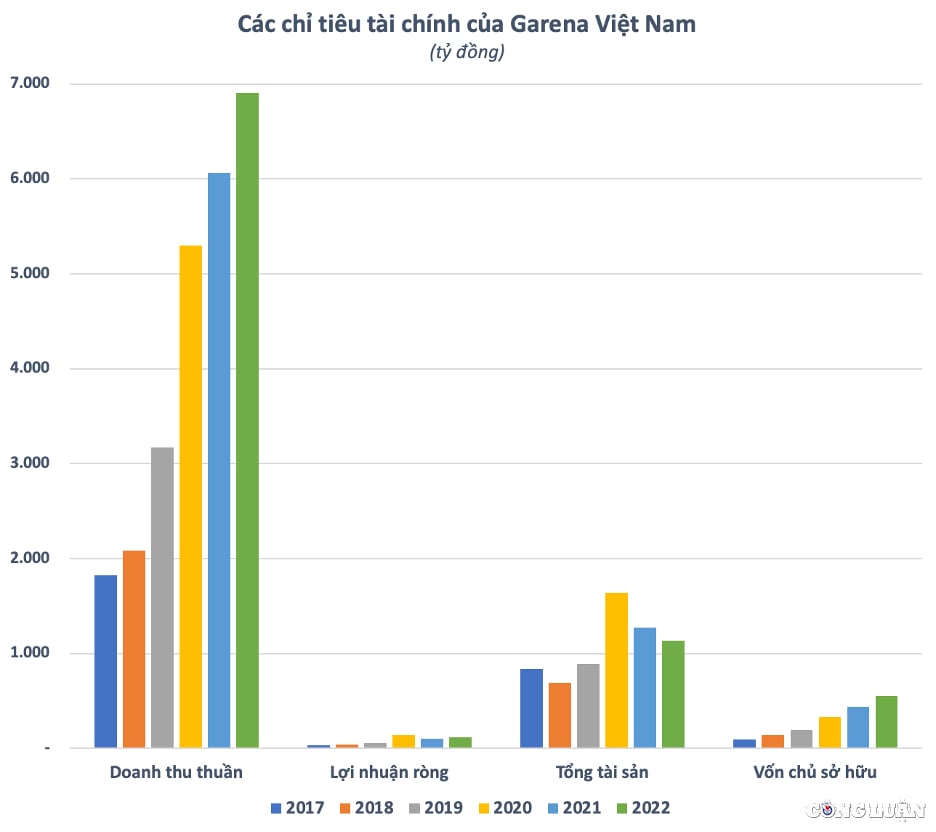
Is this profit margin suitable for a major game publisher in a game market that is considered to have great potential like Vietnam? According to data from the Vietnam Game Producers and Publishers Alliance, the revenue of the Vietnamese game industry in 2022 reached more than 600 million USD, with an average growth rate of 9%/year. The number of gamers in Vietnam by the end of 2022 also reached 54.6 million people.
Where did the money go when Garena Vietnam's revenue was in the thousands of billions but it only paid taxes equivalent to 2 days' revenue?
One thing worth noting is that the charter capital of Garena Vietnam is relatively "thin". The company only recorded a charter capital of 9 billion VND, the current equity is 553 billion VND, mainly recorded from undistributed profits accumulated over the past few years.
Despite its small initial capital, Garena's revenue has consistently grown year after year, reaching 6,900 billion VND in 2022.
However, as mentioned above, despite continuously growing revenue, Garena's profit margin remains extremely low, at only 2% in 2022. This means that for every 100 dong of revenue, only 2 dong of profit is generated.
Such low profit margins meant that Garena Vietnam only had to pay less than 26 billion VND in taxes in 2022 for a revenue of 6,900 billion VND. The amount of tax paid is equivalent to the amount Garena Vietnam earned in just two days.
Who is benefiting from Garena Vietnam's trillion-VND revenue?
Garena Vietnam's shareholders include: Mr. Mai Minh Huy owns 69.5%, foreign shareholders own 30% and Mr. Le Minh Tri owns 0.5%. The General Director and legal representative of the company is currently Mr. Vu Chi Cong (born in 1984). Garena Vietnam's foreign shareholder is Garena Vietnam Private Limited, a subsidiary of Sea Limited Group (Singapore).
The games associated with Garena's name are also being released in many countries around the world and bringing in huge revenue from these markets. For example, Lien Quan Mobile, the game is released in Taiwan, Thailand, Korea, Laos, the European Union, the US, India, Japan... under many different names such as Arena of Valor, Penta Storm, Realm of Valor.
According to statistics from Sensor Tower, a leading global market data provider, the estimated revenue of Arena of Valor (Liên quân Mobile) reached $140 million in 2018, equivalent to over 3.4 trillion VND. This revenue figure does not include revenue from the massive Chinese market. It's important to note that this is only the revenue figure before the Covid-19 pandemic. During the pandemic, social distancing regulations in many countries indirectly contributed to a boom in the gaming industry's revenue, and Arena of Valor was no exception.
Similarly, the game Garena Free Fire, released in 2017, has generated significant revenue from markets outside Vietnam, such as India, Indonesia, Brazil, and Latin America. Statistics from Sensor Tower show that the game's revenue in Southeast Asia alone reached $7.9 million USD in 2022, equivalent to 192.3 billion VND.
Recently, many businesses with foreign connections have been continuously expanding their scale and operating successfully, yet they consistently report losses or meager profits that are practically nonexistent.
Even many businesses that were supposed to benefit from the Covid-19 pandemic still reported heavy losses. For example, according to the Ministry of Finance , Airpay and Shopee, despite high revenue and expansion in 2020, still reported losses. This limited their contribution to the state budget, with these two companies contributing only a few tens of billions of VND.
The "scenario" of expanding scale, increasing revenue, but "persistent losses" that has attracted the most public attention is undoubtedly Coca-Cola Vietnam. Despite operating in Vietnam for a long time and experiencing continuous growth, Coca-Cola Vietnam consistently reports losses. According to tax authorities, the "secret" to this company's continuous reporting of losses lies in the high cost of raw materials and components, primarily imported directly from the parent company at very high prices.
The "transfer pricing scheme" of purchasing raw materials at high prices and paying royalties from the parent company has also led to several other well-known businesses being frequently mentioned in transfer pricing and tax evasion scandals, such as Adidas, Pepsico, and most recently, Grab.
Allegations of transfer pricing and tax evasion have once again surfaced in the Vietnamese gaming industry and among game publishers, with similar tactics involving high "game licensing prices" from parent companies.
The Journalists & Public Opinion newspaper will continue to report on this issue in the next issue.
Source














![[Photo] Prime Minister Pham Minh Chinh holds a phone call with the CEO of Russia's Rosatom Corporation.](/_next/image?url=https%3A%2F%2Fvphoto.vietnam.vn%2Fthumb%2F1200x675%2Fvietnam%2Fresource%2FIMAGE%2F2025%2F12%2F11%2F1765464552365_dsc-5295-jpg.webp&w=3840&q=75)












































Comment (0)