

Tajikistan's Hissar sheep are an abundant food source and also contribute to improving the soil ecosystem thanks to their ability to travel long distances to forage for food.
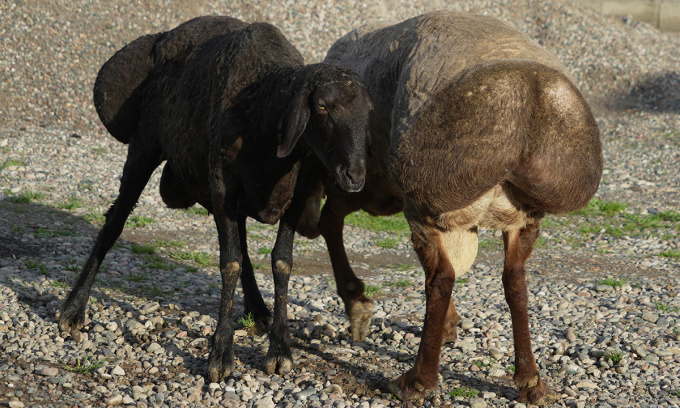
Hissar sheep stand in the yard of a biotechnology center near the town of Hissar, western Tajikistan, on March 27, 2024. Photo: AFP/Amir Isaev
The large Hissar sheep, characterized by two tufts of fat on their hindquarters, are highly valued for their profitability and adaptability to climate change. They are becoming increasingly popular in the Central Asian nation of Tajikistan, which is struggling with a shortage of meat and suitable pastures for raising them, AFP reported on April 28. "They gain weight quickly even with little water and grass," said Bakhtior Sharipov, a shepherd with a flock of about 250 sheep.
Against a backdrop of severely degraded agricultural land due to years of overgrazing and global warming, the resilient Hissar sheep benefit Tajik farmers and provide a plentiful source of meat for consumers. "The flock weighs an average of 135 kg. It's late winter now, so they're not very heavy, but they'll gain weight quickly," Sharipov said of his Hissar flock. Meanwhile, the largest Hissar sheep weigh over 210 kg.
With the ability to yield meat and fat equivalent to about two-thirds of its total weight – more than most other sheep breeds, including those with more expensive feed requirements – Hissar sheep can be highly profitable for farmers.
"This is a very unique breed of sheep, primarily because of its weight. In addition, they never stay in one place, thus contributing to the improvement of the soil ecosystem," explains Sharofzhon Rakhimov, a member of the Tajikistan Academy of Agricultural Sciences . They can travel up to 500 km to find grazing land between seasons, allowing pastures in different areas to regenerate.
Soil degradation is one of the major environmental challenges facing Central Asia. According to a United Nations report, approximately 20% of the region's land is degraded, affecting 18 million people. This area covers about 800,000 square kilometers, equivalent to the size of Türkiye. Furthermore, dust rising from the arid land can contribute to cardiovascular and respiratory illnesses.
As land degradation impacts livelihoods, many farmers choose to migrate. In this context, Hissar sheep, with their ability to thrive in harsh conditions, are of particular interest to Tajikistan.
At a biotechnology center near the Tajikistani capital, scientist and breeder Ibrokhim Bobokalonov samples genes from the best Hissar sheep in the hope of creating the largest, most profitable sheep. Last year, a sheep weighing 230 kg appeared in an agricultural competition in Kazakhstan, setting a Guinness World Record.
"The demand for Hissar sheep is increasing not only in Tajikistan but also in Kazakhstan, Kyrgyzstan, Russia, Türkiye, Azerbaijan, China, and even the United States," Bobokalonov said.
Thu Thao (According to AFP )
Source link




























































































Comment (0)