

Amidst rising deposit interest rates and early credit targets, many commercial banks are beginning to narrow or suspend preferential loan packages for young homebuyers. This puts many families with genuine housing needs in a difficult position, especially those with average incomes trying to find opportunities to own a home in Ho Chi Minh City and other major urban areas.
The calculations need to be redone.
Mr. Nhat Quang (32 years old), who is looking to buy an apartment in Binh Trung ward (Ho Chi Minh City), said he contacted several state-owned commercial banks to inquire about preferential loan packages for customers under 35 years old. However, credit officers informed him that the program has been temporarily suspended. "Two months ago, Agribank was still advising me on an interest rate of 6.3%/year fixed for 18 months. Now it has increased to over 7% and the preferential package for young people is no longer available, so I have to reconsider my loan," Mr. Quang shared.
According to a reporter from Nguoi Lao Dong newspaper, state-owned commercial banks such as Agribank, BIDV , and VietinBank have temporarily suspended their preferential home loan programs for young customers. An Agribank credit officer in Ho Chi Minh City confirmed: "The preferential home loan packages for young people under 35 have been temporarily suspended. The best interest rate currently is 7.3% per year, fixed for the first 18 months."
In its latest announcement, Agribank clarified the suspension of several preferential home loan programs and policies, including preferential home loan packages for young people.
The central bank has also stopped offering preferential loans for land use rights transfers and housing construction/renovation. However, the social housing loan package for young people under 35 years old remains in effect, with an interest rate of approximately 6.1% per year.
Similarly, BIDV also confirmed the temporary suspension of the preferential loan package for young people buying commercial housing. Previously, this group of customers enjoyed a fixed interest rate of 5.5% per year for 3 years, a loan term of up to 40 years, and no principal repayment for the first 5 years – a preferential rate considered "rare" until now.
Conversely, some other banks still maintain preferential loan packages for young people but with adjusted interest rates. For example, at Vietcombank , credit officers said that the interest rate for young customers has increased to 7.3%/year during the preferential period, instead of below 6%/year as before. The regular loan package has an interest rate of 7.5%/year for the first 6 months, then increases to 8.3%/year for the following 12 months.
At commercial banks such as BVBank, SHB, HDBank, etc., bank employees said they are still offering preferential loan packages for young people, but interest rates will be flexible depending on the type of real estate and the time period. "With rising interest rates, the incentives are no longer as generous as before," explained a credit officer.
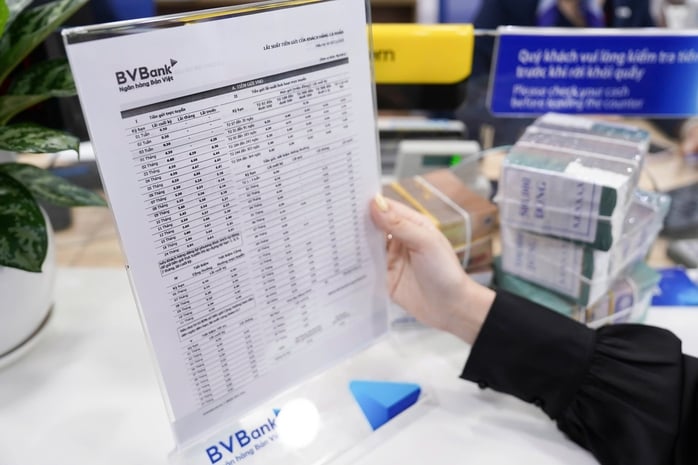
Some commercial banks have temporarily suspended or adjusted upwards preferential interest rates for home loans for young people. Photo: DUY PHÚ
Does this affect house prices?
According to our findings, the simultaneous halt of low-interest home loans by banks to young people is occurring amidst rapid credit growth and rising input interest rates. Some current homebuyers say they have also just received notifications from banks about interest rate adjustments.
In response to the question of whether rising interest rates will curb the increase in real estate prices, Dr. Can Van Luc, Chief Economist of BIDV, believes that there will be an impact, but it will not be strong enough to reverse the trend.
He stated that the slow disbursement of preferential loan packages for young people at BIDV recently was not due to the bank restricting credit, but rather to "a lack of suitable housing supply and prices that remain too high." According to him, house prices are not only determined by interest rates, but also by project development costs, lengthy legal procedures, land auctions, and the excessively high profit expectations of some developers.
Meanwhile, a Vietnamese civil servant would need nearly 26 years of continuous work to afford a standard apartment. Therefore, a comprehensive solution is needed to address the root causes of continuously escalating housing prices. "Regulatory agencies need to accelerate the completion of institutional reforms, standardize land and real estate market databases, and specifically address long-standing shortcomings," this expert suggested.
Regarding future lending interest rates, Dr. Can Van Luc believes the increase will not be too high, because the Government has requested credit institutions to control interest rates to avoid shocking the economy. "Banks are forced to reduce operating costs, lower profit margins, and restructure their capital portfolios, instead of sharply increasing lending rates," he predicted.
Meanwhile, financial expert Dr. Nguyen Tri Hieu warns that although the supply of projects is gradually improving, housing prices continue to be beyond the affordability of most people. This leads to increased inventory, poor market liquidity, but prices are not adjusting.
He cited figures from the State Bank of Vietnam showing that by the end of October 2025, credit across the entire system had increased by approximately 15% compared to the end of the previous year, and was expected to reach 19%-20% by the end of the year, the highest in many years. Of this, real estate credit accounted for nearly 24% of the total outstanding loans in the economy. Lending for real estate business alone increased by nearly 24%, double the growth rate of consumer loans.
"The rapid increase in deposit interest rates has driven up the cost of capital for homebuyers. Real estate credit needs to be tightened to reduce its proportion to below 20% of total outstanding loans. At the same time, the State Bank must support banks in lowering lending rates so that people and businesses can easily access capital, creating momentum for economic recovery," said Dr. Hieu.
Capital must flow to the right place.
Dr. Tran Nguyen Dan, a financial expert, believes that the proposal to tighten real estate credit is not without merit. If credit is massively extended to investors for speculative purposes, the flow of money will be amplified, pushing house prices beyond reach and exacerbating the shortage of affordable housing. Furthermore, the current high proportion of real estate loans means significant systemic risk to the banking system. When the real estate market declines, the risk of a chain reaction of bad debts is entirely possible.
However, Mr. Dan noted that tightening credit across the board would not address the root cause of housing prices. What is needed is selective tightening, targeting businesses with weak project development capabilities, large debts, and a lack of transparency in management. He cited the "three red lines" model in China, which requires businesses to meet financial safety criteria before being granted loans, and suggested that Vietnam could refer to and adapt it accordingly.
According to this expert, real estate credit needs to be expanded to first-time homebuyers and the affordable housing segment (under 3 billion VND) to stimulate genuine demand, instead of continuing to pump capital into businesses with "lots of land but little money" or investors under financial pressure. To achieve this, input interest rates must be maintained at a reasonable level, and the banking system needs to clearly categorize loan needs and prioritize capital for projects with good construction capacity, transparent legal status, and serving genuine housing needs. "We cannot continue to use credit to rescue weak businesses. Capital must flow to the right places for a healthy market recovery," this expert emphasized.
S.Nhung
Source: https://nld.com.vn/goi-vay-uu-dai-cho-nguoi-tre-bat-ngo-tam-dung-196251205202701948.htm


![[Photo] General Secretary and President To Lam presides over a meeting on preparations for the review of one year of operation of the three-tiered government system.](https://vphoto.vietnam.vn/thumb/1200x675/vietnam/resource/IMAGE/2026/06/02/1780391821195_a1-bnd-4595-9717-jpg.webp)


































































































Comment (0)