

According to the planning for the period 2021-2030, with a vision to 2050, Hanoi is oriented to become a leading center for the semiconductor industry.
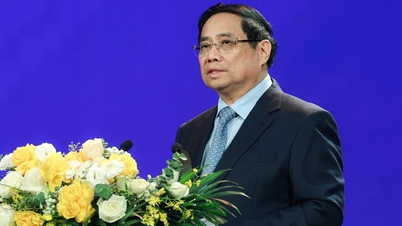
On the afternoon of February 23, Minister of Planning and Investment Nguyen Chi Dung chaired a meeting to appraise the Hanoi Capital City Planning for the period 2021-2030, with a vision to 2050.
"Hanoi is the political nerve center, a major hub for economy, culture, and science. The city is also a crucial driving force for the development of the Red River Delta region and the entire country," the Minister assessed.
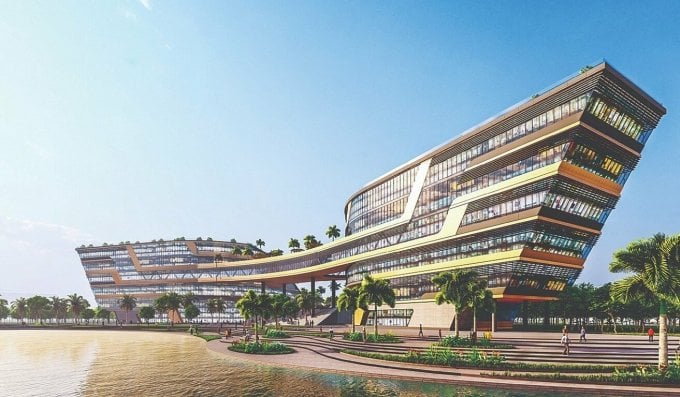
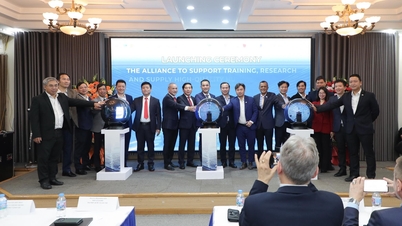
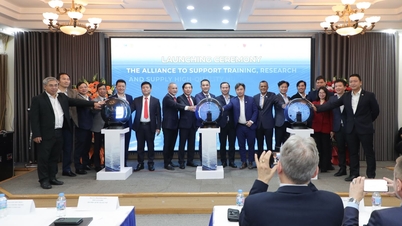
The National Innovation Center in Hoa Lac High-Tech Park, Hanoi, began operations near the end of 2023. Photo: NIC
In recent years, despite its strong development, Hanoi has faced many difficulties and major bottlenecks. The capital's economic position has tended to decline compared to other localities in the region. The economic restructuring is perceived to be slow, and it has not yet formed high-efficiency, leading economic sectors.
The city also faces numerous problems related to traffic, pollution, and flooding. According to Minister Dũng, the transportation routes within the basic infrastructure system have not been developed synchronously, particularly lacking radial North-South and East-West axes. Meanwhile, Hanoi's population has exceeded projections, and relocating residents from the inner city is not feasible.
"To develop strongly, Hanoi needs to identify its unique potential and outstanding strengths," Minister Dung said regarding this capital city planning.
According to the Master Plan, Hanoi has several objectives, including becoming a major economic and financial center of Vietnam with regional influence; a center for science, technology, and innovation. The city is also to play a leading role in driving regional development.
The plan also outlines the development direction for key sectors, such as aiming to become a leading center for semiconductor microchip industry, information technology and artificial intelligence, and biotechnology; and developing agricultural products with high scientific and technological content.
The Red River axis is also considered a major driving force for Hanoi's development. The city's transportation infrastructure will connect four modes of transport: air, expressways, urban rail with the national railway network connecting inter-regional and international areas, inland waterways with maritime transport; and ring roads 4 and 5 connecting the region.
Hanoi will focus on developing an urban rail system capable of replacing private vehicles and connecting the capital's center with urban centers in the Hanoi region; expanding and increasing the capacity of Noi Bai Airport; and building a second airport in the Capital region.
Commenting on the planning, Dr. Cao Viet Sinh, former Deputy Minister of Planning and Investment, said that it is necessary to properly assess Hanoi's position compared to other localities in order to determine reasonable development goals. He argued that the plan must identify high-tech industries as a breakthrough point and a key economic sector. Accordingly, it is necessary to expand industrial zones to attract investors in the chip and semiconductor fields. He also suggested clarifying the driving force and development space in the plan, as well as solutions to mobilize resources from the private and foreign sectors.
Professor Le Quan, Director of Hanoi National University, added that priority should be given to developing new spaces to attract investment and accelerate the development of transportation infrastructure. He noted that Hanoi needs a strategy for human resource training, including investment in universities.
Duc Minh
Source link


![[Image] Close-up of the newly discovered "sacred road" at My Son Sanctuary](/_next/image?url=https%3A%2F%2Fvphoto.vietnam.vn%2Fthumb%2F1200x675%2Fvietnam%2Fresource%2FIMAGE%2F2025%2F12%2F13%2F1765587881240_ndo_br_ms5-jpg.webp&w=3840&q=75)
































































Comment (0)