

The Ministry of Finance is seeking comments on the draft Decree regulating the declaration, calculation and deduction of taxes, and the use of electronic invoices by business households and individual businesses. The draft is the first to be developed specifically for tax management for business households, separate from the current Law on Tax Management.
Business households with revenue from 1 billion VND are required to use electronic invoices with codes.
Regarding the use of electronic invoices, the draft Decree clearly states that business households and individuals with annual revenue of 1 billion VND or more must apply electronic invoices with tax authority codes, electronic invoices generated from cash registers with data connection to tax authorities according to the provisions of Decree 70.
Households and individuals doing business with annual revenue of less than 1 billion VND are not required to use electronic invoices with tax authority codes or electronic invoices generated from cash registers with data connection to tax authorities.
In cases where the conditions for information technology infrastructure are met and there is a need to use electronic invoices, the tax authority encourages and supports business households and individuals to register to use electronic invoices with tax authority codes or electronic invoices generated from cash registers with data connection to the tax authority.
In case a business household or individual does not register to use electronic invoices but needs to use electronic invoices, they must declare and pay taxes before being issued an electronic invoice with a tax authority code by the tax authority for each transaction of selling goods or providing services.
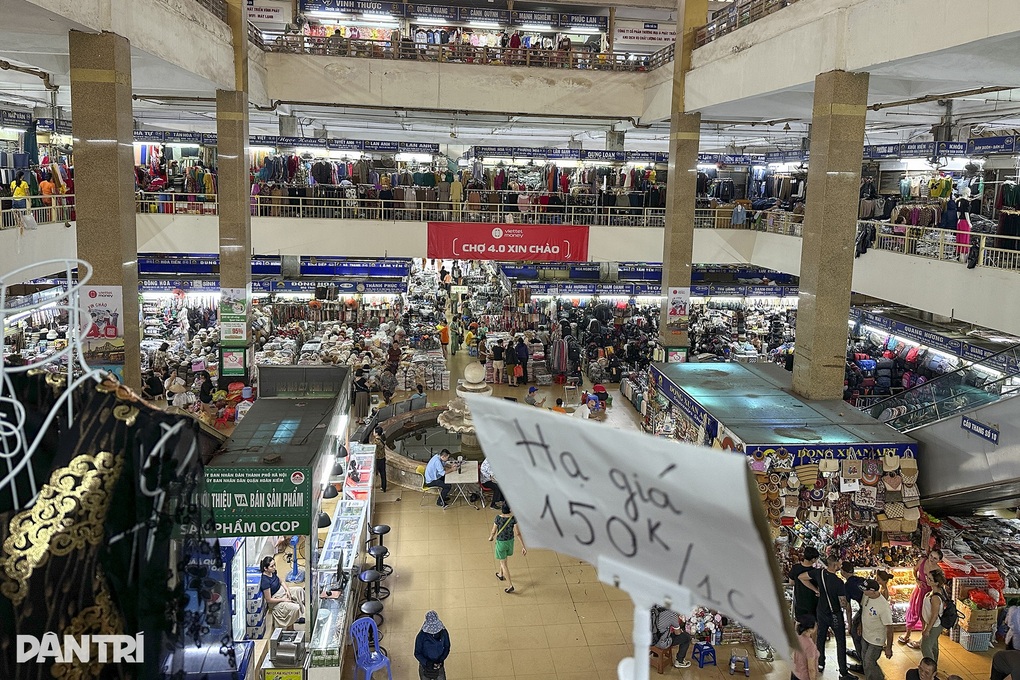
Stalls at Dong Xuan market (Photo: Huu Nghi).
How do business households declare taxes?
According to the draft Decree, business households and individuals, based on the actual annual revenue from production and business activities of goods and services, self-determine whether they are subject to tax, not subject to tax, subject to tax, or subject to tax according to the provisions of the law on value added tax and personal income tax from January 1, 2026.
In cases where they are determined to be subject to value added tax and must pay personal income tax, business households and individuals will calculate their tax obligations and declare and pay taxes according to each tax.
If subject to value added tax, taxpayers must declare and pay taxes monthly or quarterly according to the provisions of tax administration law.
If subject to personal income tax according to the method of revenue multiplied by tax rate, tax declaration and payment shall be made quarterly, concurrently with the deadline for value added tax payment.
If paying personal income tax using the method of calculating taxable income (revenue minus expenses) multiplied by tax rate, taxpayers must pay tax annually, no later than January 21 of the following year.

Food stores in Hanoi (Photo: Toan Vu).
For households and business individuals using electronic invoices or invoices generated from cash registers with data connection to tax authorities, the tax authority's information technology system will automatically synthesize data from electronic invoices, tax management databases and other data sources to create suggested tax declarations, supporting taxpayers in declaring and calculating taxes.
In case of self-determining that they are not subject to value added tax and do not have to pay personal income tax, business households and individuals must declare their revenue and send it to the direct tax authority no later than January 31 of the following year.
For taxes such as value added tax, personal income tax, special consumption tax, resource tax and environmental protection tax, the draft Decree is divided into two cases.
If business households and individuals use electronic invoices with tax authority codes, the tax management information system will support the determination of tax payable and update data for taxpayers. Conversely, if electronic invoices are not used, taxpayers must determine their own tax amounts according to regulations.
For environmental protection fees and other charges, business households and individuals must also determine the amount to be paid according to regulations.
Regarding the tax payment deadline, the draft stipulates that the tax payment deadline coincides with the last day of the tax declaration submission deadline. In case the taxpayer makes additional declarations, the tax payment deadline is determined according to the tax period in which the error occurs.
It is expected that the decree will take effect from January 1, 2026, which is also the time when business households officially abandon the form of lump-sum tax payment and switch to declaring and paying taxes based on actual revenue.
Source: https://dantri.com.vn/kinh-doanh/ho-kinh-doanh-doanh-thu-duoi-1-ty-dong-khong-bat-buoc-dung-hoa-don-dien-tu-20251206004500972.htm


![[Photo] 60th Anniversary of the Founding of the Vietnam Association of Photographic Artists](/_next/image?url=https%3A%2F%2Fvphoto.vietnam.vn%2Fthumb%2F1200x675%2Fvietnam%2Fresource%2FIMAGE%2F2025%2F12%2F05%2F1764935864512_a1-bnd-0841-9740-jpg.webp&w=3840&q=75)
![[Photo] National Assembly Chairman Tran Thanh Man attends the VinFuture 2025 Award Ceremony](/_next/image?url=https%3A%2F%2Fvphoto.vietnam.vn%2Fthumb%2F1200x675%2Fvietnam%2Fresource%2FIMAGE%2F2025%2F12%2F05%2F1764951162416_2628509768338816493-6995-jpg.webp&w=3840&q=75)





![[Infographic] Cross-calculated exchange rates to determine taxable value from December 4-10](https://vphoto.vietnam.vn/thumb/402x226/vietnam/resource/IMAGE/2025/12/04/1764832340841_infographic-ty-gia-tinh-cheo-de-xac-dinh-tri-gia-tinh-thue-tu-4-1012-20251204120447.jpeg)





















































































Comment (0)