

Soldiers love digital technology
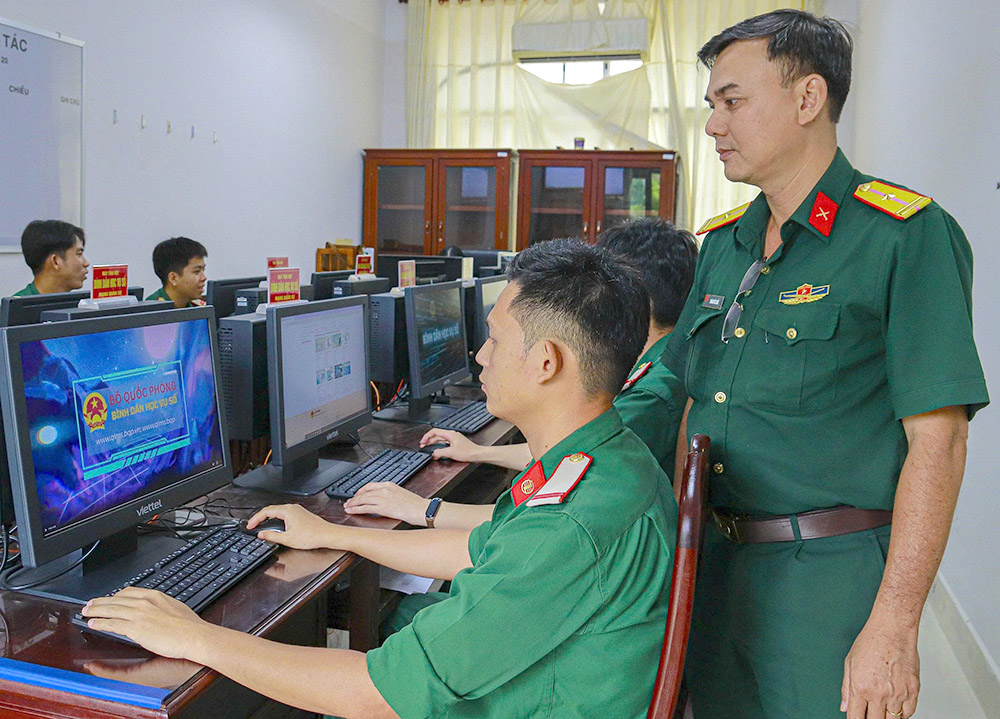
In the evening at the 892nd Regiment ( An Giang Provincial Military Command), the barracks were quiet. In a corner of the room, the light from the phone screen shone on the face still tanned from the training ground of Captain Nguyen Thai Hoc (Training Assistant). He was meticulously looking up each term of infantry shooting simulation technology - software that the unit had just deployed. "Up until now, I was only used to manual operations, now switching to computer simulation feels strange, but I am determined to learn it. I think learning technology now is like learning to read in the past. If you don't learn, you will be left behind," Nguyen Thai Hoc shared.
 |
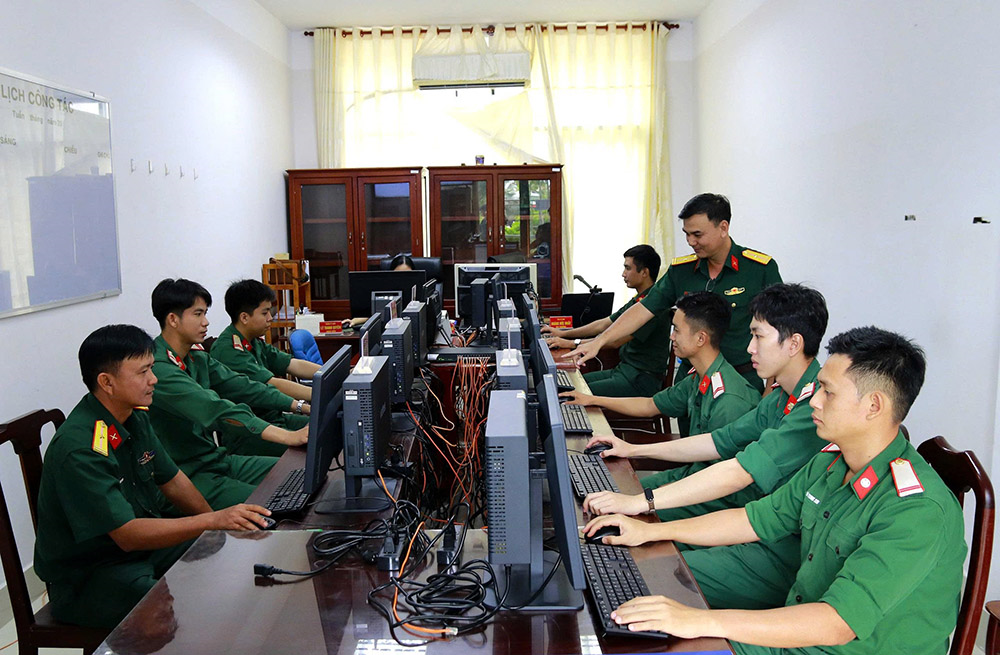 |
| Officers and soldiers of the An Giang Provincial Military Command participate in the "popular digital literacy" class. |
Captain Nguyen Thai Hoc's story is not unique. Since the An Giang Provincial Military Command launched the "Digital Education for the People" movement, all units have responded enthusiastically. "Digital classes" are flexibly organized during breaks, in the middle of the training ground, or in the unit's activity room. The movement "One operation a day, one skill a week" has spread widely. From using document software, sending and receiving secure emails to exploiting live-fire training simulations, applying artificial intelligence (AI) to political education... all are included in training. In many units, officers and soldiers also form study groups, following the motto "those who know a lot teach those who know less" to help each other improve every day.
Lieutenant Colonel Bui Sy Hung, Deputy Commander of the An Giang Provincial Military Command, affirmed: “A soldier of the new era must not only know how to shoot and march, but must also be proficient in digital skills. We do not follow formalities. Learning must be substantive, serving the practical tasks of training and combat readiness.”
That learning spirit has brought about practical initiatives. A typical example is the initiative "Electronic handbook on Party work and political work" by Senior Lieutenant Tran Dang Ngoc Tien, Propaganda Assistant of the Defense Command of Region 1 - Long Phu. Not only integrating QR codes and automatic reading, the handbook is also designed in the form of an interactive application and political game, making the dry content easier to access, easier to remember and easier to apply. Senior Lieutenant Tran Dang Ngoc Tien's initiative not only won a high provincial award but is also being applied in many military units in the province, contributing to improving the effectiveness of political education and Party building in the Army.
To be closer to the people
If learning technology is to keep up with the times, learning Khmer is to get closer to the people. An Giang has nearly 9% of the population being Khmer, living concentrated in many communes in the border area. For soldiers, mastering the language and understanding the culture is an important key to effective mass mobilization work.
At the Khmer language training class organized by the Provincial Military Command in coordination with Tra Vinh University, the image of Major Truong Van Ut, a medical officer of the Defense Command of Area 5 - An Bien, diligently learning each Khmer character moved everyone who witnessed it. "I studied medicine but had never been exposed to Khmer. At first, the letters looked very confusing, but thinking about the times I went to the base, met people and could only laugh because of the language barrier, I was determined to learn it," Ut said, his eyes shining with joy.
Not only learning theory, Ut and his teammates also practiced in real situations: greeting, asking about health, instructing people to take medicine in Khmer. "At first, we pronounced it wrong, people laughed happily. But thanks to that, they became closer, they loved the soldiers more," he said.
The atmosphere in the class is always lively and exciting. Students are divided into groups to practice speaking and correct each other's pronunciation. Instructor Danh Sol commented: "The soldiers are very inquisitive and serious. They study not only for exams, but also to serve the people. Many comrades after the course can communicate at a basic level."
Senior Lieutenant Mai Hoang Tu, Political Commissar of Company 3, Battalion 512, Regiment 892, stationed in Ba Chuc commune, where there are many Khmer people, shared: “Just being able to say a few greetings in Khmer makes a big difference. People are more respectful and open. The work of grasping the situation and propagandizing is also much more convenient.”
From the oil lamps in the "popular education" classes in 1945 to the light of the phone screen in today's digital classroom, the spirit of non-stop learning remains. The only difference is that the learning content has changed: from letters to QR codes, from blackboards to virtual training simulations, from Mandarin to familiar Khmer. In any era, soldiers learn to serve better: Serve the people, serve the Fatherland. As Senior Colonel Le Van Sang, Political Commissar of the An Giang Provincial Military Command said: "In the digital age, knowledge is a weapon. If soldiers do not self-study, they will fall behind. Only continuous learning can help each soldier be able to adapt and complete their tasks."
Each soldier and each officer who knows Khmer today is proof of a modern armed force that is close to the people, technological yet humane, worthy of being a loyal and trustworthy political and fighting force of the Party, State and people.
Article and photos: HUU DANG
* Readers are invited to visit the National Defense and Security section to see related news and articles.
Source: https://www.qdnd.vn/quoc-phong-an-ninh/xay-dung-quan-doi/hoc-de-lam-chu-cong-nghe-va-gan-dan-hon-857789


![[Photo] Cat Ba - Green island paradise](/_next/image?url=https%3A%2F%2Fvphoto.vietnam.vn%2Fthumb%2F1200x675%2Fvietnam%2Fresource%2FIMAGE%2F2025%2F12%2F04%2F1764821844074_ndo_br_1-dcbthienduongxanh638-jpg.webp&w=3840&q=75)























![[VIMC 40 days of lightning speed] Da Nang Port: Unity - Lightning speed - Breakthrough to the finish line](https://vphoto.vietnam.vn/thumb/402x226/vietnam/resource/IMAGE/2025/12/04/1764833540882_cdn_4-12-25.jpeg)


































Comment (0)