

In many developed countries such as France, Germany, the UK, and Denmark, successful models of research collaboration between the academic and business sectors have been implemented—a prime example being France's "Conventions Industrielles de Formation par la Recherche" (CIFRE) program. These models not only generate practical economic value but also contribute to improving the quality of training for highly skilled personnel.
In Vietnam, the collaborative relationship between businesses and universities is frequently discussed, but remains limited. Establishing a business-university networking center , inspired by international models like CIFRE, would be a strategic solution to promote applied research and innovation, helping to provide high-quality human resources for the economy and serving the country's strategic goal of double-digit growth in the coming years.
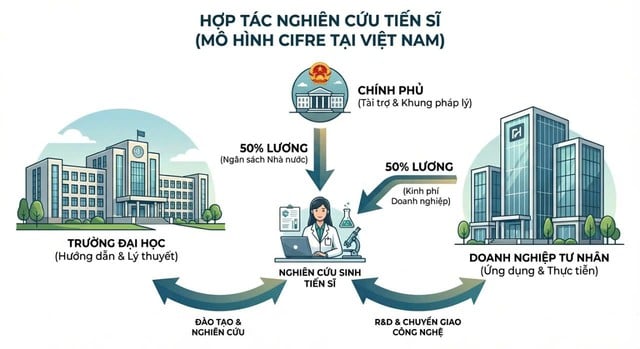
Model of collaboration between businesses and universities
Photo: The Nguyen
Connectivity Center: A Proposed Model for Vietnam
Although Vietnam has implemented and achieved many successes in science and technology, the link between universities and businesses remains weak , lacking a supportive ecosystem. Models from CIFRE in advanced countries demonstrate that establishing a Business-University Connection Center is a necessary step to promote innovation and improve the effectiveness of applied research in Vietnam.
The center has three main functions: Connecting research supply and demand. The center will build an online data platform on the R&D (Research and Development) needs of businesses and the research strengths of universities.
Next, the center The center will support the implementation of collaborative projects. Accordingly, it will provide project design consultancy, ensuring feasibility and suitability with the capabilities of both parties. In addition, the center can monitor, evaluate, and assist in resolving any issues that arise during implementation.
Finally, the center It promotes funding and investment. This is a place where connections can be made with domestic and international funds to provide financial support for joint research projects. The center can also provide consulting services on preferential policies and legal documentation for businesses investing in R&D.
Areas of operation of the connectivity center
In its initial phase after establishment, the Business-University Connection Center should operate in areas essential to Vietnam's development goals.
That's information technology and artificial intelligence (AI). This is a rapidly growing field that urgently needs a team of high-quality experts and engineers. The center can facilitate collaboration between technology companies and universities in the development of AI, Big Data, and cloud computing.
Next is High-tech agriculture . Priority should be given to activities related to the application of IoT, sensors, and automation in agricultural production to increase productivity and optimize resources.
Renewable and sustainable energy is a field that requires extensive research on energy storage, new energy sources, green and clean energy, the construction and development of smart grids, and meeting Vietnam's emission reduction commitments from now until 2050 (especially the target of net zero emissions by 2050).
The field of medical technology and biomedical science needs to focus on smart medical devices, genetic analysis technology, and personalized healthcare solutions, serving the growing health needs of an aging population.
In the field of economic management and business administration, the focus should be on the urgent and sustainable needs of economic development, coupled with the training of highly qualified and appropriate professionals in economic analysis and management, and business administration in a rapidly changing environment.

Connecting the University of Economics (Vietnam National University, Hanoi) with businesses in science and technology.
Photo: TN
Government support policies are needed.
To promote well-functioning applied research, the State should have policies to support financial assistance, such as establishing a national fund to co-finance up to 50% of research costs for collaborative projects between businesses and universities. This fund could be managed by the Center for Business-University Connection. The State should also have tax incentives, such as exemptions/reductions in corporate income tax for companies investing in R&D through the aforementioned business- university collaboration model.
To assess the feasibility of establishing the center, a small-scale pilot project should be implemented for a period of 5 years, starting in localities with developed innovation ecosystems such as Hanoi, Ho Chi Minh City, and Da Nang. Based on the evaluation of effectiveness, if successful, the model should be replicated nationwide.
The CIFRE program and similar models worldwide have proven effective in promoting collaboration between businesses and academia, thereby improving research quality and contributing to economic growth. For Vietnam, the implementation of a Business-University Connection Center is a strategic step, especially in the context of the increasingly urgent need for innovation and the development of high-quality human resources.
If properly developed and implemented, this model will not only enhance applied research capabilities and contribute to GDP, but also improve the nation's competitiveness in the global knowledge economy.
Models of other countries
In France, CIFRE was initiated by the government in 1981 to connect doctoral students with businesses through collaborative research projects. Under this mechanism, doctoral students are both employees of the company and work on their dissertations under the supervision of a professor at the training institution.
The program is coordinated by the National Association for Research and Technology (Association Nationale de la Recherche et de la Technologie - ANRT), under the sponsorship of the French Ministry of Higher Education, Research and Innovation. The government subsidizes a portion of the salary (up to 50%) for postgraduate students, with the remainder covered by the employer.
As of 2022, CIFRE has supported over 30,000 postgraduate students. In 2021 alone, there were over 1,500 new projects, involving 1,200 businesses and 350 research institutions. Over 90% of businesses rated CIFRE projects as delivering significant added value, such as product, technology, or process improvements. Approximately 80% of postgraduate students were retained for full-time employment at their companies after graduation.
Industrial PhD of Denmark. This program, run by Innovation Fund Denmark, aims to support doctoral students pursuing their degrees in companies, in collaboration with universities. Similar to France, the government also co-funds salaries, helping businesses save costs. Statistics show that approximately 80% of doctoral students continue working in the industrial sector after graduation.
Collaborative Doctoral Awards - CDA's This program, funded by UK Research and Innovation (UKRI), connects businesses with universities through joint research projects. More than 75% of CDA researchers contribute directly to the long-term development strategies of their companies.
Germany's Industrial Research Projects are managed by the German Academic Exchange Service (DAAD) and the Fraunhofer Society, with participation from major corporations such as Siemens, Bosch, and BASF. Germany maintains its leading position in high-tech industries thanks to close cooperation between academia and business.
Spain's Industrial Doctorates program focuses on strategic areas such as renewable energy, AI, and biotechnology. The Spanish government strongly supports small and medium-sized enterprises (SMEs) to encourage investment in R&D.
Author information :
Professor Nguyen Van Phu , Director of Research - CNRS Center, Republic of France and School of Economics, Vietnam National University, Hanoi.
Professor Pham Thi Kim Cuong , University of Paris Nanterre, Republic of France and the University of Economics - Vietnam National University, Hanoi.
Associate Professor Dr. To The Nguyen , University of Economics - Vietnam National University, Hanoi.
Source: https://thanhnien.vn/ket-noi-doanh-nghiep-va-dai-hoc-thuc-day-nghien-cuu-ung-dung-185251211094214585.htm




































































































Comment (0)