

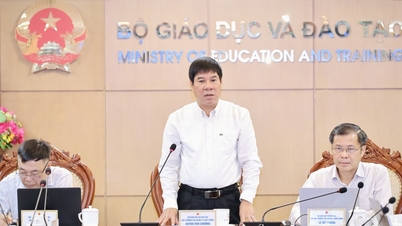
At the conference summarizing the 2023-2024 school year and outlining tasks for the 2024-2025 school year held this morning, August 19th, the Ministry of Education and Training announced that, as of April, localities had recruited 19,474 teachers out of a total of 27,826 additional positions.
Specifically, 5,592 teachers were recruited for preschools, 7,737 for primary schools, 4,609 for lower secondary schools, and 1,536 for upper secondary schools. According to the Ministry of Education and Training, the teaching staff has grown in number, gradually overcoming structural inadequacies.
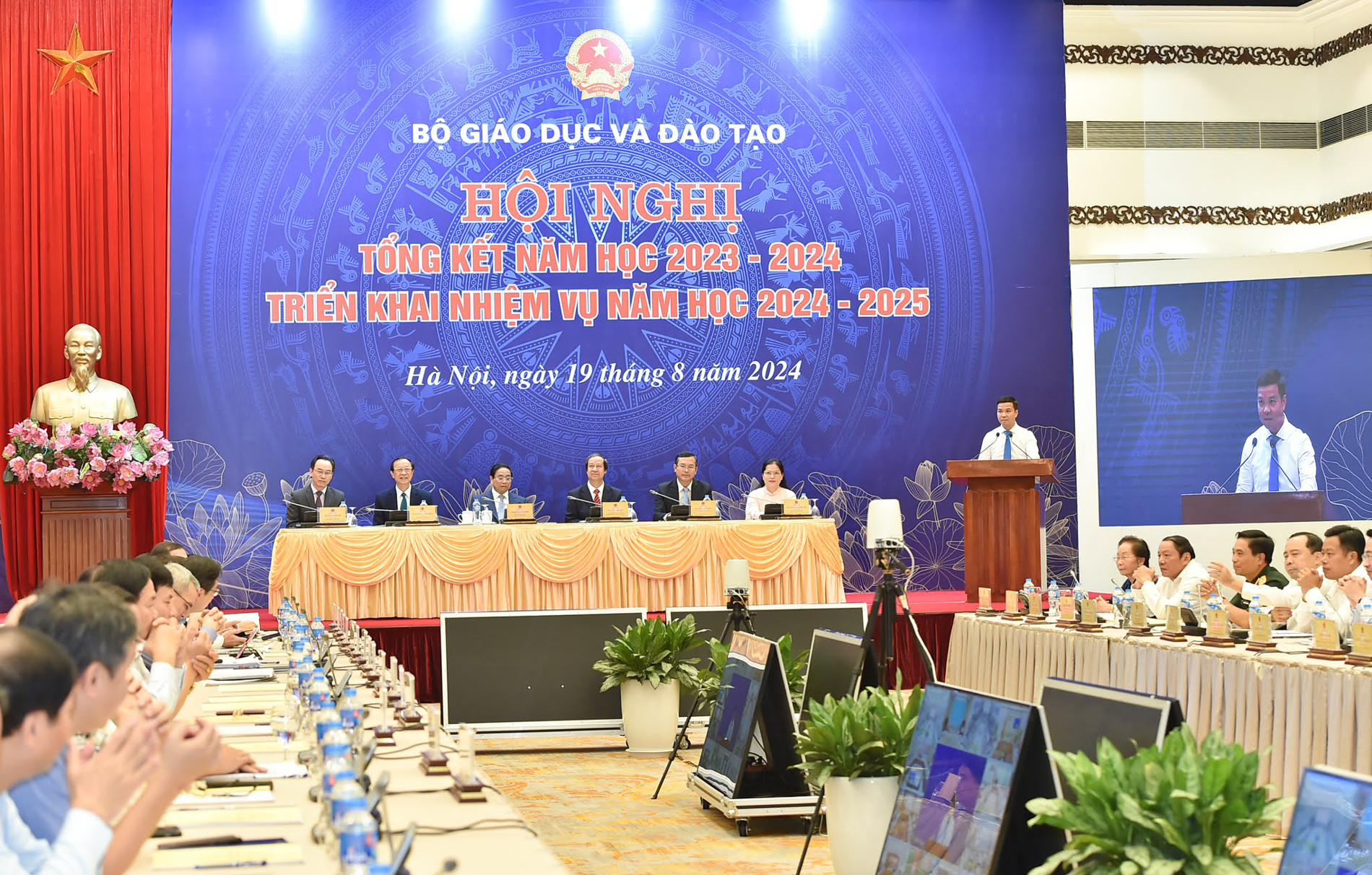
In order to gradually overcome difficulties and shortcomings in recruiting teachers for new subjects under the 2018 General Education Program, the Ministry of Education and Training has developed, and the Government has proposed, a Resolution of the National Assembly allowing the recruitment of individuals with college degrees to teach some subjects under the 2018 General Education Program.
The Ministry of Education and Training is also conducting research on preferential allowances for education sector officials and reviewing and proposing policies on salary regimes for officials in ethnic minority boarding schools, ethnic minority semi-boarding schools, and general schools with boarding students in mountainous areas and areas with particularly difficult socio -economic conditions.
Teacher shortages are causing difficulties for the new school year.
However, the Ministry of Education and Training also pointed out that the localized shortage of teachers still exists in most localities, especially for teachers of new subjects (English, Information Technology, Music, Fine Arts), but this problem is slow to be resolved.
Specifically, English and Information Technology, previously elective subjects, are now compulsory from grade 3; a new art subject has been added to the high school curriculum; and there is a shortage of teachers for elective subjects such as ethnic minority languages. This creates difficulties in implementing the curriculum and teaching plan.
Speaking at the conference, Mr. Vu A Bang, Vice Chairman of the People's Committee of Dien Bien province, stated that the local teaching staff is currently significantly short of the required number, especially in subjects like English, Information Technology, Music, and Fine Arts. This workforce often experiences considerable turnover at the end of each school year due to teachers transferring to work in the lowlands, hindering the implementation of the new school year.
Although Dien Bien province has specific policies to attract and recruit teachers, especially for subjects like Information Technology, English, and specialized subjects, there is still no source of recruitment.
“Based on Decree 141, we prioritize local students, implementing a scholarship policy and focusing on training in fields such as Information Technology and Foreign Languages… However, after three years of implementation, only 72 students have enrolled in these scholarship programs, including 45 in Foreign Languages, 5 in Information Technology, and the rest in other specialized fields,” Mr. Bang said.
In light of this situation, Mr. Bang proposed continuing the policy of attracting teachers to work for the entire duration in areas with particularly difficult socio-economic conditions; and providing indefinite contracts for teachers who have worked in particularly difficult areas for 10 years or more. At the same time, teachers working in particularly difficult areas would receive support for expenses such as: housing rent, travel expenses (if teaching in remote villages), lunchtime supervision allowance, etc.
In Ho Chi Minh City, Ms. Tran Thi Dieu Thuy, Vice Chairman of the City People's Committee, said that currently, it is very difficult to recruit teachers for subjects such as Information Technology, English, Fine Arts, and Music due to extremely low salaries.
"Given the current average salary levels in Ho Chi Minh City, it's impossible to recruit teachers for these sectors, and we also can't propose to the Ho Chi Minh City People's Council a mechanism or policy regarding financial support, similar to how the People's Council has a separate mechanism and policy for preschool teachers," Ms. Thuy said.
Ms. Thuy suggested that the Ministry of Education and Training research and advise the Government on removing difficulties regarding financial mechanisms, creating conditions for provinces and cities to develop specific mechanisms for recruiting teachers of Information Technology, English, Fine Arts, and Music.
As of April 2024, the country still lacks 113,491 teachers at all levels of education, from preschool to general education.
Furthermore, the teaching staff structure is unbalanced across subjects within the same educational level and between regions with different socio-economic conditions; the teacher allocation quotas for most localities are lower than the actual needs. The teacher-to-class ratio at all educational levels is lower than the standards set by the Ministry of Education and Training.
The Ministry of Education and Training believes the main reasons are the limited appeal of the profession; the high rate of teacher resignations; a shortage of teachers for some specialized subjects; and slow recruitment by localities, with approximately 72,000 allocated positions still unfilled.
In addition, the increase in the number of classes and students leads to an increased demand for teachers; the planning and forecasting of teacher needs from the strategic level to the local level are not accurate and do not keep up with reality; population fluctuations and labor migration between regions are large-scale and unpredictable.
"The quality of the teaching staff is a major bottleneck in the education sector."
Professor Nguyen Thi Doan, President of the Vietnam Association for the Promotion of Learning, believes that the most fundamental bottleneck in education today that needs to be addressed is the quality of the teaching staff.
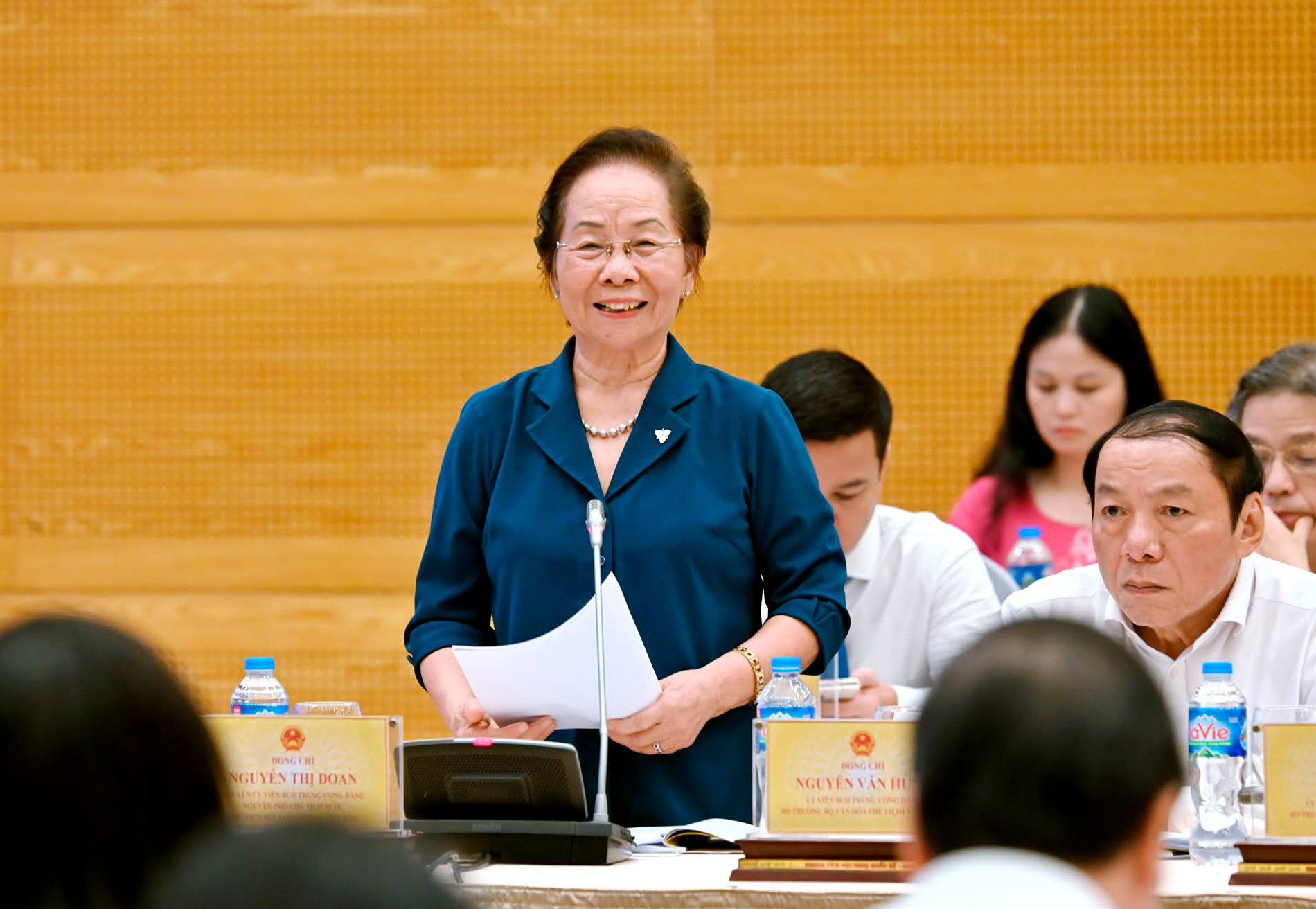
"This is a challenge for the education sector."
According to Ms. Doan, the current generation of teachers is mostly Generation Y, while Generation X teachers are very few. Generation Y, born between approximately 1971 and 1986, has begun to embrace science and technology very well. They are starting to break through and dare to innovate, unlike Generation X.
“The generation of students we are training is Generation Z. These generations are immersed in technology. Therefore, the teaching staff must understand the characteristics of this generation of students to improve quality. However, the quality of our teaching staff remains a major bottleneck. We need to assess who our students are and where they are, so that teachers also become immersed in technology, suitable for the target audience we teach,” Ms. Doan said.
According to Ms. Doan, the second bottleneck is the immense pressure to achieve high grades, weighing heavily on teachers, students, and parents.
The third issue, according to Ms. Doan, is the difficult living conditions of teachers. Because of these difficulties, teachers don't have much time for reading and self-study. "How much time do teachers actually dedicate to reading, self-study, and improving their skills? Reading and self-study are the real issues," Ms. Doan said.
Ms. Doan also stated that, despite the digitalization trend, paperwork and reports are still time-consuming tasks for teachers.
To improve the quality of Vietnam's human resources, the Chairwoman of the Vietnam Association for the Promotion of Learning emphasized the need to boost educational quality. "To boost it, we must improve the quality of the teaching staff because teachers are the 'key.' This is a very difficult and long-term problem that requires the involvement of all levels, sectors, and provinces and cities," Ms. Doan affirmed.
As of the end of the 2023-2024 school year, the percentage of teachers and administrators meeting the training standards according to the 2019 Education Law in preschool education was 89.3%, in primary education 89.9%, in lower secondary education 93.8%, and in upper secondary education 99.9%. Compared to the 2022-2023 school year, the percentage of teachers meeting the standards according to the 2019 Education Law increased by 1.9% in preschool education, 5.5% in primary education, and 2.9% in lower secondary education.
However, according to the Ministry of Education and Training, a small number of teachers and education administrators are hesitant to embrace innovation and have not yet fully grasped the importance of continuous professional development. As a result, training remains superficial and perfunctory, with limited time dedicated to self-study and professional development. The quality of teachers and education administrators is uneven, especially in areas with particularly difficult socio-economic conditions, where there is a significant gap compared to more developed regions.
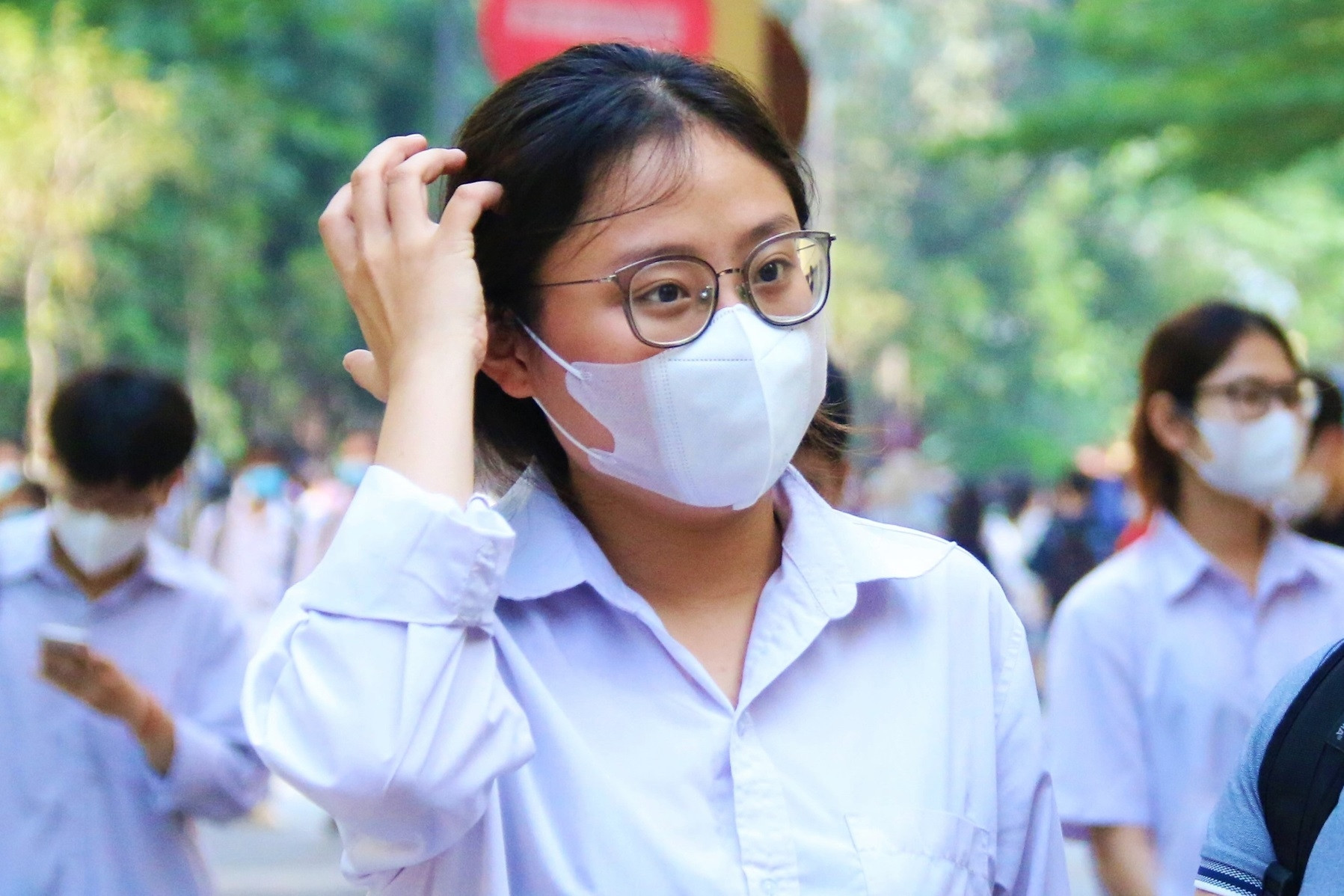
'Ordering' teacher training: Local authorities place orders in small increments, even owing money to schools.
Source: https://vietnamnet.vn/kho-tuyen-giao-vien-do-luong-qua-thap-2313211.html
![[Photo] Ba Lang An Lighthouse - the "eye of the sea" amidst the "rock museum" of Quang Ngai province.](https://vphoto.vietnam.vn/thumb/1200x675/vietnam/resource/IMAGE/2026/05/29/1780038698840_anh-man-hinh-2026-05-29-luc-14-10-42.png)



![[Image] Pleasant weather helps students enter the 10th grade entrance exam with confidence.](https://vphoto.vietnam.vn/thumb/1200x675/vietnam/resource/IMAGE/2026/05/29/1780034401612_ngay-1-thi-lop-10-minh-duy-8-5009-jpg.webp)






























































Comment (0)