

According to researcher and translator Nguyen Quoc Vuong, parents' excessive joy over their children's school grades shows that they themselves have not yet escaped from "achievement-oriented thinking" and view education as purely an examination system...
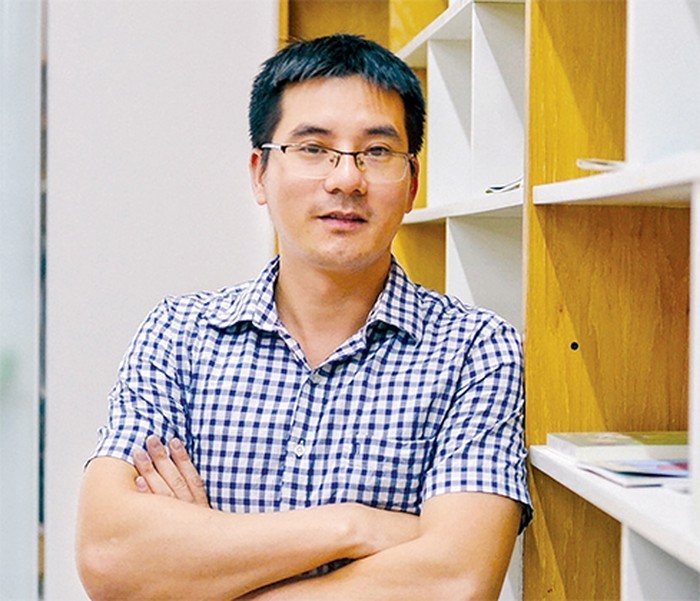 |
| Translator Nguyen Quoc Vuong argues that many parents still cannot break free from the "achievement-oriented" mindset and view education as purely a matter of examinations. (Source: Provided by the author) |
Every time the school year ends, many parents enthusiastically post their children's report cards and certificates on social media. In your opinion, what are the consequences of this phenomenon?
In my opinion, there are two consequences to this. Firstly, it hurts the feelings of parents whose children have not achieved good academic results. Some feel pressured and vent that pressure on their children by comparing them to "the neighbor's child" or "other people's children."
Secondly, the fact that parents are so overjoyed with school grades shows that they themselves have not escaped from "achievement-oriented thinking" and view education as purely a matter of examinations. This is fertile ground for diseases like vanity and obsession with degrees to flourish.
What is your perspective on the current pressures of exams and academic achievement? Exams seem to be becoming increasingly stressful?
Despite widespread calls for innovation and reform, the reality is that children today are under immense academic stress. While demanding continuous effort from learners is necessary in education, it's different from simply subjecting them to stress. Here, the stress primarily stems from exams, rather than from the demands of exploration , discovery, and expression.
Things like entrance exams for first grade, countless online competitions, and cramming with syllabuses right from the start of the school year are becoming commonplace. Schools are not creating a diverse learning environment but are instead narrowly focused on exam preparation, resulting in impoverished spiritual lives and experiences for students.
Can measuring a child's value through grades and certificates trigger anxiety and negativity in them?
Humans are complex beings. It's not easy to assess an individual's abilities based solely on school grades, even with fair and objective evaluation. As the saying goes, you shouldn't judge a fish's ability to climb a tree. We all have strengths, weaknesses, and abilities in certain areas. Grades and certificates cannot define a person's core value.
| "The pressure of having to take entrance exams for first grade, the countless online competitions, and cramming with syllabuses right from the start of the school year... has gradually become commonplace. Schools are not creating a diverse learning environment but are instead narrowly focused on exam preparation, leading to impoverished spiritual lives and experiences for students." |
In my opinion, assessment should be a process rather than just a few tests, and it needs to focus more on holistic observation, aiming for students' self-improvement and development, rather than evaluating them for competition or classification purposes, as many places are currently doing.
When schools, teachers, and parents absolutely prioritize evaluation for classification and ranking, they push children into fierce competition. In this competition, the winning team will feel superior and become complacent and vain, while the losing team will become insecure and self-conscious. Of course, both demonstrate the failure of an education system that should focus on self-improvement and value cooperation.
 |
| Don't push children into a fierce competition called achievement. (Source: VOV) |
In reality, many children today are studying to pass exams, to achieve good grades, to fulfill their parents' wishes, and to meet societal expectations. So, in your opinion, what solutions can reduce the pressure of achievement on children?
If the motivation for learning is external, such as pressure, parental expectations, or promised future salary and bonuses, then when the pressure decreases or disappears, students and young people will stop studying or only study half-heartedly, just to pass exams.
Educational researcher and translator Nguyen Quoc Vuong has translated and written approximately 90 books on education, history, and culture. Some of his notable works include: - Translated books: Vietnamese Education Reform, National Dignity, Happiness with Everyday Life... - Books written: Reading books and the arduous journey of a thousand miles, What can Vietnamese education learn from Japan, History is not as boring as you think, Reflecting on Vietnamese education from afar, Searching for the philosophy of Vietnamese education… Award: Best Book Award 2020 for the book "What Vietnam Can Learn from Japan in Education". |
Healthy learning motivation must come from within: finding joy and happiness in discovering new things, things one doesn't know, and improving oneself. It sounds abstract, but that's the essence of learning.
Unfortunately, instead of nurturing this trait from a young age, children are forced to study irrationally under immense pressure due to the expectations and insecurities of adults.
It's not uncommon to see images of children eating sandwiches right in their mothers' cars on their way to evening tutoring sessions, or children dozing off in the car...
As a result, children study only out of pressure, not for enjoyment. Therefore, once they get into university, their studies end; once they finish the exams, their studies end; once they get their degree, their studies end. With such a learning environment, it's very difficult to achieve top-level success, even if they have the aptitude to do so.
To what extent do families have a responsibility in this matter to help ensure children's rights, sir?
While your child's achievements are commendable, they should be approached with composure. Education is a long-term endeavor, and numbers alone cannot fully reflect potential or accurately assess ability. Humans possess an element of surprise related to focus, motivation, inspiration, effort, and enlightenment.
The important thing is to guide children towards a spirit of progress, a thirst for knowledge, and the ability to share and cooperate with those around them, such as their classmates and playmates. The goal is to encourage them to practice tirelessly, not just to meet exam requirements or focus solely on grades. This is also one of the things we can do to ensure and promote children's rights.
Thank you, sir!
In early May 2021, during a meeting with the Ministry of Education and Training , among many directives and orientations for education, Prime Minister Pham Minh Chinh emphasized his desire for the education sector to focus on "genuine learning, genuine testing, and genuine talent." Following this directive, Minister of Education and Training Nguyen Kim Son affirmed that the education sector will focus on effectively implementing the important directions set forth by the Prime Minister. These include the requirement that education must be based on "genuine learning, genuine testing, and genuine talent." According to Minister Nguyen Kim Son, genuine learning, or practical learning, in terms of content, is an education that teaches people knowledge, skills, qualities, and ethics, creating real capabilities—that is, what learners can use for their work, for their livelihood, for life, and for the country. |
Source


![[Photo] Prime Minister Pham Minh Chinh attends the Conference summarizing and implementing tasks of the judicial sector.](/_next/image?url=https%3A%2F%2Fvphoto.vietnam.vn%2Fthumb%2F1200x675%2Fvietnam%2Fresource%2FIMAGE%2F2025%2F12%2F13%2F1765616082148_dsc-5565-jpg.webp&w=3840&q=75)













































































Comment (0)