

Should we be greedy for 'cheap goods'?
Although the liquidity index of Vietnamese enterprises has improved significantly in the past 2 years, many enterprises are still in the process of restructuring and are under great pressure to repay debts. This is considered a space for " distressed M &A" deals associated with corporate restructuring.
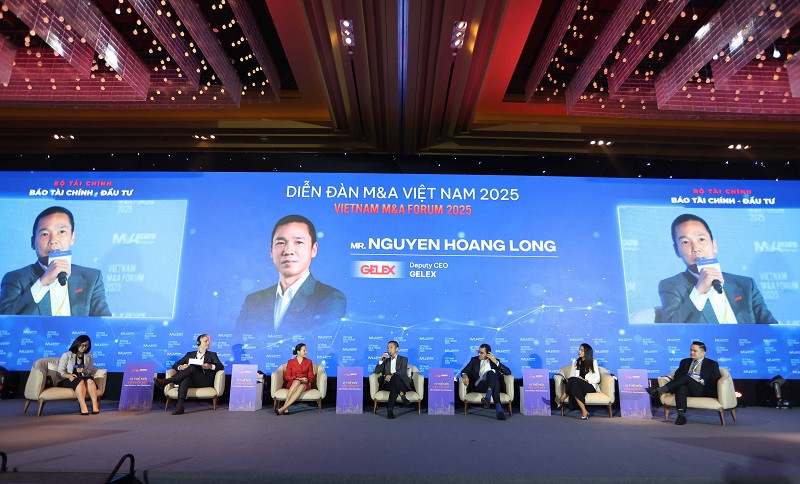
The above comment was made by Ms. Dang Nguyet Minh, Head of Research Department, Dragon Capital Vietnam, at the Vietnam Mergers and Acquisitions Forum 2025 (M&A Vietnam Forum 2025) organized by the Finance - Investment Newspaper on December 9.
“How has investor appetite for distressed assets changed? What are the most effective solutions in restructuring deals?” she asked at the event in her role as moderator.
Responding to the above concerns, Ms. Binh Le Vandekerckove, General Director & Head of M&A Consulting Department, ASART Transaction Consulting Company, said that not many investors are interested in rescue deals, because this segment is considered unattractive.
"Only a few specialized consultants and specialized funds focusing exclusively on rescue projects like this segment," she affirmed.
According to Mr. Nguyen Hoang Long, Deputy General Director of GELEX Group, in most of the rescue M&A deals, bad assets appeared and could not be saved. Many businesses not only faced temporary financial imbalances but also had structural problems.
In the 6 M&A deals that Gamuda Land Vietnam has carried out in the past 3 years, the company has not been successful in any rescue M&A transaction. All 6 transactions were valued based on the market value of the investment opportunity, at a level acceptable to both the buyer and the seller.
Gamuda Land Vietnam General Director, Ms. Nguyen Thi Van Khanh, further explained that many projects that this group approached were put on the "rescue" list due to legal issues that have not been resolved for many years; land funds have not been compensated; planning is no longer suitable... Or the project is being mortgaged at the bank, with the loan value even greater than the value of the land.
"The above factors are both opportunities and big challenges for investors," she said.
According to Ms. Khanh, when participating in an M&A deal, foreign investors will not only rely on the price factor. Instead, investors rely on the correlation between the disbursed capital and commitments on legal progress. For example, the time when the project is qualified for construction and opening for sale are important milestones.
Large time slippage compared to disbursed cash flow will affect the cash flow returning to the parent corporation. Meanwhile, most foreign companies are listed enterprises and have commitments to shareholders - this is an important factor.
Therefore, when receiving and evaluating the project, Gamuda Land carefully considers whether to buy back the project at the proposed price with the current status. Or, the enterprise accepts to buy back the project at a higher price, but ensures a better time frame with acceptable risks, according to Ms. Khanh.
Factors to consider when performing a 'rescue'
Mr. Douglas Jackson, CEO of Alvarez & Marsal (Vietnam), said that it is necessary to distinguish clearly between two cases: bad companies and good companies that are in bad situations. The CEO pointed out the main points to pay attention to when evaluating businesses in M&A rescue deals.
First , the position of the business in the market. Specifically, Alvarez & Marsal will evaluate whether the loss-making business is able to generate revenue again; whether it has loyal customers; and whether the brand is still recognized in the market. If the company is in trouble but the brand is strong and still has customers, then this is a business worth paying attention to.
Second , is the market in which the company operates growing steadily? Here, investors need to distinguish whether the company's business results are bad or whether the industry has entered a "sunset" phase, i.e., a recession. If the industry has declined, the company's situation will be difficult to turn around, and the rate of successful rescue is very low.
Third , is the problem the company is facing unique? Will adjusting operating costs save the company?
Fourth , the factor of corporate governance and management. The key point here is not the senior leadership team but the middle leadership.
"If these factors are not considered, a rescue M&A deal cannot proceed. A poorly executed rescue M&A deal can push a business to the brink of collapse," he emphasized.
From the perspective of businesses that need to be rescued, Ms. Binh Le Vandekerckove noted that businesses should not wait until the company is about to lose liquidity to seek M&A consulting services. Because, M&A is a medium and long-term strategy. A short-term period of 6-12 months is not enough for an M&A deal to carry out a process that creates real value. Therefore, this is just a "firefighting" move and is not encouraged.
However, for businesses forced to handle such situations, the first thing to do is remain calm. Businesses need time to sit down with consultants and stakeholders to determine the best course of action, avoiding hastily signing M&A deals that they may regret later.
To change the situation, one of the fastest ways to improve is to review the sales, market and business position. "If done correctly and turned around in time, in just 6-12 months, the business can regain its value and become an attractive criterion for investors," ASART representative advised.
According to KPMG data, in the first 10 months of 2025, Vietnam recorded 218 M&A deals with a total value of 2.3 billion USD, reflecting a trend of careful appraisal and cautious valuation, especially in industries with pressure on profit margins or slow growth demand.
Notably, large-scale transactions contributed nearly $1 billion in transaction value, largely from international investors, demonstrating the appeal of high-quality assets and stable performance. After peaking in 2024, the average transaction size returned to $29.4 million, bringing the market back to a more balanced state, with increased activity in the mid-range segment.
Domestic capital flows continued to be a crucial driving force, accounting for over 30% of total transaction value, while foreign capital maintained a strong presence, particularly from Singapore, Japan, the US, and South Korea – the group that led many of the largest deals this year.
Notable deals in 2025 mainly focus on real estate, materials, finance and healthcare . Several large deals worth 1-1.5 billion USD are in the process of completion, expected to create a new boost for the period 2026-2027.
Source: https://vietnamnet.vn/khong-nhieu-nha-dau-tu-quan-tam-toi-cac-thuong-vu-giai-cuu-2471002.html
![[Photo] Explore the US Navy's USS Robert Smalls warship](/_next/image?url=https%3A%2F%2Fvphoto.vietnam.vn%2Fthumb%2F1200x675%2Fvietnam%2Fresource%2FIMAGE%2F2025%2F12%2F10%2F1765341533272_11212121-8303-jpg.webp&w=3840&q=75)




















![[Video] The craft of making Dong Ho folk paintings has been inscribed by UNESCO on the List of Crafts in Need of Urgent Safeguarding.](https://vphoto.vietnam.vn/thumb/402x226/vietnam/resource/IMAGE/2025/12/10/1765350246533_tranh-dong-ho-734-jpg.webp)


















































Comment (0)