


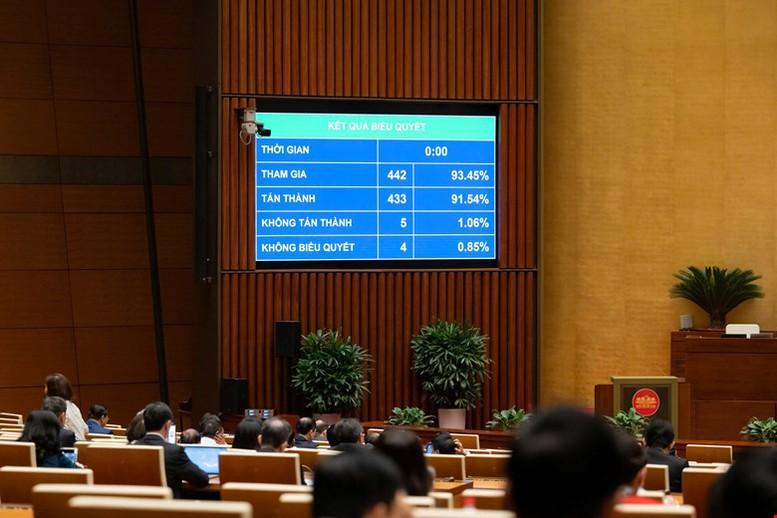
On the morning of December 11th, continuing the program of the 10th Session, the National Assembly voted to pass the Law on Digital Transformation with 433 out of 442 attending delegates voting in favor, reaching 91.54% of the total number of National Assembly delegates. This result shows a very high level of consensus in perfecting the legal framework to serve the national digital transformation process.
Presenting the report explaining, receiving feedback, and revising the draft law, Minister of Science and Technology Nguyen Manh Hung stated that the Law on Digital Transformation consists of 8 chapters and 48 articles, built on the model of a "framework law" – stipulating the principles, requirements, and major orientations, without delving into regulations within the scope of specialized laws, but playing a role in creating uniformity in the way of organizing and coordinating the digital transformation process nationwide.
According to Minister Nguyen Manh Hung, while the Law on Information Technology has fulfilled its purpose during the period of informatization, the Law on Digital Transformation is designed to address the new challenges of the digital data and digital economy era, where the requirements for connecting, sharing, integrating, and operating digital platforms are crucial to national competitiveness.
One of the most important aspects of the draft law is that, for the first time, it legalizes fundamental concepts of digital transformation, ranging from digital transformation, digital systems, digital data, digital infrastructure, digital platforms to digital government, digital economy, and digital society.
The government stated that it has thoroughly reviewed and revised these definitions to ensure scientific rigor and to unify the understanding across the entire political system and all stakeholders involved in digital transformation.
Transform first – digitize later
The highlight of the draft is clarifying the difference between digital transformation and information technology application. While information technology application only moves old operations to a digital environment, digital transformation is about changing the way operations are conducted, the governance model, and the methods of service delivery. This is considered the core philosophy of the law, reflecting the spirit of "transformation first – digitalization later".
Besides refining the conceptual framework, the draft law clearly defines macro-governance tools such as: the National Digital Transformation Program, the National Digital Architecture Framework, the Data Governance Framework, the Digital Competency Framework, and the National Digital Transformation Measurement Indicators Set.
These tools are likened to a "central coordinating body," helping the government assess progress, promote implementation, and ensure synchronization between digital transformation at the national, ministerial, and local levels.
Representatives of the drafting agency affirmed that legalizing these frameworks will create uniformity in implementation, avoiding the fragmented investment and inconsistent approach seen in the past.
Completely eliminate the "every man for himself" mentality.
Regarding digital design and architecture, incorporating these opinions, the draft law has added mandatory regulations on system design based on "default connectivity, default sharing, default security".
Accordingly, digital systems must prioritize the use of cloud computing, shared platforms, and one-time data declarations; data connectivity and sharing between government agencies is a default requirement, not an exception; and the principle of ensuring cybersecurity must be applied from the design stage.
The government believes these principles are effective in thoroughly addressing the "every man for himself" situation, while also saving on investment, operation, and maintenance costs.
For unprecedented digital transformation projects, which often face difficulties in determining total investment and selecting implementation models, Minister Nguyen Manh Hung stated that the draft law has added a pilot development mechanism with independent funding and a mechanism for selecting partners to test solutions before officially implementing investment projects. This is considered an important step to reduce risks, avoid budget waste, and encourage innovation in new fields such as big data and artificial intelligence.
Another prominent aspect of the draft law is the policy to narrow the digital divide, especially in remote, border, and island areas. The draft law stipulates the principle of prioritizing resources to ensure these areas achieve the infrastructure level necessary to provide essential digital services such as online learning, telemedicine, and online public services.
At the same time, the digital economy is considered a new growth engine, so the law adds mechanisms to support small and medium-sized enterprises in applying digital platforms and participating in the digital economic value chain, with the expectation of contributing to double-digit growth in the coming period.
According to the Ministry of Science and Technology, with the adoption of the Law on Digital Transformation, Vietnam now has a unified legal framework for a new phase of development – where data, digital infrastructure, and digital platforms become strategic national assets.
The law will create conditions for Vietnam to better utilize opportunities from the digital space, enhance competitiveness, build a digital government to serve people and businesses, develop the digital economy, form a safe and sustainable digital society, and make an important contribution to the country's rapid and sustainable development goals.
Updated December 11, 2025
Source: https://laichau.gov.vn/tin-tuc-su-kien/chuyen-de/chuyen-doi-so/lan-dau-tien-luat-hoa-khai-niem-chuyen-doi-so.html

![[Photo] Closing Ceremony of the 10th Session of the 15th National Assembly](/_next/image?url=https%3A%2F%2Fvphoto.vietnam.vn%2Fthumb%2F1200x675%2Fvietnam%2Fresource%2FIMAGE%2F2025%2F12%2F11%2F1765448959967_image-1437-jpg.webp&w=3840&q=75)



![[Photo] Prime Minister Pham Minh Chinh holds a phone call with the CEO of Russia's Rosatom Corporation.](/_next/image?url=https%3A%2F%2Fvphoto.vietnam.vn%2Fthumb%2F1200x675%2Fvietnam%2Fresource%2FIMAGE%2F2025%2F12%2F11%2F1765464552365_dsc-5295-jpg.webp&w=3840&q=75)





![[Infographic] Preventing students from making their own firecrackers: 7 things parents need to know](https://vphoto.vietnam.vn/thumb/402x226/vietnam/resource/IMAGE/2025/12/11/1765466656703_img_0320_20251211183542.jpeg)































![[OFFICIAL] MISA GROUP ANNOUNCES ITS PIONEERING BRAND POSITIONING IN BUILDING AGENTIC AI FOR BUSINESSES, HOUSEHOLDS, AND THE GOVERNMENT](https://vphoto.vietnam.vn/thumb/402x226/vietnam/resource/IMAGE/2025/12/11/1765444754256_agentic-ai_postfb-scaled.png)

















































Comment (0)