

A study by the National Institute for Applied Sciences (INSA) on August 24 showed that in Saxony, 32% of respondents were willing to vote for the AfD and only 6% supported the Social Democratic Party (SPD) of Chancellor Olaf Scholz.
Second place went to the opposition Christian Democratic Union (CDU) with 30% support, followed by the left-wing populist Sarah Wagenknecht Alliance (SSV) with 15%. According to the poll, the Green Party, part of the ruling coalition in Saxony, received only 5%.
In Thuringen, the AfD also led with 30%, while the SPD received only 6% support and the Green Party had 3%. The CDU and SSV competed fiercely for second place with a close margin of 21% to 20%. Only in Brandenburg did the AfD challenge the leading position to Prime Minister Olaf Scholz's SPD – 24% to 20%. Meanwhile, the CDU was projected to receive 19% of the vote, and the SSV 17%.
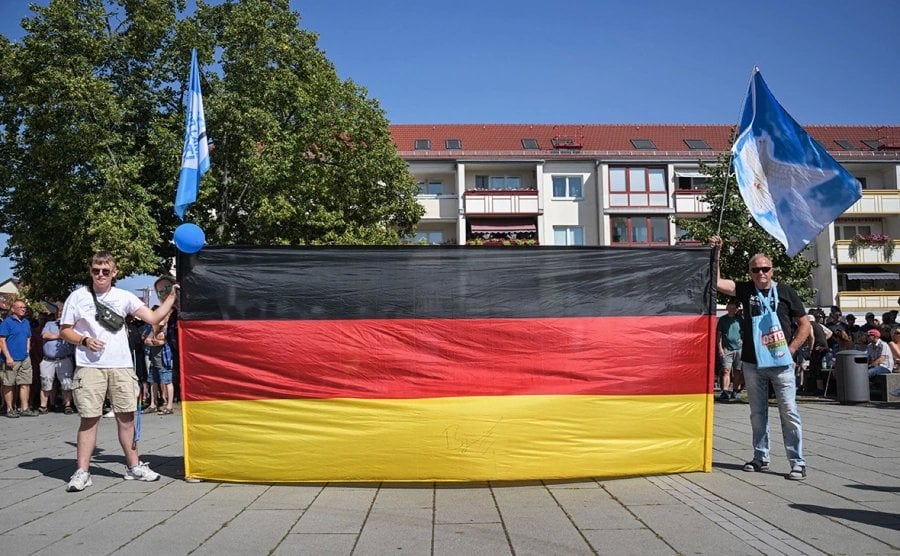
The campaign trail of the Alternative for Germany (AfD) party in the state of Thuringia. Photo: Global Look Press
A difficult problem for the ruling party in eastern Germany.
Currently, the population in western Germany is more than five times that of the east – 68 million compared to 12.5 million. However, it is the regional elections in the eastern states that have long been a serious challenge to the ruling powers.
Local voters, traditionally, tend to criticize the ruling coalition's policies and support the opposition, particularly the far-right AfD party. Left-wing parties are also popular in eastern Germany, seen as the political successors to the Socialist Unity Party, also known as the East German Communist Party.
Following Russia's special military operation against Ukraine, internal political rifts began to appear in Germany – some of the country's leading politicians, headed by Sarah Wagenknecht, did not support Berlin's policy of cutting ties with Moscow and condemned the supply of German weapons to Ukraine.
As a result, the SSV coalition emerged in January 2024. In the European Parliament elections in June, most left-wing voters cast their ballots for the SSV. While left-wing parties received 5.5% in the 2019 European elections, this year they only received 2.7%, while the SSV garnered 6.2%.
Analysts suggest that the main reason for the anti-government sentiment among people in eastern Germany is the continued deepening inequality, with residents feeling like "second-class citizens." According to a study by the German Federal Statistical Office (Destatis), in 2023, people in the former East Germany earned an average of 824 euros less per month than those in the former West Germany.
Meanwhile, residents in eastern Germany pay an average of 22% more for electricity than those in western Germany – €5,042 per year compared to €4,139. Authorities explain this is due to the significant costs that energy companies incur in expanding and maintaining their electricity networks.
German sociologist Detlef Pollack notes that nearly 30% of people in eastern Germany are skeptical of the ruling parties, and the upcoming elections will once again confirm this. “Dissatisfaction is beginning to become a defining characteristic of the people in the East. Their expectations for equal economic conditions have not been met, and they still see themselves as second-class citizens,” Pollack observes.
The role of the Russia-Ukraine conflict.
Traditionally, foreign policy issues have not played a pivotal role in German elections, particularly at the local level (local governments do not make decisions regarding defense policy). However, this time the Russia-Ukraine conflict has become the central theme of the election campaign in eastern Germany.
According to a study by the Allensbach Institute for Population Studies, 76% of respondents in eastern Germany are concerned that Germany could be drawn into a military conflict (compared to only 44% in western Germany). While 75% of respondents nationwide consider Russia a threat, this figure is 53% in eastern Germany. Furthermore, 40% of respondents in eastern Germany perceive a threat from the United States, compared to 24% nationwide.
These differences in political views are actively exploited by both the AfD and the SSV. Despite the fact that, ideologically, these parties are at opposite extremes, they both unanimously criticize the government for supplying weapons to Ukraine and support negotiations with Moscow.
As German state radio ZDF noted, the AfD and SSV are “turning local elections into a choice between war and peace.” The AfD representative in Thuringia, Bjorn Hecke, believes that “the elections in the east will decide whether the country abandons the path of war in the medium term or continues on the path of escalation.” “Peace” is also a key word in the SSV’s campaign programs in Thuringia, Saxony, and Brandenburg.
According to Tagesspiegel, besides the AfD and SSV, representatives of the CDU and SPD parties have also begun discussing peace in Ukraine during the election campaign. The primary goal of these parties is to draw voters away from their opponents or even signal to Wagenknecht that they are willing to cooperate to prevent the AfD's victory. Recently, the Minister President of Saxony, Michael Kretschmer (a member of the CDU), called on Russia and Ukraine to sit down for negotiations.
In early August, Brandenburg State Premier Dietmar Woidke (a politician from the SPD party) emphasized that the Russia-Ukraine conflict had been going on for almost three years and it was time for both sides to end provocative actions that escalate tensions.
According to Dietmar Woidke, Germany could play a mediating role in this conflict. Meanwhile, Thuringia State Premier Bodo Ramelov argued that Europe needs a new security system that includes Russia; and called on all countries to “sign a non-aggression pact and form a defense alliance focused on resolving conflicts in Europe.”
How will the election affect German politics?
The approval ratings of the ruling forces at the federal level continue to decline; meanwhile, the next parliamentary election is scheduled for September 2025. According to a ZDF television survey on August 15th, 62% of Germans have a negative view of the government's performance, while 33% have a positive one. Chancellor Olaf Scholz's performance was considered unsuccessful by 58% of respondents.
However, according to the German newspaper TAZ, the low approval ratings of the SPD, the Free Democratic Party (FDP), and the Green Party in the east of the country are unlikely to lead to early parliamentary elections, despite growing doubts among Germans about the governing coalition's ability to manage the country.
Conversely, Der Spiegel journalists believe that if the SPD fails to win seats in the Thuringian and Saxon parliaments, Chancellor Olaf Scholz's position will inevitably be affected. The publication recounts that after the SPD lost the 2005 regional elections in North Rhine-Westphalia, then-Chancellor Gerhard Schröder called on the Bundestag to pass a vote of no confidence against him in order to call early federal elections. As a result, in the fall of that same year, the head of government was transferred to Angela Merkel, representing the CDU.
Ha Anh
Source: https://www.congluan.vn/dang-cuc-huu-len-ngoi-o-mien-dong-nuoc-duc-lien-minh-cam-quyen-gap-kho-post309609.html















































































Comment (0)