

Electronic health record platforms offer numerous benefits to citizens, doctors, healthcare facilities, and government agencies.
Hanoi's Electronic Health Record (EHR) is a computerized version of a health record that is created, displayed, updated, stored, and shared electronically.
 |
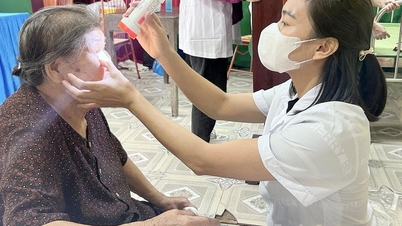
| Illustrative image. |
Hanoi's electronic health records document the healthcare history of a resident in Hanoi from birth to death, following the format prescribed by the Ministry of Health .
Every Hanoi resident has an electronic health record that is tracked and stored for life, managing all activities related to their health; the electronic health record is secure, and only relevant individuals can access the information; residents have the right to decide whether or not to share personal information in their health record.
From Hanoi's electronic health records, residents can manage their personal and family health using an electronic health record (Name: PHR - Personal Health Record) shared on the iHanoi application, aiming to support people in the process of medical examination, treatment, and disease prevention.
Further develop analytical and evaluation models, including disease models, to assess trends and disease prevalence in the city. Simultaneously, research the integration of major technologies such as Big Data and AI into the system, and study options for sharing citizens' health information with the smart healthcare operations center and the Hanoi City Operations Center.
We will continue to upgrade the API for sharing people's health data and receiving information declared by citizens from the Electronic Health Book on the iHaNoi application, in order to support people in using the electronic health book to manage their entire family's health, and to facilitate their medical examinations and treatment at healthcare facilities when using the electronic health book on iHaNoi.
Connect with the Social Insurance database to receive health data from Hanoi residents who receive health insurance-covered medical examinations at central-level hospitals, ministerial hospitals, and medical facilities located in other provinces and cities.
Implement the collection and interconnection of health examination data at healthcare facilities providing group health check-up services; connect and supplement service-based examinations, connect diagnostic imaging results, and simultaneously research options for sharing people's health information to support healthcare services at hospitals.
In addition, the system will be expanded to include a wider range of users, functions, and data management and updating capabilities for school health services (Department of Education and Training) in student health examinations and for health services in agencies/enterprises to support health management at these units.
Simultaneously, the activities of managing people's health were expanded to 30 district, county, and town health centers and 579 commune, ward, and town health stations, including activities such as managing non-communicable diseases, cancer patients, maternal and child health care, elderly care, and occupational disease management, etc.
To date, the pilot program for electronic health records and electronic health books has been implemented, installed, and operated by Hanoi city according to the set schedule.
Specifically, the city has completed the development of the electronic health record software to serve the management, examination, and treatment of diseases; connecting and sharing data on the examination and treatment of people on the city's electronic health record software with 661 public and private medical facilities in the area.
Through electronic health records, residents of Hanoi can manage their personal and family health using electronic health books shared on the iHanoi application, aiming to serve and support people in the process of examination, treatment, and disease prevention. This is a breakthrough in public health care in Hanoi.
To date, the pilot program for electronic health records and electronic health books has been implemented, installed, and operated by Hanoi city according to the set schedule.
Specifically, the city has completed the development of the electronic health record software to serve the management, examination, and treatment of diseases; connecting and sharing data on the examination and treatment of people on the city's electronic health record software with 661 public and private medical facilities in the area.
The city has also generated data on nearly 10 million residents from the Covid-19 vaccination system, the national immunization program, and medical examination and treatment management software.
Over 16.6 million medical examinations and treatments have been synchronized from the medical examination and treatment management software at healthcare facilities to the city's electronic health record system.
Synchronizing 3.5 million citizen records with all 48/48 required information fields as stipulated by the Ministry of Health onto the Vietnam Social Security system, ready to connect and display on the Ministry of Public Security's VNeID electronic identification application.
Replacing paper medical records and vaccination records with electronic health records has saved approximately 83 billion VND in costs and other related expenses.
According to the leaders of the Hanoi Department of Health, from January 1, 2024 to the present, medical facilities in Hanoi have received more than 4 million visits for medical examinations and treatment using chip-embedded citizen identity cards.
Regarding the implementation of electronic health records and electronic health books, the city has created electronic health records for over 9 million people; standardized information on the system for 7.75 million people; updated citizen identification information for over 6.16 million people; and updated health insurance card numbers for over 4.3 million people.
Hanoi has also completed the issuance of 3,200 accounts to units and individuals participating in the exploitation and use of the system; and organized the connection and interoperability of health insurance data from 50 hospitals, 39 polyclinics, and 297 health stations.
To date, Ho Chi Minh City has synchronized nearly 3.3 million people's health records to the National Insurance Database Portal to display electronic health records on the VneID application.
Applying digital transformation in medical examination and treatment, five hospitals under the Hanoi Health Department have effectively implemented electronic medical records: Hanoi Obstetrics and Gynecology Hospital, Saint Paul General Hospital, My Duc General Hospital, Van Dinh General Hospital, and Hoe Nhai General Hospital. Five hospitals have implemented telemedicine: Hanoi Heart Hospital, Hanoi Obstetrics and Gynecology Hospital, Hanoi Oncology Hospital, Saint Paul General Hospital, and Thanh Nhan Hospital.
To implement biometric-based medical examination and treatment (self-service kiosks), the Hanoi Health Department is piloting 5 self-service kiosks, accommodating approximately 1,600 patients per day, at Xanh Pon General Hospital and 1 kiosk at Dong Da General Hospital; simultaneously, it is continuing to pilot self-service kiosks at Ba Vi General Hospital and Hoai Nhai Hospital.
Source: https://baodautu.vn/loi-ich-cua-van-hanh-nen-tang-ho-so-suc-khoe-dien-tu-d218930.html


![[Photo] Prime Minister Pham Minh Chinh attends the Conference summarizing and implementing tasks of the judicial sector.](/_next/image?url=https%3A%2F%2Fvphoto.vietnam.vn%2Fthumb%2F1200x675%2Fvietnam%2Fresource%2FIMAGE%2F2025%2F12%2F13%2F1765616082148_dsc-5565-jpg.webp&w=3840&q=75)

































































































Comment (0)