

Ultimately, Mr. Ishiba Shigeru won what was considered the most unpredictable race in years, with new and even unusual elements...
The race for the presidency of the ruling Liberal Democratic Party (LDP) has concluded with a victory for Ishiba Shigeru, the former party secretary-general. Thus, the 67-year-old politician won on his fifth attempt and is almost certain to become Japan's new Prime Minister early next week.
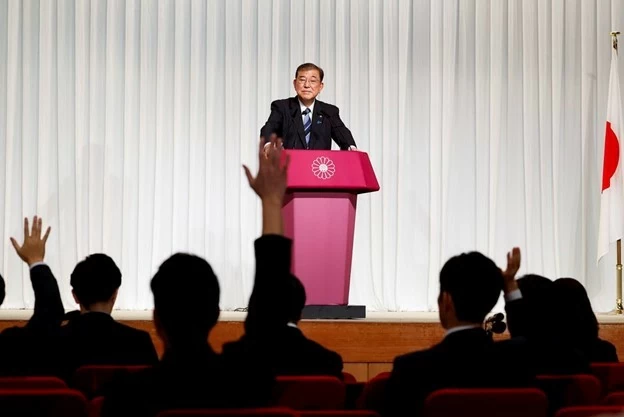 |
| Mr. Ishiba Shigeru speaks at a press conference in Tokyo, Japan on September 27. (Source: Getty Images) |
The race took place against the backdrop of a political fund abuse scandal that rocked Japan's ruling party, which had ruled almost continuously since 1955, forcing most major factions within the party to disband, expelling several lawmakers, and prompting Prime Minister Kishida Fumio to announce he would not seek re-election as party president.
This election features nine candidates, the most ever. Unlike this year's White House race, where Vice President Kamala Harris and former President Donald Trump are likely to have only one public debate, many debates between LDP presidential candidates are being held in short periods, both in Tokyo and locally.
This is considered one of the main reasons for the "decline" of Shinjiro Koizumi, who had been the leading candidate for a long time. Many LDP supporters believe that his performance in the debates showed that Koizumi, the son of former Prime Minister Junichiro Koizumi, who was elected to Parliament at the age of 28 and aspires to become the youngest Prime Minister in Japanese history at the age of 43, is not yet mature enough for this challenging position.
| "I will trust the people, speak the truth with courage and honesty. I will do my best to make this country a safe place, where everyone can live with a smile on their face again." (Ishiba Shigeru's celebratory speech after the vote, September 27) |
The absence of factions has created a unique, fresh, and even strange atmosphere. This may have partly led to the emergence of many candidates, as there is no longer the official "coordination" of faction leaders. It also contributed to making this the most unpredictable race in years; even a day before the election, no Japanese news agency dared to predict which candidate would ultimately win, only stating that a second round of voting would be necessary.
However, it is too early to say that the influence of factions and "elders" has disappeared. It is believed that the 10 minutes given to the two candidates to speak before the second round significantly impacted the final outcome, not only because of the impact of the speeches, but also because during that time, "elders" sent messages to members of Parliament. Some argue that the support of Prime Minister Kishida and other MPs was decisive in enabling Ishiba to secure 189 parliamentary votes in the second round, thus reversing the situation against Takaichi Sanae, who had the highest number of votes in the first round.
The LDP chairmanship has a new occupant. The Japanese Parliament is expected to hold an extraordinary session tomorrow, October 1st, to elect Shigeru Ishiba as the new Prime Minister, with hopes of bringing new vitality and energy to the world's fourth-largest economy.
Source: https://baoquocte.vn/luong-gio-moi-thoi-qua-nen-chinh-tri-nhat-ban-288068.html


















![[Photo] Prime Minister Pham Minh Chinh holds a phone call with the CEO of Russia's Rosatom Corporation.](/_next/image?url=https%3A%2F%2Fvphoto.vietnam.vn%2Fthumb%2F1200x675%2Fvietnam%2Fresource%2FIMAGE%2F2025%2F12%2F11%2F1765464552365_dsc-5295-jpg.webp&w=3840&q=75)















































Comment (0)