

It usually takes about two months for domestic rice prices to fall in line with market trends. This is why paddy rice prices are low, export rice prices are falling, while domestic rice prices remain high.
Rice prices are currently 40-50% lower than last year.
According to data from the Vietnam Food Association, the average price of regular rice at the field is currently 5,400 VND per kilogram, while fragrant rice sells for 7,000-8,500 VND per kilogram. At warehouses, the price of fragrant rice has dropped to 8,000-9,500 VND per kilogram, 40-50% lower than last year.
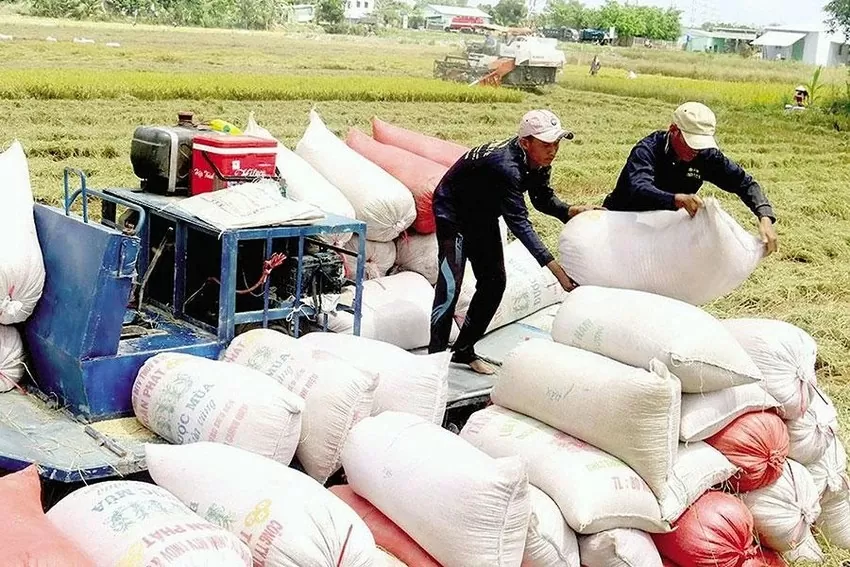 |
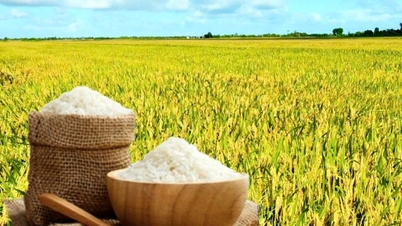
| Vietnam is one of the three largest rice exporting countries in the world . Photo: Quang Huy |
On the export market, according to data updated by the Vietnam Food Association on February 17th, the export price of Vietnamese rice remains below 400 USD/ton. Specifically, 5% broken rice is being offered at 395 USD/ton; 25% broken rice at 372 USD/ton; and 100% broken rice at 310 USD/ton.
Meanwhile, Thai rice exports are fetching better prices. Specifically, 5% broken rice is being offered at $418/ton; 25% broken rice at $397/ton; and 100% broken rice at $365/ton.
Similarly, Indian export prices for 5% broken rice are at $413/ton; 25% broken rice is at $394/ton. For Pakistani export prices, 5% broken rice is at $402/ton; 25% broken rice is at $370/ton; and 100% broken rice is at $337/ton.
Overall, Vietnam's rice exports are the lowest among the top four exporting countries, which include India, Thailand, and Pakistan. Last year, Vietnam benefited from India's export restrictions, which drove up rice prices and resulted in record exports of 9 million tons. However, when India lifted the ban, the market reversed quickly. A sharp increase in global supply drove prices down.
At the same time, Indonesia – Vietnam's second-largest market – is boosting its food self-sufficiency, importing only a small amount. The Philippines is also limiting purchases due to abundant stockpiles. According to the General Department of Customs, rice exports to Indonesia in January reached only 651 tons, a 98% decrease compared to the same period last year, causing domestic prices to fall sharply.
Mr. Nguyen Vinh Trong, Sales Director of Viet Hung Co., Ltd. ( Tien Giang ), reported that export rice prices have fallen sharply due to a sluggish export market, with the Philippines making small purchases and Indonesia restricting imports. Meanwhile, the peak harvest season for the Winter-Spring crop is currently underway, so export businesses are not yet aggressively stocking their warehouses with rice. They are waiting to see how prices will fluctuate in the market.
The sharp drop in export rice prices has led to unusual phenomena in Vietnam's rice-exporting hub – the Mekong Delta. Specifically, since the beginning of the year, some traders in the Dong Thap, Ben Tre , and Tien Giang regions have been using trucks to transport rice and selling it cheaply along rural roads.
The price of rice sold by small traders is commonly between 12,000 and 15,000 VND per kilogram, which is 4,000 to 8,000 VND/kg lower than the price at markets (depending on the type), so many people in the area have rushed to buy and stockpile it.
According to traders, this rice was milled by small traders from paddy purchased from farmers before Tet (Lunar New Year). Normally, after milling, the rice is stored at the mills, waiting for businesses to come and buy it. This year, prices have dropped sharply, and businesses are buying in small quantities, so they decided to sell it door-to-door because they fear that if they keep it in storage, the price will fall further, resulting in even greater losses.
According to a trader in Ben Tre, the average price of rice in 50kg bags is currently being offered at 600,000 - 750,000 VND, or 12,000 - 15,000 VND per kg, which is 20-40% lower than in the market. Traders use trucks for transportation. They usually choose a local location and sell for about a week; once demand decreases, they move to another location to sell.
Domestic rice prices lag behind export markets.
In Ho Chi Minh City, the price of puffed rice remains at 17,000 VND/kg, American fragrant rice at 19,000 VND/kg, and Nang Hoa rice fluctuating between 23,000 and 24,000 VND/kg, almost unchanged from last year's peak prices. In Hanoi, Japanese jasmine rice is priced at 22,000 VND/kg, Dien Bien fragrant rice at 19,000 VND/kg, and Thai fragrant rice at 20,000 VND/kg;... According to experts, the "street vending" of rice by traders is an opportunity for people to access cheaper rice, while retail prices in the market remain high.
Low paddy prices and declining export prices, yet domestic rice prices remain high? In an interview with the Industry and Trade Newspaper, agricultural expert Hoang Trong Thuy stated that while export prices have decreased, domestic rice prices haven't fallen due to price controls by intermediaries. Furthermore, it typically takes 2-3 months for domestic rice prices to follow the trend of the export market. This is a market-driven phenomenon that the government cannot regulate.
Meanwhile, according to rice businesses, related costs such as transportation, warehousing, and labor have all increased, making it difficult for rice prices to fall quickly in the market. In addition, losses during storage are also a factor forcing many stores to maintain prices. Supermarkets, on the other hand, mainly focus on the mid- and high-end rice segments, which are less volatile. Furthermore, supply contracts between supermarkets and distributors are often long-term with time lags, meaning retail prices are less affected immediately when raw rice prices fall.
Businesses in the industry also believe that the practice of traders "selling" rice door-to-door is only an isolated incident. The amount of rice sold is not large enough to cause significant market disruption.
According to the report on the supply and demand balance of commercial rice for the purpose of managing rice exports in 2025, submitted by the Ministry of Agriculture and Rural Development to the Ministry of Industry and Trade, the estimated total production for the Mekong Delta region is 3.778 million hectares, with an estimated average yield of 63.4 quintals/hectare; the estimated output is 23.965 million tons.
Of the above, domestic consumption and use as seeds, animal feed, etc., accounted for approximately 8.9 million tons. Commercial rice production was estimated at around 15.085 million tons, equivalent to 7.542 million tons of commercial rice for export.
Specifically, the amount of high-quality rice and fragrant rice is approximately 5.657 million tons, equivalent to 75%; glutinous rice is about 754,000 tons, equivalent to about 10%; and medium-quality rice is 1.131 million tons, accounting for about 15%.
With the total amount of rice available for export as mentioned above, the estimated export volume for the first six months of the year is 4.53 million tons, and over 3 million tons for the last six months of the year.
Given the current supply situation, the Ministry of Agriculture and Rural Development proposes that the Ministry of Industry and Trade focus on boosting rice exports during the months with high harvest yields, namely February, March, April, July, August, and September in 2025, to respond to market developments.
At the same time, it is proposed that the Ministry of Industry and Trade strengthen trade promotion to expand rice export markets to ensure that all rice is exported, while ensuring a harmonious balance of interests between producers and export businesses.
The Ministry of Agriculture and Rural Development also proposed a mechanism for managing the rice purchasing system in a professional manner, with business registration, where traders sign contracts with farmers based on contracts signed with export enterprises regarding rice varieties and quality, and traders are entitled to the same support policies as enterprises.
| According to the Ministry of Agriculture and Rural Development, the total rice cultivation area nationwide in 2025 is estimated at 7 million hectares, a decrease of 132,000 hectares. The average yield is estimated at 61.6 quintals/hectare, an increase of 0.7 quintals/hectare compared to the same period in 2024. Production is estimated at 43.143 million tons, a decrease of 323,000 tons compared to the same period in 2024. |
Source: https://congthuong.vn/ly-do-gia-gao-xuat-khau-giam-gao-noi-dia-van-cao-374201.html


















































































Comment (0)