

Recently, during the State visit of General Secretary To Lam to the Lao People's Democratic Republic and his participation in the 50th anniversary celebration of the Lao People's Democratic Republic's National Day, high-ranking leaders of the two countries witnessed the signing ceremony of cooperation documents, including a Memorandum of Understanding between the Ministry of Industry and Trade of Vietnam and the Ministry of Industry and Trade of Laos on the development of industrial linkage chains.
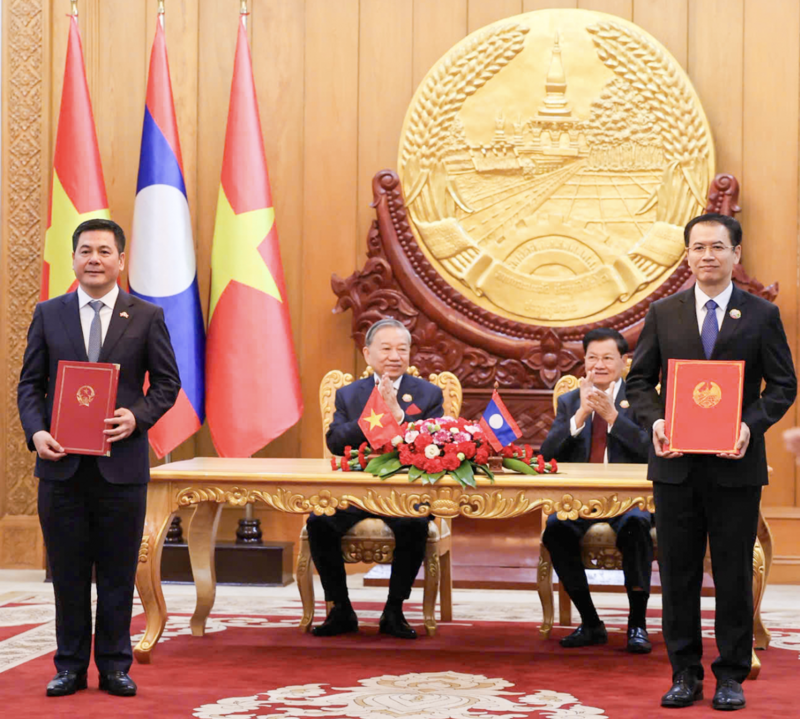
General Secretary To Lam and General Secretary and President of Laos Thongloun Sisoulith witnessed the signing ceremony of the Memorandum of Understanding between the Ministry of Industry and Trade of Vietnam and the Ministry of Industry and Trade of Laos on developing industrial linkage chains between Vietnam and Laos. Photo: MoiT
Notably, both sides designated the Vietnam Institute for Strategic and Policy Research in Industry and Trade (VIOIT) of the Vietnamese Ministry of Industry and Trade and the Institute of Industry, Trade and Energy (IICE) of the Lao Ministry of Industry and Trade as focal points responsible for coordinating the implementation of this Memorandum of Understanding. A reporter from the Industry and Trade Newspaper interviewed the Director of the Vietnam Institute for Strategic and Policy Research, Nguyen Van Hoi, about the plan for implementing this agreement.
"A memorandum of exceptional significance"
- Mr. Director, the Institute has been assigned the role of coordinating the implementation of the Vietnam-Laos industrial linkage chain. In your opinion, what are the key factors that need to be prioritized to ensure the chain operates effectively from the outset?
Director Nguyen Van Hoi: First of all, it must be affirmed that this is a particularly special memorandum of understanding. It is very difficult to find in bilateral or multilateral commitments a document of a similar nature regarding industrial linkages as the one between the Ministry of Industry and Trade of Vietnam and the Ministry of Industry and Trade of Laos this time.
The main content of the memorandum focuses on supporting businesses in both countries to collaborate across most industries, from materials, cement, iron and steel, chemicals, dairy, fertilizers, and electronics to textiles, footwear, and agricultural, forestry, and fisheries processing industries. A particularly important pillar is cooperation and linkage in the energy industry, including solar power, wind power, and power transmission.
The key point of this linkage is supporting businesses and complementary products. The document does not stipulate rigid legal obligations, but sets out an important direction: both sides will support each other in developing legal documents, sharing experiences, and coordinating the implementation of industrial development policies.
Among these initiatives, one groundbreaking aspect is the development of a model for joint Vietnam-Laos industrial parks. "Joint" here refers to the convergence of mechanisms, policies, operational methods, and management practices—meaning a high degree of compatibility that creates a favorable environment for businesses from both countries to operate.
The larger goal is to create a foundation to boost bilateral trade. Although the Vietnam-Laos relationship is characterized by its "special, loyal, and pure" nature, bilateral trade reached only around US$1.6 billion by 2024, a modest figure compared to its potential. Therefore, the memorandum of understanding is expected to be key to unlocking bottlenecks, from production and industry to hard and soft infrastructure.
This linkage focuses on connecting planning, technical infrastructure, logistics, and industrial parks, while strengthening soft infrastructure such as preferential policies, trade and investment mechanisms, and incentives for technology transfer. Both countries possess some of the most favorable policies compared to other bilateral partners, but the crucial aspect is implementation, and the memorandum of understanding serves as a common framework to ensure its effectiveness.
The institute will coordinate with relevant units to develop a comprehensive implementation plan, encompassing all priority industries of both countries.
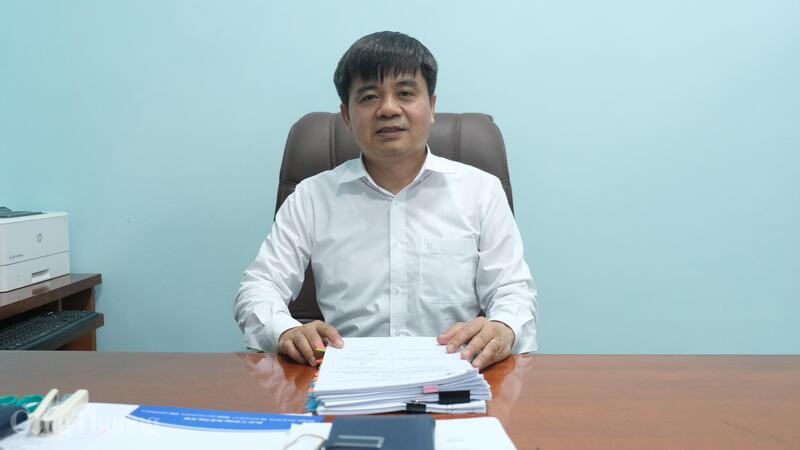
Mr. Nguyen Van Hoi - Director of the Institute for Strategic Research and Policy in Industry and Trade. Photo: Le An
Creating genuine cooperation between businesses.
- The memorandum mentions piloting collaborative models in priority sectors such as agricultural products, electronics, and renewable energy. What criteria does the Institute plan to use to evaluate and select pilot models to ensure their scalability?
Director Nguyen Van Hoi: The first step is to assess the current situation, identifying existing problems and obstacles in industrial linkages between Vietnam and Laos. Based on that, we can then develop a set of criteria for selecting pilot models.
Firstly, consider the needs of both countries. What does Vietnam need? What does Laos need? For example, Laos has an advantage in raw materials, elements that Vietnam desperately needs for its production and export activities. Conversely, Vietnam's manufacturing strengths can support Laos in developing its foundational industries.
Secondly, there are criteria regarding the businesses involved. Besides size, it's crucial that the businesses genuinely have a need for cooperation and the potential to complement each other. A sustainable supply chain only forms when both businesses are motivated.
Thirdly, criteria regarding products. It is necessary to clearly identify which products are suitable for industrial production linkages, which products have unique advantages for Vietnam and Laos, and then select the right model for piloting.
Fourth, the market criterion. The Vietnam-Laos supply chain must first and foremost serve the domestic markets of the two countries. However, the long-term goal is to target regional and global markets, especially as both countries aspire to participate more deeply in the global value chain.
Fifth, criteria regarding enforcement mechanisms and legal framework. This includes taxation, customs, land, investment incentives, technology transfer, trademarks, and trade and investment promotion. Both sides must jointly develop a specific implementation roadmap: "Do what needs to be done first," avoiding a scattered approach and ensuring effectiveness.
Based on that foundation, the Institute will take the lead in developing a detailed implementation plan, closely adhering to the content of the memorandum of understanding and adapting to the realities of both countries.
Human resource training linked to practical experience.
- In the course of cooperation, training and capacity building for Lao officials and businesses is identified as a crucial pillar. How will the Institute design training programs to meet the specific needs of the Lao side, while also supporting businesses from both countries to participate more deeply in regional and global supply chains?
Director Nguyen Van Hoi: Training and developing staff is a key element in the memorandum of understanding. And this time, the Institute aims for a completely innovative approach.
Firstly, training will be closely linked to trade promotion, investment, and technology transfer between the two countries. It will not only focus on theoretical training or field trips as before, but will also be practical, business-oriented training that builds concrete models.
For example, training in industrial park and economic zone management, operational models for border economic zones, or training in supply chain management and the operation of specific production lines. This helps Lao trainees immediately apply their knowledge to practical management and production.
Secondly, training also provides an opportunity for Vietnam to understand the thoughts, needs, and practical difficulties of the Lao side, thereby providing a basis for guiding Vietnamese businesses to cooperate more effectively with their Lao counterparts.
Thirdly, training will simultaneously support both government and business management. This means that Lao managers will be trained according to the Vietnamese model, while businesses in both countries will receive guidance on policy implementation, industrial promotion, trade, investment, and related services.
Furthermore, a crucial task is to build a shared information system and database to support training and practical implementation. After each course, there must be concrete products, including data, models, and practical reports, that can be immediately used by businesses and regulatory agencies in both countries.
Training is not just a supporting task, but a fundamental foundation for Vietnamese and Lao businesses to participate more deeply in regional and global production networks and supply chains, especially in the context of significant fluctuations in both global and regional supply chains.
Thank you very much, Director!
The Institute for Strategic and Policy Research in Industry and Trade is a public science and technology organization under the Ministry of Industry and Trade, serving the state management of the Ministry of Industry and Trade, performing the functions of research, strategy and policy development; postgraduate training; and professional and vocational training and development.
Source: https://congthuong.vn/lien-ket-cong-nghiep-viet-lao-mo-hinh-dac-biet-cua-dac-biet-434620.html








































































Comment (0)