

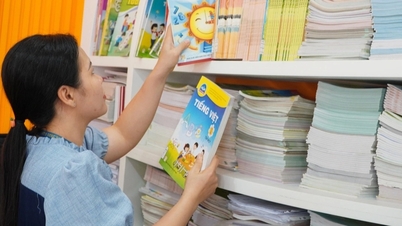
4 criteria for a suitable set of textbooks.
The amended Education Law, recently passed by the National Assembly on December 10th, stipulates a more flexible approach: allowing the Ministry of Education and Training to decide on the method of compiling a new set of textbooks or selecting and revising existing textbooks, depending on the practical situation and the decision of the competent authority.
To implement this, the Ministry of Education and Training stated that it is developing a plan for a unified set of textbooks starting from the 2026-2027 school year, ensuring transparency, objectivity, cost-effectiveness, and preventing waste; while inheriting and building upon the advantages of existing textbooks, minimizing the impact on teachers and students, and avoiding disruption to teaching and learning activities.
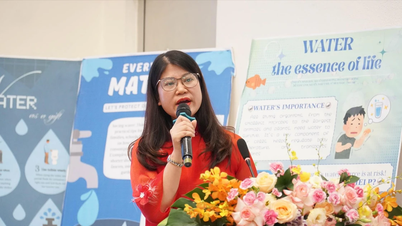
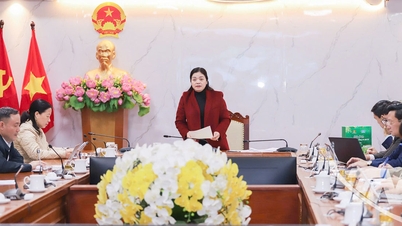
Representative Nguyen Thi Viet Nga (Deputy Head of the National Assembly Delegation of Hai Phong City) argued that a suitable set of textbooks must first and foremost truly meet the goals of the 2018 general education program, which is to develop students' qualities and competencies, innovate teaching methods, and shift from knowledge transmission to holistic development. Therefore, the criterion of suitability lies not only in the content of the books, but also in their compatibility with the philosophy of the program.
Representative Nguyen Thi Viet Nga presented four important criteria for a suitable set of textbooks. Firstly, regarding content, it must ensure scientific accuracy, precision, and modernity; it should not be overloaded or repetitive. The structure should be coherent, pedagogically sound, and capable of supporting teachers in innovating their teaching methods. The integration and differentiation should be clear, allowing students from different regions to access the material.
Secondly, regarding methods and accompanying learning materials, current textbooks cannot be separated from the learning resource ecosystem: teacher's books, electronic materials, illustrative videos, exercise banks, digital lectures, etc. A suitable set of textbooks must be accompanied by a complete learning resource system capable of supporting digital transformation in education, saving teachers time in lesson planning and increasing students' learning effectiveness.
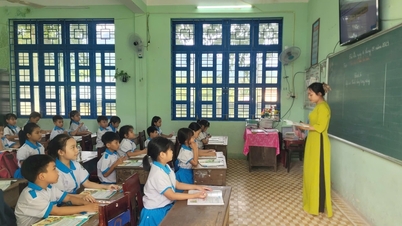
Next, regarding stability and feasibility of implementation, textbooks must be designed to be easy for teachers to teach and easy for students to learn. Frequent changes that cause disruption in schools should be avoided. They should have sufficient stability to allow educational institutions to develop professional development plans.
Finally, regarding fairness and inclusiveness, students in remote areas can still easily access and use the textbooks. The content of the books is not localized, but reflects the overall picture of national education. "If a set of textbooks simultaneously meets the requirements regarding content, methods, learning materials, feasibility, and fairness, then it can be considered appropriate and truly a national textbook," Ms. Viet Nga said.
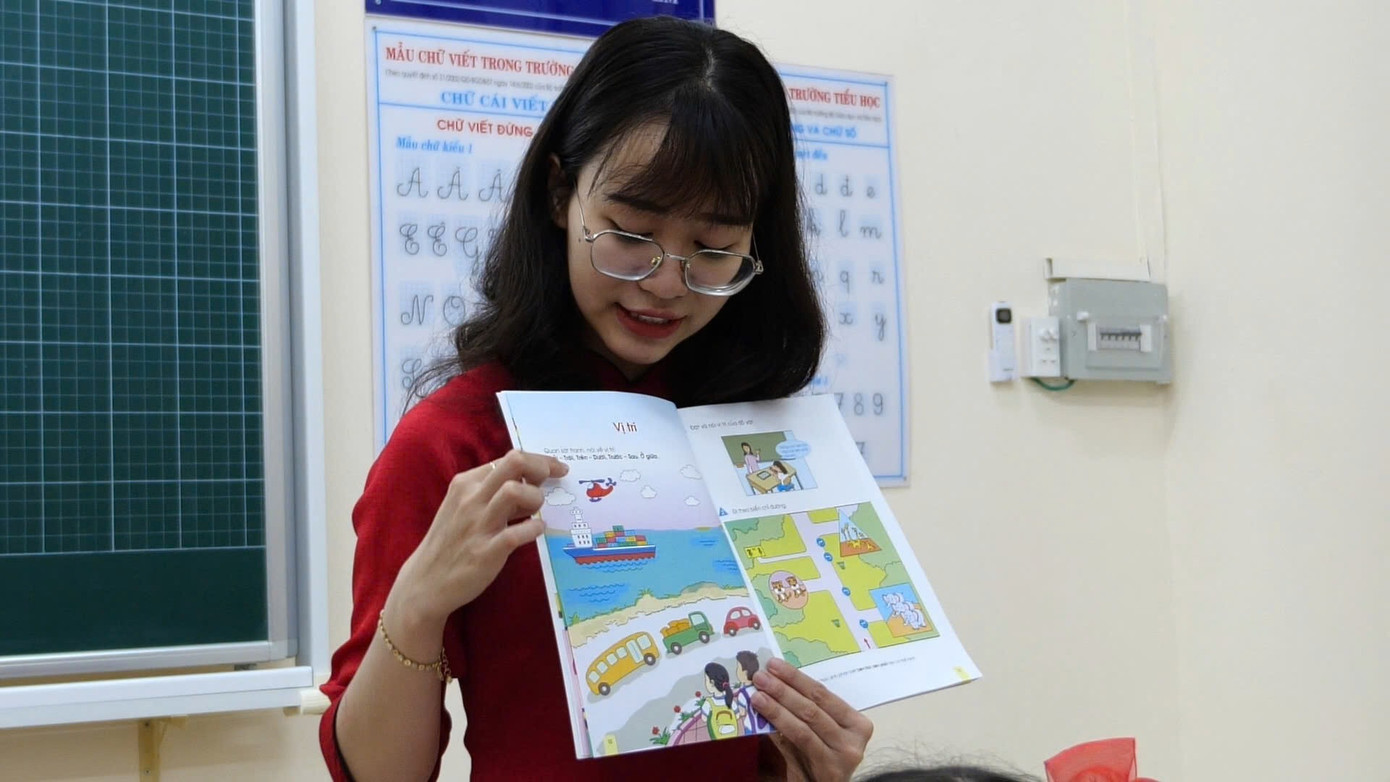
Ms. Mai Thi Chuc Binh, a math teacher from Son La province, believes that math textbooks, from junior high to high school, should not be so cluttered with text as they are now. According to Ms. Binh, the current math textbooks are overwhelming for readers. Furthermore, if the teaching time doesn't increase, then the amount of material must be reduced. Compared to the 2006 education program, the math curriculum has been streamlined but is still too demanding for students. The authors have included too much information, resulting in a lack of depth, leaving students with only a superficial understanding.
Strict control is needed.
Representative Nguyen Thi Viet Nga also raised several challenges in implementing a single set of textbooks. The tight timeframe and the diversity of educational practices (mountainous areas, islands, urban areas, rural areas, etc.) easily lead to conflicts between general standards and the specific characteristics of each locality. Furthermore, there is the social concern that teachers have become familiar with multiple sets of textbooks over the past five years. The transition to a new set of textbooks will require further familiarization, training, and research to ensure timely adoption.
Compared to the 2019 Education Law, the new Education Law passed by the National Assembly has many new points related to textbooks. Specifically, textbooks must concretize the requirements of the general education program regarding objectives, content, qualities, and competencies of students, while also guiding teaching methods, testing, and quality assessment. The content and presentation must not contain prejudices based on ethnicity, religion, occupation, gender, age, or social status.
In addition, textbooks will be published in various formats, including printed books, Braille books, and e-books. A national textbook review council will be established for each subject and educational activity, and will be responsible for the content and quality of the review. The Minister of Education and Training will approve textbooks after the national review council assesses them as meeting the requirements; and will also issue standards and procedures for compilation and revision.
To ensure a truly high-quality, unified set of textbooks, Ms. Nga stated that it cannot be entrusted to just one group of authors or one publisher, but requires the participation of four main entities. These include the State and the Ministry of Education and Training, which play a key role in creating and issuing the legal framework, curriculum standards, and organizing the National Council for Textbook Compilation and Evaluation; the team of authors, including those who participated in compiling the three current sets of textbooks, in collaboration with leading experts in each field; the teaching staff, the direct users of the textbooks, who need to participate in the review and feedback process from the beginning (framework and outline development); and the relevant agencies for oversight and social critique.
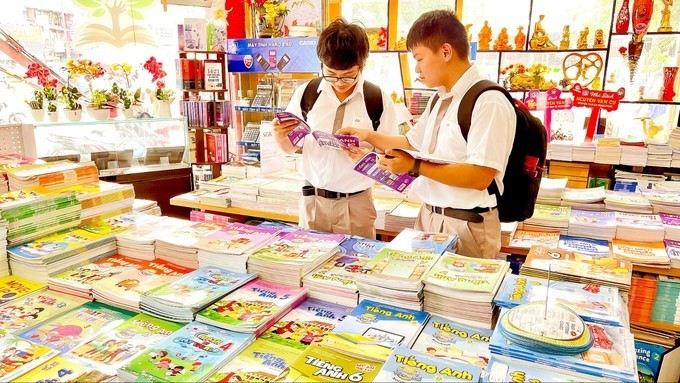
Ms. Nga emphasized that the coordination mechanism should follow the principle of three control mechanisms: author - state - society. Before publication, books must undergo public review and broad consultation. The National Assembly needs to monitor progress, quality, and costs through various means. This not only ensures transparency and compliance with the law but also strengthens public trust in a unified set of textbooks.
Regarding concerns that implementing a unified set of textbooks would "uniformize" the curriculum, depriving teachers of choice and students of opportunities for diversity, delegate Nguyen Thi Viet Nga argued that the important thing is not the number of textbooks, but how they are used. She emphasized the need to understand that textbooks are a means, not an end. Creativity in teaching depends on the teacher, their pedagogical methods, and how they organize the classroom.
A unified set of textbooks creates a common standard, avoiding disparities in quality between different sets, and simultaneously creating a level playing field for students nationwide. On that foundation, diversity can come from supplementary learning materials, digital resources, and extracurricular activities.
Therefore, the core issue is not how many sets of textbooks there are, but rather the mechanism to support teachers in being creative and innovating teaching methods. If the State has policies for training, supporting learning materials, and creating conditions for teachers to be proactive, then a unified set of textbooks can completely ensure common standards while encouraging creativity.
Implementing a unified set of textbooks from the 2026-2027 school year is an urgent task, so difficulties will inevitably arise during the implementation process. If we leverage the achievements of the three current textbook sets, compiling the new set based on inherited and selected elements, it will be much more convenient and cost-effective. More importantly, it is necessary to design a transparent and scientific mechanism, mobilize the participation of many stakeholders, avoid waste, and especially create conditions for teachers to continue to be creative in their teaching.
Source: https://tienphong.vn/mot-bo-sach-giao-khoa-dung-chung-chon-theo-tieu-chi-nao-post1803584.tpo












































































Comment (0)