

Participating in the discussion at the hall on the draft Resolution of the National Assembly on the mechanism and policy for national energy development in the period of 2026 - 2030 (draft Resolution), delegate Nguyen Thi Le Thuy - former Deputy Head of the National Assembly's Committee on Science , Technology and Environment, National Assembly delegate of Vinh Long province highly agreed on the necessity of issuing the Resolution.
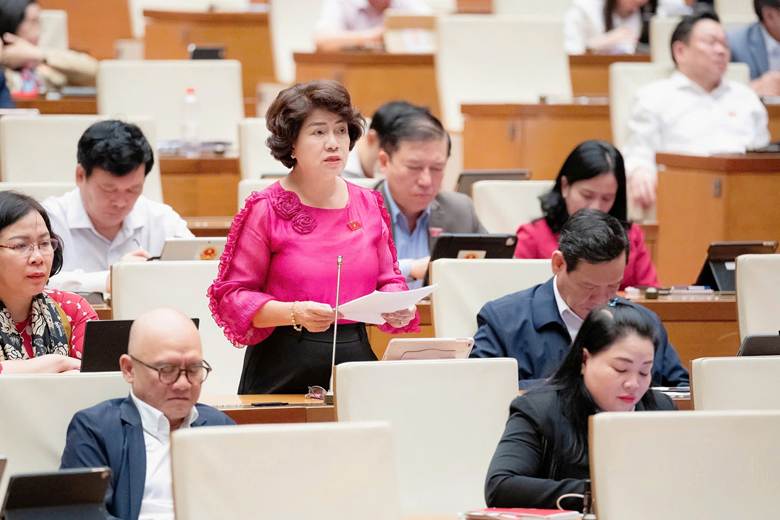 |
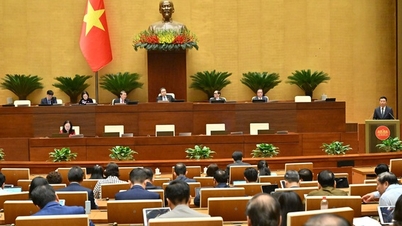
| Delegate Nguyen Thi Le Thuy spoke at the hall on the afternoon of December 8. |
In order to complete the draft Resolution, delegates made many important comments as follows:
Firstly, regarding the policy that is not "open" to the private economy: Delegates believe that socialization and attracting private investment is extremely important and urgent because according to Document No. 1144/TTr-CP dated December 3, 2025 of the Government on the promulgation of the National Assembly Resolution on mechanisms and policies for national energy development in the period 2026 - 2030, the total power capacity in the next 5 years must reach 190,000 to 254,000 MW (2.5 to 3 times higher than the present), requiring capital of up to 18 - 20 billion VND. However, delegates commented that the policies in the draft Resolution are not really open to promote and encourage private investment in power development. Specifically, the legal basis for drafting this Resolution is Resolution No. 70-NQ/TW dated August 20, 2025 of the Politburo on ensuring national energy security until 2030, with a vision to 2045, but many contents are not really consistent with other Resolutions of the Politburo, such as Resolution No. 68-NQ/TW dated May 4, 2025 of the Politburo on private economic development.
Second, regarding special incentives focusing on state-owned enterprises: Delegates said that policies to promote the development of power projects, including investment projects in power grid business and offshore wind power, almost only focus on facilitating state-owned enterprises and subsidiaries of state-owned enterprises.
Incentives for state-owned enterprises include skipping planning, no need to auction land use rights, no need to bid to select investors, and lowering criteria to facilitate their participation, such as regulations on principles and bases for flexible adjustment of power development planning, power grid development plan in Provincial Planning (Article 4), Investment in construction of Power projects (Article 6) and Investment in construction of infrastructure serving the operation of the power system and electricity market (Article 7). Although the Government 's explanatory report accepts the expansion of offshore wind power project investment policies for private enterprises, it has not clarified whether private enterprises enjoy similar regulations to state-owned enterprises.
Regarding the policy of developing small-scale nuclear power (Article 10): Although there is an expansion for private participation compared to the Electricity Law, it is only in the form of a general encouragement slogan, without a specific policy framework. Delegates said that it is difficult to implement, especially when the draft Resolution only has 5 years, while the Government explained that this is a new issue, in the research phase, waiting for investors to propose.
Third, regarding the bottleneck in negotiating power purchase agreements (PPA): Delegates are also concerned about the barriers in negotiating power purchase agreements (PPA). In fact, the prolonged PPA negotiations are one of the barriers that prevent businesses from participating in project bidding.
According to Clause 1, Article 9 of the draft Resolution, “Except for thermal power projects and offshore wind power projects, the electricity business investment project with a price frame for bidding to select investors shall have the winning electricity price be the price of the power purchase contract and not higher than the price frame in the bidding year. The electricity buyer is responsible for negotiating and concluding the power purchase contract with the winning investor in accordance with current law provisions.”
According to this regulation, when participating in bidding, investors must calculate investment efficiency based on the state price framework prescribed in the bidding year and the contracted electricity output, ensuring that the bid price is both competitive and effective. However, after winning the bid based on the bid price, investors must continue to negotiate with the electricity buyer on the price and minimum electricity output before signing the contract. This regulation becomes even riskier when Clause 3, Article 21 stipulates that the investment project will have its contract terminated if the time limit for signing the electricity purchase and sale contract is exceeded without signing. Delegates commented that such a regulation will put investors in a passive position and easily lead to negativity in the contract negotiation process. The current regulation is not a breakthrough and does not help shorten the time for negotiating and signing the electricity purchase and sale contract, although Resolution No. 70-NQ/TW has assessed this problem and requested to resolve it.
Fourth, the risk of legal conflicts between the Resolution and the Electricity Law: Regarding the implementation provisions (Article 24): In Clause 6, Article 24 of the draft Resolution stipulates: "In case there are different provisions on the same issue between this Resolution and other laws or resolutions of the National Assembly, the provisions of this Resolution shall apply. In case other legal documents have provisions on preferential or more favorable mechanisms and policies than this Resolution, the subjects receiving incentives shall be allowed to choose to apply the most favorable incentive level", stipulating that if there are differences between this Resolution and other laws or resolutions of the National Assembly, the provisions of this Resolution shall apply. The delegate said that it needs to be reconsidered because the Electricity Law also stipulates similarly that "if there is a difference between laws and resolutions of the National Assembly on the same issue, the provisions of the Electricity Law shall apply" and many contents in the draft Resolution have been specified in detail in the Electricity Law. The delegate would like to cite a number of issues that are regulated in the same way in both the Electricity Law and the draft resolution as follows:
Clause 3, Article 10 of the Electricity Law stipulates the establishment, appraisal, approval, announcement, adjustment, and organization of implementation of electricity development plans and provincial plans, including the content of the power supply network development plan, which must comply with the provisions of the law on planning and the provisions of this Law; Clause 4, Article 10 stipulates that the establishment and adjustment of plans must comply with the provisions of the law on planning and ensure the following requirements, including the requirement to ensure that the power grid system is synchronized with power sources, meeting the load development needs of regions and localities.
Emergency power projects and works in Article 14 and specific regulations, investment in construction of emergency power projects and works Article 15 of the Electricity Law stipulates the authority to decide on emergency power projects and works, which according to the draft Resolution, emergency power projects and works stipulated in the Electricity Law are one of the types of important and urgent power projects and works of the country stipulated in this draft Resolution, although the classification criteria are not different, and even lack clarity and detail compared to the Electricity Law.
Regulations on bidding to select investors for electricity business investment projects in Article 19 of the Electricity Law, including regulations on winning electricity prices; approval of investment policies and bidding to select investors for offshore wind power projects in Articles 28-29 of the Electricity Law. And many other related contents are regulated by both the Law and the draft Resolution on the same content but with different meanings, which document will apply?
On the afternoon of December 8, after the National Assembly heard the Report on a number of specific and special mechanisms and policies applicable to the high-speed railway project on the North-South axis; the Verification Report on a number of specific and special mechanisms and policies applicable to the high-speed railway project on the North-South axis. The National Assembly discussed in the hall the following contents: (1) Draft Resolution of the National Assembly on mechanisms and policies for national energy development for the 2026 - 2030 period; (2) On some specific mechanisms and policies, especially applicable to the high-speed railway project on the North-South axis; (3) Investment policy for Gia Binh International Airport construction investment project; (4) Investment policy for Vinh - Thanh Thuy Expressway Construction Investment Project; (5) Adjusting the content of Resolution No. 94/2015/QH13 of the National Assembly on investment policy of Long Thanh International Airport; (6) Amendment and supplementation of Resolution No. 170/2024/QH15 dated November 30, 2024 of the National Assembly on specific mechanisms and policies to remove difficulties and obstacles for projects and land in inspection, examination and judgment conclusions in Ho Chi Minh City, Da Nang City and Khanh Hoa Province. |
HONG YEN (recorded)
Source: https://baovinhlong.com.vn/thoi-su/202512/mot-so-gop-y-ve-du-thao-nghi-quyet-nang-luong-2026-2030-a07260f/

![[Photo] The captivating scenery of the fragrant maple forest in Quang Tri](/_next/image?url=https%3A%2F%2Fvphoto.vietnam.vn%2Fthumb%2F1200x675%2Fvietnam%2Fresource%2FIMAGE%2F2025%2F12%2F10%2F1765353233198_lan09046-jpg.webp&w=3840&q=75)


![[Photo] Explore the US Navy's USS Robert Smalls warship](/_next/image?url=https%3A%2F%2Fvphoto.vietnam.vn%2Fthumb%2F1200x675%2Fvietnam%2Fresource%2FIMAGE%2F2025%2F12%2F10%2F1765341533272_11212121-8303-jpg.webp&w=3840&q=75)













![[Video] The craft of making Dong Ho folk paintings has been inscribed by UNESCO on the List of Crafts in Need of Urgent Safeguarding.](https://vphoto.vietnam.vn/thumb/402x226/vietnam/resource/IMAGE/2025/12/10/1765350246533_tranh-dong-ho-734-jpg.webp)























































Comment (0)