

| Coffee prices reverse course and fall sharply, coffee exports move towards sustainability. Strongly, Arabica coffee export prices reach highest level since mid-June 2023. |
Exports of processed coffee increased.
Recently, Phuc Sinh Consumer Joint Stock Company signed a cooperation agreement with LNS International Corporation to promote the distribution of K COFFEE branded coffee products in the US, Europe, Australia - New Zealand, and Japan markets.
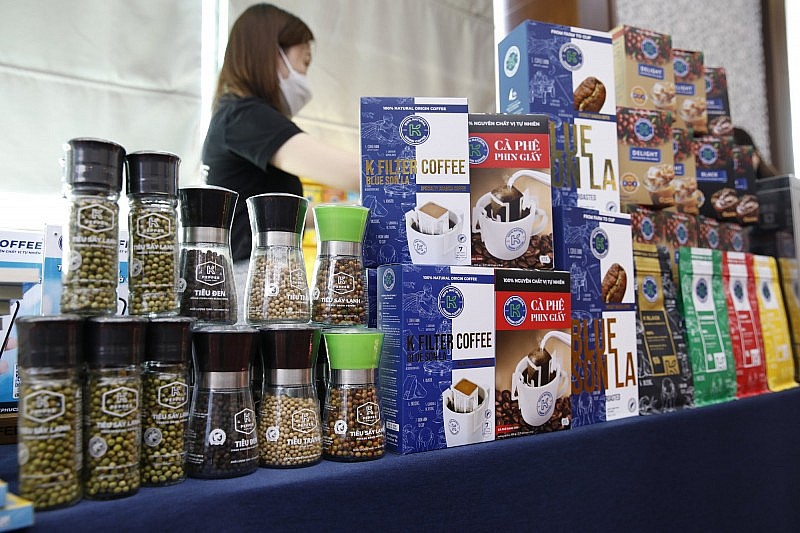 |
| Phuc Sinh has introduced the K COFFEE brand to the US, Europe, Australia, New Zealand, and Japan markets. |
This collaboration between Phuc Sinh Consumer and LNS International Corporation marks a further step in the development of Vietnamese coffee brands on the global map. From here, many international consumers will have easier access to pure, premium coffee products from Vietnam, produced by Vietnamese businesses using modern technology, rather than under the brand name of a foreign company.
This is just one of the efforts by Vietnamese businesses to enhance the value of coffee beans – one of the highlights of agricultural exports since the beginning of the year.
According to the Vietnam Coffee and Cocoa Association (VICOFA), at the end of the 2022-2023 crop year (from October 2022 to September 2023), Vietnam's coffee exports reached 1.66 million tons (more than 27.7 million bags, 60kg/bag), a decrease of 4.5% compared to the previous crop year.
However, export revenue increased by 3.4% to $4.08 billion (the highest level ever). Thus, the average export price of Vietnamese coffee reached $2,451 per ton.
Looking at each type of coffee exported, Robusta coffee accounted for the highest proportion with 1.49 million tons, worth 3.25 billion USD; Arabica green coffee beans only exported 41,500 tons, worth 169 million USD; and decaffeinated green coffee beans amounted to 36,000 tons, worth 136 million USD.
Notably, roasted and instant coffee exports totaled approximately 90,000 tons (not yet converted to green coffee beans), with a value of about 510 million USD (accounting for approximately 5.4% of the volume and 12.5% of the value of all types of coffee exported in the 2022-2023 coffee crop year).
In the first 10 months of 2023, total coffee exports reached nearly 1.3 million tons, with a value of nearly 3.3 billion USD; a decrease of nearly 11% in quantity and 1.2% in value.
According to Mr. Do Ha Nam , Vice Chairman of VICOFA, the high export price of coffee has created favorable conditions for an increase in domestic coffee prices. In recent months, the price of green coffee beans in Vietnam has fluctuated between 60,000 and 68,000 VND/kg (a record high in decades), contributing to a significant increase in the value of the past crop year.
" Many coffee-producing countries have seen a decrease in output, while global demand remains strong, especially from China. Therefore, coffee prices are likely to remain at a good level compared to previous years in the near future ," Mr. Nam commented.
Businesses proactively improve their processing capacity.
VICOFA forecasts that the 2023-2024 coffee crop will be harvested later than the previous crop. Some localities such as Gia Lai, Kon Tum , and Son La will harvest coffee earlier, in late October and early November, with the peak harvest occurring in late December 2023.
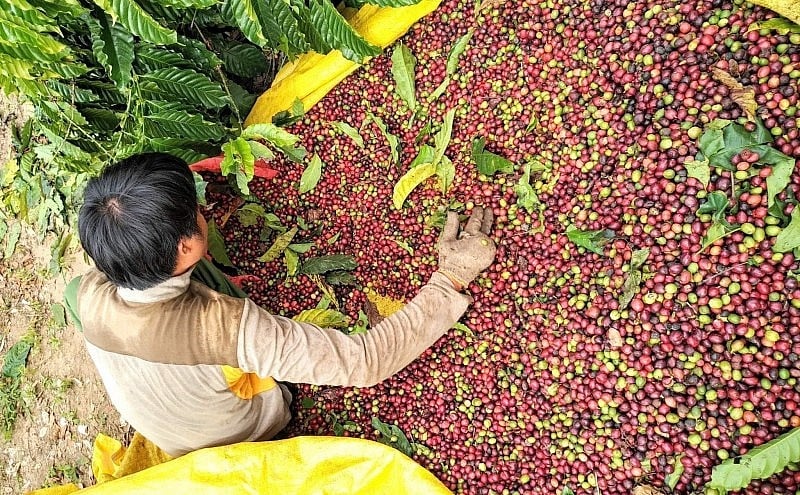 |
| Improving processing capacity will help increase the export value of coffee (Photo: VNA) |
Despite high coffee prices, many experts believe the industry will face certain challenges, such as declining planted area and the impact of anti-deforestation and forest degradation regulations from Europe.
According to this regulation, seven items, including coffee, cocoa, palm oil, soybeans, livestock, wood, rubber, and related processed products such as furniture, tires, frozen meat, and printed products, will not be allowed to be imported into the EU market if they were grown on land that had been deforested since December 31, 2020. This will officially apply to large corporations from December 2024 and to small and medium-sized enterprises from June 2025. This regulation is considered a barrier to the import of goods into the EU, including Vietnamese coffee.
Furthermore, despite increasing the volume of processed coffee exports, VICOFA leaders acknowledge that the coffee industry, like other agricultural products, primarily produces and exports raw coffee products. Deeply processed coffee accounts for less than 10% of total production and is mainly consumed domestically.
To enhance the value of exported coffee, many businesses are now investing more in coffee processing. Mr. Phan Minh Thong, Chairman of Phuc Sinh Group, said that after exporting raw coffee, Phuc Sinh has started exporting its own brand of coffee (K COFFEE) instead of doing contract processing.
To expand its brand into international distribution channels, Phuc Sinh has partnered with a company to introduce K Coffee into supermarkets and grocery store chains in the US starting in 2022. Additionally, the product is sold on e-commerce platforms such as Amazon, Walmart, and Faire. In the near future, this partner will also export K Coffee to the EU, Australia, New Zealand, and Japan starting in December.
Mr. Vuong Van Hai, Chairman of the Son La Coffee Association, said that due to the limited area of only 20,000 hectares, farmers have to focus on specialty coffee. Although it is not the most economically efficient crop, coffee has the advantage of stability, so farmers still maintain their planted area.
" Notably, in the past, 80% of coffee processing facilities in Son La were small-scale, thus failing to increase the value of the product. Recently, the province has implemented policies to attract investment in large, high-tech processing plants to elevate the status of Son La coffee," Mr. Hai informed.
Mr. Do Ha Nam shared that Indonesia consistently sells raw coffee at the highest prices in the world because its coffee processing industry accounts for 50% of its production. Vietnam faces a more difficult situation, producing 3-4 times more coffee than Indonesia but with only half the domestic consumption. "Investing in processing requires significant capital, technology, and branding... A positive sign is that since the EU-Vietnam Free Trade Agreement (EVFTA), not only Vietnamese but also foreign businesses have invested heavily in coffee processing, gradually increasing the proportion of processed coffee exported, " Mr. Nam cited as an example.
Source link
![[Photo] Prime Minister Pham Minh Chinh holds a phone call with the CEO of Russia's Rosatom Corporation.](/_next/image?url=https%3A%2F%2Fvphoto.vietnam.vn%2Fthumb%2F1200x675%2Fvietnam%2Fresource%2FIMAGE%2F2025%2F12%2F11%2F1765464552365_dsc-5295-jpg.webp&w=3840&q=75)
























































Comment (0)