

The Organization for Economic Cooperation and Development (OECD) assessed that the world economy this year still maintained its strength and resilience to shocks. Positive indicators from major economies, especially the US and Europe, have painted a bright color scheme for the world economic picture.
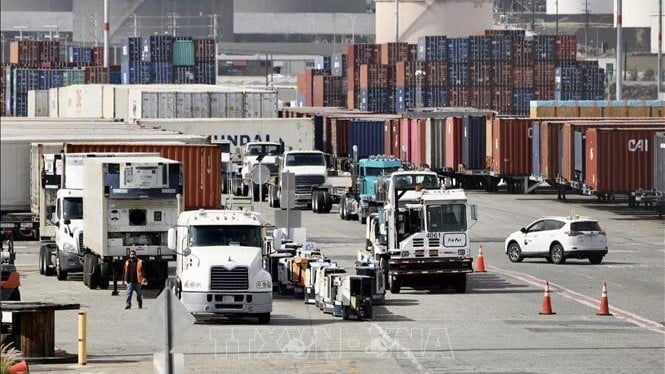
The recently published World Economic Outlook report by the OECD has outlined a bright picture of the global economy, with consumer demand standing out. The OECD pointed out that this positive result is thanks to the loosening of fiscal policies by many governments. In addition, many countries have issued solid macroeconomic policies to promote growth, increase workers' income, along with huge investments in the field. artificial intelligence (WHO).
The OECD has revised its forecasts for the health of major economies, with most of them being positive. Contributing significantly to the bright picture of the world economy, the US economy is estimated to grow by 2% of GDP in 2025, 0.2 percentage points higher than the OECD forecast announced in September. For the Eurozone, the OECD forecasts a growth rate of 1.3% this year, 0.1 percentage points higher than the previous forecast.
The OECD also revised its forecasts for the US and Eurozone growth in 2026 to 1.7% and 1%, respectively, both higher than previous forecasts. The world economy is forecast by the OECD to grow 3.2% in 2025, down slightly from 3.3% in 2024, before slowing to 2.9% in 2026 and "reversing the trend" to 3.1% in 2027. The OECD said it needs to "commend" the world economy for its strong resilience in 2025. A bright spot in the world economy comes from emerging economies in Asia with positive contributions to growth global
In the overall bright economic picture, there are still some gloomy colors. Regarding Germany, the Federation of German Industries (BDI) warned that the Eurozone's leading economy is experiencing its worst crisis since World War II. BDI warned that Germany's industrial output in 2025 will fall for the fourth consecutive year, with the assessment that this is not a temporary economic decline but a structural one.
Europe's largest economy has been hit by high energy costs, weak export demand in key markets, Chinese competition in the industrial sector and high US tariffs. After two years of recession, the German economy is forecast to grow only modestly in 2025. BDI President Peter Leibinger called on Chancellor Friedrich Merz's government to act more decisively and focus on competitiveness and growth, saying current measures, while strong, are not yet effective enough.
Across the Atlantic, concerns about the health of the US economy have also arisen, though not as serious. US companies cut 32,000 jobs in November, in stark contrast to forecasts of 20,000 new jobs being created.
According to economist Nela Richardson, hiring has been difficult recently as the macroeconomic environment is uncertain and employers face cautious consumer sentiment. She noted that November's job cuts were mostly at small businesses, which have been hit hardest by the Trump administration's reciprocal tariffs. Heather Long, chief economist at Navy Federal Credit Union, warned that this was not a seasonal job loss, but rather a wave of mass layoffs.
Analysts say that we cannot be subjective in a world full of instability and unpredictability. Each country and each economy needs to be ready to prepare for unexpected situations.
Source: https://baolangson.vn/nen-kinh-te-the-gioi-buc-tranh-tuoi-sang-5067133.html
![[Photo] 60th Anniversary of the Founding of the Vietnam Association of Photographic Artists](/_next/image?url=https%3A%2F%2Fvphoto.vietnam.vn%2Fthumb%2F1200x675%2Fvietnam%2Fresource%2FIMAGE%2F2025%2F12%2F05%2F1764935864512_a1-bnd-0841-9740-jpg.webp&w=3840&q=75)
![[Photo] National Assembly Chairman Tran Thanh Man attends the VinFuture 2025 Award Ceremony](/_next/image?url=https%3A%2F%2Fvphoto.vietnam.vn%2Fthumb%2F1200x675%2Fvietnam%2Fresource%2FIMAGE%2F2025%2F12%2F05%2F1764951162416_2628509768338816493-6995-jpg.webp&w=3840&q=75)


































































































Comment (0)