

Mr. T. was brought to the emergency room by his family. Doctors immediately provided first aid to his injuries and ordered a CT scan. The results revealed that Mr. T. had fractured the C1 and C2 cervical vertebrae, with no brain damage detected.
On March 26th, Dr. Tran Vu Hoang Duong, Head of the Craniofacial and Spinal Surgery Department 2 at Xuyen A General Hospital, stated that the patient suffered a fracture of the cervical vertebrae in the vertebral body and C2 vertebral body with multiple detached fragments, and a fracture of the C1 spinous process, causing significant neck pain, but fortunately, there were no neurological complications.
"This is a complex fracture that makes movement difficult for the patient and poses a risk of nerve damage if not treated promptly. Therefore, we prescribed posterior cervical spine fixation surgery using screws and plates to stabilize the cervical spine, allowing the patient to move and walk, and preventing paralysis later on. This surgery requires high precision from the surgeon to avoid injuries that could compress the spinal cord," Dr. Duong shared.
The doctors thoroughly consulted with the patient's family about the option of cervical spine fixation surgery. This method will help avoid nerve damage and help the patient regain mobility, allowing them to return to normal activities and work as soon as possible.
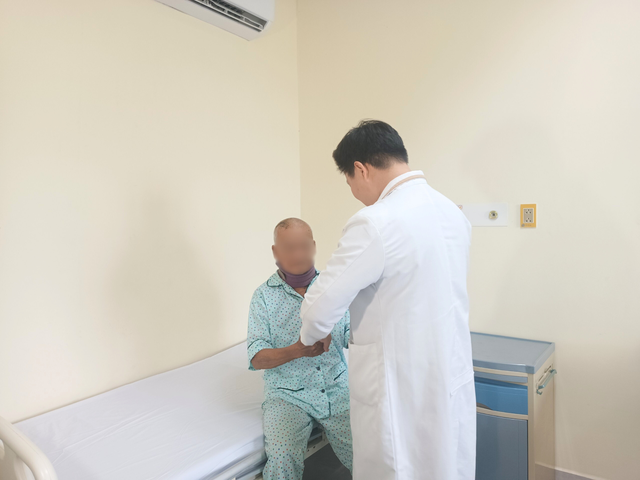
The doctor examines the patient.
PHOTO: BSCC
Two hours after the surgery, the patient regained consciousness and no longer felt any neck pain. By the second day, the patient was able to sit up, walk, and carry out normal daily activities independently.
According to Dr. Duong, if cervical spine fractures are not detected and properly stabilized, unconscious movements such as turning the head or struggling due to pain can worsen the condition, even causing spinal cord edema or secondary spinal cord contusion, leading to disability due to weakness and paralysis of the limbs.
"Patients suspected of having a cervical spine injury should have their spine immobilized and be properly transported to the nearest medical facility with a neurosurgery or spinal surgery specialist for prompt surgery. Under no circumstances should you attempt to manipulate or adjust the patient's neck yourself," the doctor advised.
Source: https://thanhnien.vn/nga-xe-may-xuong-ruong-cu-ong-82-tuoi-bi-gay-cot-song-co-185250326113020619.htm







































































Comment (0)