

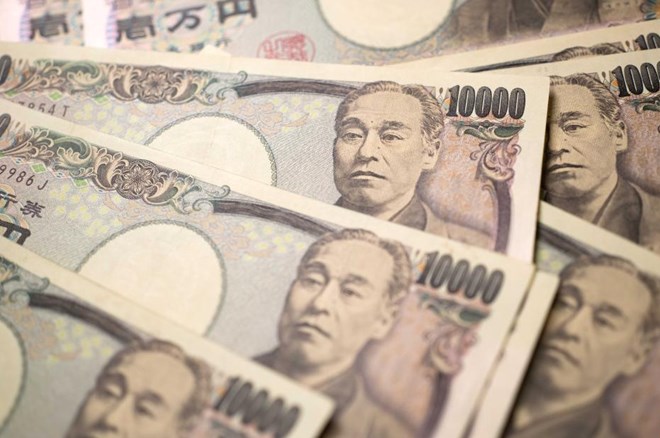
In its policy statement, the Bank of Japan said it would maintain short-term interest rates at -0.1% and cap the yield on 10-year Japanese government bonds at 0%.
This action by the BOJ is quite consistent with previous predictions. The Bank of Japan is expected to hold a press conference next Friday, at which time Governor Kazuo Ueda may provide more specific guidance.
"Given the extremely high levels of uncertainty surrounding domestic and international economies and financial markets, the BOJ will patiently continue its monetary easing while responding swiftly to developments in economic activity, prices, and financial conditions," the Bank of Japan's statement said.
However, loose monetary policy has made the BOJ an exception. Major central banks around the world have had to raise interest rates over the past two years to control inflation.
The yen fell by about 0.4% to around 148.16 JPY/USD following the BOJ's decision. Yields on 10-year Japanese government bonds remained largely unchanged. The yen has now weakened by more than 11% against the dollar so far.
At its previous policy meeting in July, the BOJ under Ueda loosened its yield curve control (YCC), allowing for long-term interest rate volatility. This policy tool allows the BOJ to target interest rates, then buy and sell bonds as needed. Loosening the YCC control also marks the beginning of a gradual move away from the old policy under former Governor Kuroda.
Experts predict that the Bank of Japan (BOJ) will quickly move away from its loose monetary policy around the first half of 2024. Ueda himself revealed that the BOJ may have enough data by the end of this year to determine when to end negative interest rates.
Despite core inflation exceeding the Bank of Japan's stated 2% target for 17 consecutive months, BOJ officials remain cautious about exiting the stimulus package.
Japan's core inflation in August was 3.1% year-on-year. Consumer prices, excluding energy and fresh food, rose 4.3%.
Oliver Lee, an economist at Eastspring Investments, said: “Japan has a good opportunity to transition from a deflationary environment to a sustained inflationary environment.”
“The key is wages. Japan needs to see meaningful and sustainable wage inflation to impact consumer sentiment. Hopefully, this could be the start of a positive economic growth cycle, but it’s still too early to say whether that will be successful. Perhaps we need another 6 to 12 months to see the situation,” Lee added.
Raising interest rates too soon could derail growth, while delaying it too long would put further pressure on the yen, increasing financial stress.
Japan's gross domestic product growth forecast for the April-June quarter has been revised down to 4.8% year-on-year from the initial 6% forecast due to weak capital spending.
Source
![[Photo] Prime Minister Pham Minh Chinh holds a phone call with the CEO of Russia's Rosatom Corporation.](/_next/image?url=https%3A%2F%2Fvphoto.vietnam.vn%2Fthumb%2F1200x675%2Fvietnam%2Fresource%2FIMAGE%2F2025%2F12%2F11%2F1765464552365_dsc-5295-jpg.webp&w=3840&q=75)


![[Photo] Closing Ceremony of the 10th Session of the 15th National Assembly](/_next/image?url=https%3A%2F%2Fvphoto.vietnam.vn%2Fthumb%2F1200x675%2Fvietnam%2Fresource%2FIMAGE%2F2025%2F12%2F11%2F1765448959967_image-1437-jpg.webp&w=3840&q=75)













































![[OFFICIAL] MISA GROUP ANNOUNCES ITS PIONEERING BRAND POSITIONING IN BUILDING AGENTIC AI FOR BUSINESSES, HOUSEHOLDS, AND THE GOVERNMENT](https://vphoto.vietnam.vn/thumb/402x226/vietnam/resource/IMAGE/2025/12/11/1765444754256_agentic-ai_postfb-scaled.png)

















































Comment (0)