

Keep Vietnamese for your children
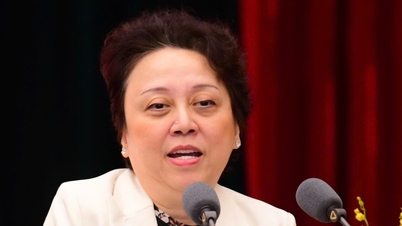
Ms. Do Thi Bich Hang Hang is working for a Finnish educational technology company; co-founder and President of the Vietnam Culture, Language and Cooperation Organization in Finland. Since her son Antony was born, she has been the one who directly taught him Vietnamese. When he entered first grade, she sent him to a Vietnamese class organized by the city of Helsinki so that he could have a more systematic learning environment.
Ms. Hang said that there are now quite a lot of books, newspapers, and online materials about the Vietnamese language abroad. However, teaching Vietnamese to children overseas also presents many difficulties. As children grow older, they think more and more in their native language. They cannot naturally express the knowledge they learn at school in Vietnamese, especially knowledge about history, geography, and literature… Sometimes, Vietnamese classes are taught by teachers of all levels together, and some older students may not feel enthusiastic. Meanwhile, busy lives mean that not all parents have the patience to regularly tutor their children in Vietnamese.
According to Ms. Hang, language is culture. Therefore, in order for children to learn Vietnamese on their own, they need to understand the meaning of learning the language, not just because their "parents require them to." Born in Finland, Antony was raised in a multilingual environment. Since he could speak, Antony knew how to speak Vietnamese to his mother and Finnish to his father very naturally. It was just that speaking Vietnamese later became more difficult because he lacked vocabulary. The environment for him to practice Vietnamese compared to his friends in the country was also much more limited. However, Ms. Hang still persevered in teaching and speaking Vietnamese to her child every day.
When Antony was 5 years old, he loved activities and followed his mother wherever she went, so she taught him Vietnamese, starting with naming familiar objects and daily activities. When he was a little older, she taught him and explained in an easy-to-understand way that if he knew Vietnamese, he would understand what his grandparents and relatives were saying and everyone would understand him better.
Preserving culture is preserving roots
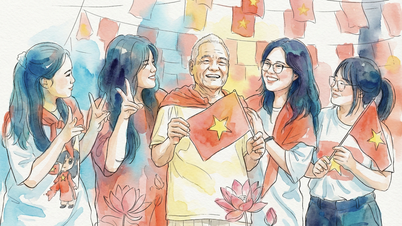
Ms. Hang's job is related to Finland - Vietnam cooperation, she told her son that if he knew English, Finnish and Vietnamese, he might have the opportunity to work like his mother in the future. When her son started to like watching the news, Ms. Hang often told him about the events happening in Vietnam such as the liberation of the South and the reunification of the country on April 30, and National Day on September 2. She also showed him videos about the history and country of Vietnam, and told him about Uncle Ho.
In Finland, Antony also experienced Vietnamese Tet through his mother's job of wrapping Chung cakes, and eating the Vietnamese Tet feast that his mother cooked for his grandparents to enjoy at home. Ms. Hang also introduced Antony's father and grandparents to Vietnamese culture so that the family members in Finland could understand and continue to encourage Antony to learn Vietnamese.
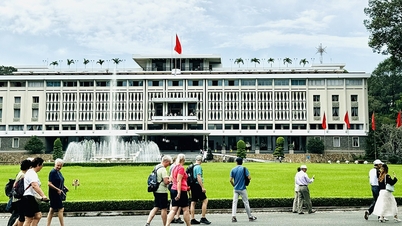
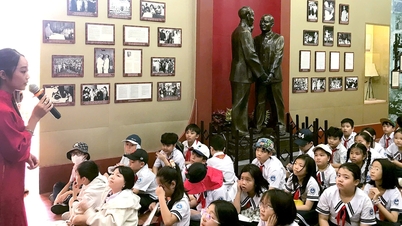
Ms. Hang also tries to regularly take Antony back to Vietnam to visit his grandparents and visit the places that his mother used to tell him about, such as the Independence Palace, Uncle Ho's mausoleum, Uncle Ho's stilt house, the War Remnants Museum, the Military History Museum, and the Ho Chi Minh Museum. Ms. Hang does not force her son to love his country or Vietnamese culture, but through such stories and activities, she realizes that her son naturally loves and absorbs Vietnamese culture. He can also tell his grandparents about the places and historical lessons that he has been to or heard about. From loving culture, Antony also loves Vietnamese and sees the meaning of learning Vietnamese.
As someone who values preserving her roots, Ms. Hang hopes that her son will always study Vietnamese diligently, love Vietnamese and connect with his roots. She also hopes that, no matter where he lives, he will always turn to his homeland, love Vietnam, understand and preserve the good values of the nation. For her, her son speaking Vietnamese is not just knowing another language, but also a bridge to help him connect with his family, with his grandparents, and with the Vietnamese identity in his heart.
Source: https://phunuvietnam.vn/nguoi-viet-o-phan-lan-cho-con-ngam-van-hoa-nguon-coi-mot-cach-tu-nhien-238251208155340705.htm






















![[Photo] Urgently help people soon have a place to live and stabilize their lives](/_next/image?url=https%3A%2F%2Fvphoto.vietnam.vn%2Fthumb%2F1200x675%2Fvietnam%2Fresource%2FIMAGE%2F2025%2F12%2F09%2F1765248230297_c-jpg.webp&w=3840&q=75)


















































Comment (0)