

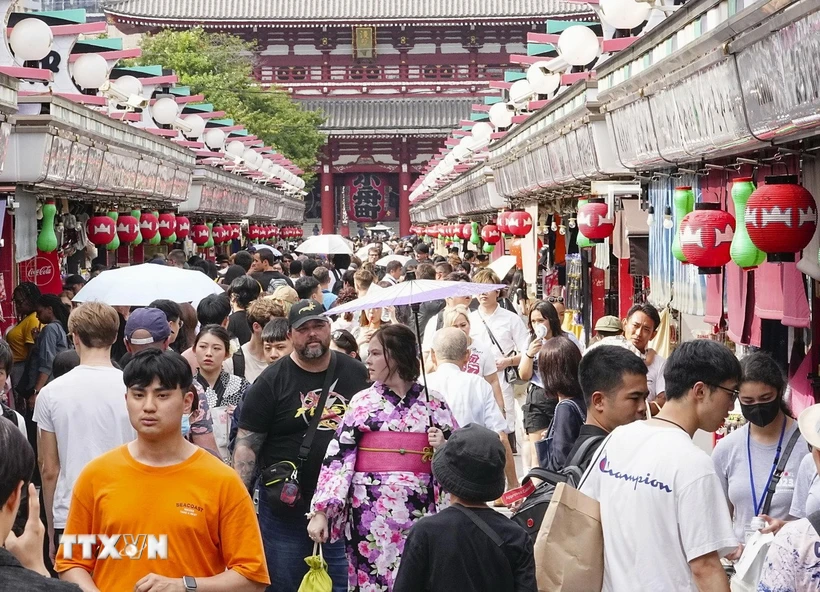
Tourists in Tokyo, Japan. (Photo: Kyodo/VNA)
According to the Vietnam News Agency correspondent in Tokyo, the Japanese capital's authorities are stepping up efforts to assist foreign tourists in the event of a disaster.
As part of this initiative, Tokyo has been conducting disaster response drills for non-Japanese speakers. During an evacuation drill last month in Tokyo's Shinjuku district, no one was allowed to speak Japanese.
Participants, posing as foreigners, used translation apps to communicate with first responders.
The drill aimed to simulate the aftermath of a major earthquake in Shinjuku Ward. People unable to return home due to impassable streets and malfunctioning trains sought shelter at the Tokyu Kabukicho Tower.
Nearly 30 of the evacuees, or 40% of the total, were foreign nationals sheltering there. Shelter staff were able to display signs in multiple languages instructing evacuees to remain silent, along with other instructions.
The drill revealed several incidents. Staff had difficulty responding to victims who wanted to charge their phones or those who inquired about whether the meals contained allergens.
A member of Sompo Risk Management, the company that conducted the evacuation drill, acknowledged the difficulty of "communication between people who cannot speak to each other."
Another evacuation drill took place last month near Tokyo Station. Railway staff interacted with about 20 foreign university students posing as international tourists.
Staff told the students in English that the train was not operational. Translation apps were used to convey further evacuation instructions.
In January, a drill in Tokyo's Shibuya district used drones to deliver instructions via loudspeakers. The instructions were given after drill participants confirmed the presence of people through built-in cameras. Organizers plan to conduct disaster drills in multiple languages at a later time.
The drills are taking place against the backdrop of a surge in international visitors to Tokyo. According to preliminary figures from the Tokyo metropolitan government, there were 6.83 million foreign visitors from April to June 2024, a 31% increase compared to the same period in 2023. This is the highest number of visitors for the same period, and represents a 64% increase compared to the same period in 2019.
Meanwhile, according to a 2023 fiscal year survey by the Japanese Cabinet Office, only 27.2% of respondents in the restaurant and hotel industry reported having plans to maintain business operations in response to a disaster. This is the lowest percentage across all sectors.
Because foreign tourists may lack experience in responding to earthquakes, there is a possibility of widespread disorder in hotels and restaurants in the event of an emergency.
According to city estimates, foreign visitors spent 1.18 trillion yen (US$7.92 billion) in Tokyo between April and June 2024. This marks the first quarter that the figure has exceeded 1 trillion yen.
However, according to a Nikkei survey published last fall, disaster management plans in 16 of Tokyo's 23 special prefectures do not include provisions specifically for international visitors.
Tokyo Governor Yuriko Koike said that communicating disaster relief measures to foreigners is "extremely important" and "We will study ways to make the information accessible to a wider audience."






















![[Video] The craft of making Dong Ho folk paintings has been inscribed by UNESCO on the List of Crafts in Need of Urgent Safeguarding.](https://vphoto.vietnam.vn/thumb/402x226/vietnam/resource/IMAGE/2025/12/10/1765350246533_tranh-dong-ho-734-jpg.webp)













































Comment (0)