

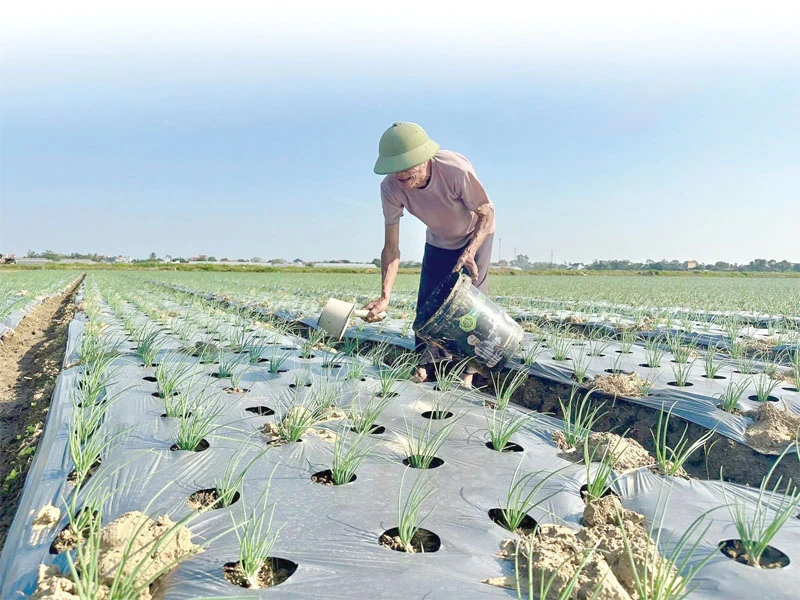
Residents of Ho Vuong commune tend to their winter crops. Photo: Le Hoi
As a locality with a tradition of winter crop production, Xuan Lap commune planned to plant 1,120 hectares of various crops in the 2025-2026 winter season. However, the impact of Typhoon No. 10 in 2025, along with prolonged heavy rains, caused flooding in 300 hectares of winter crops such as chili peppers, sweet corn, commercial corn, and various vegetables, forcing farmers to replant. The damage was not limited to the cost of seeds, labor, and materials, but also resulted in a significant disruption to the planting schedule, a crucial factor for winter crops. According to Hoang Anh Viet, Vice Chairman of the People's Committee of Xuan Lap commune: "Due to the continuous and prolonged rain and storms during the winter crop season, the planting schedule for some key crops has been disrupted. Ensuring the planned targets for area, quality, and value of winter crops is extremely difficult. Therefore, the commune encourages people to plant flexibly and diversify other crop groups during the winter season to ensure the planted area, paying particular attention to staggered planting of vegetables to reduce the phenomenon of both surplus and shortage in the market."
For the 2025-2026 winter crop season, the entire province aims to achieve a planted area of 46,000 hectares or more of various crops. The total value of winter crop production is targeted at 3,580 billion VND or more, averaging 77.8 million VND/hectare or more. According to the planting schedule and crop variety structure, warm-loving crops will be planted early in the winter season, with planting completed before October 10, 2025; cold-loving crops will be planted after October 10, 2025, and potatoes will be planted between October 20, 2025 and November 15, 2025. However, according to the Department of Agriculture and Environment, as of December 3, 2025, the total planted area of winter crops in the province is 33,680 hectares out of 46,000 hectares, reaching 79.7% of the plan. Specifically, corn accounts for 9,360 hectares out of 14,000 hectares, reaching 66.9%; peanuts 1,092 hectares out of 1,400 hectares, reaching 78%; sweet potatoes 1,199 hectares out of 1,700 hectares, reaching 70.5%; vegetables and legumes 17,020 hectares out of 23,000 hectares, reaching 74%; and other crops 5,013 hectares out of 5,900 hectares, reaching 85%...
The agricultural sector attributes the delay in planting the 2025-2026 winter crop to the impact of successive storms and heavy rains at the beginning of the season, which flooded and damaged many crops. The prices of agricultural inputs remain high, leading to increased production costs. Small-scale, fragmented production is prevalent, and the participation of businesses in product distribution or investment in winter crop production is insufficient and weak. Large enterprises show little interest in investing in agricultural production due to low efficiency and high risks. There is a growing shortage of rural labor, while the winter crop planting season requires urgent attention, simultaneously harvesting autumn crops and planting winter crops. Farmers still lack the funds to invest in seeds, fertilizers, machinery, and labor. The unpredictable impact of climate change, extreme weather events causing production losses such as droughts, floods, severe cold, and frost, can occur at any time, affecting the morale of farmers during winter crop production. Pests and diseases always pose a potential risk of causing serious damage, such as: fall armyworm damaging corn; red spider mites and anthracnose damaging chili peppers; downy mildew and false downy mildew damaging melons, gourds, and pumpkins... reducing yield and production if not controlled promptly.
Despite this, people and localities in the province are still striving to overcome difficulties, adjust crop structures, apply techniques, and take advantage of favorable weather conditions to ensure planting targets are met. Many households have boldly switched to planting short-term crops that are easier to care for and less risky. Local authorities and the agricultural sector are also continuously monitoring the situation, providing technical guidance, and supporting areas with seeds and supplies that have suffered damage. It is hoped that with proactive and flexible efforts from the grassroots level, along with support from the agricultural sector, the 2025-2026 winter crop will still achieve the target in terms of area and yield, creating additional income for the people.
Lighthouse
Source: https://baothanhhoa.vn/nhieu-kho-khan-trong-san-xuat-vu-dong-271479.htm











![[E-Magazine]: The season closes the chapter on sources of love](https://vphoto.vietnam.vn/thumb/402x226/vietnam/resource/IMAGE/2025/12/12/1765547070855_e-magazine-mua-w1200t0-di2549d199d5153818t11920l1-mkl-014.webp)




















































Comment (0)