

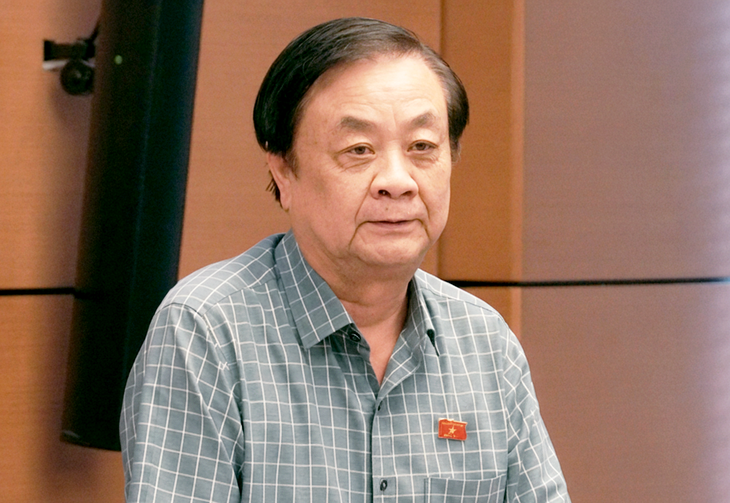
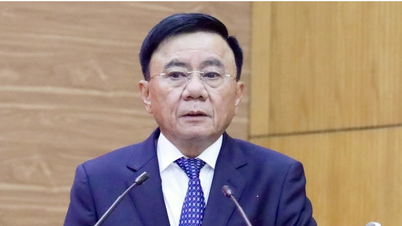
Deputy Speaker of the National Assembly Le Minh Hoan - Photo: NGOC AN
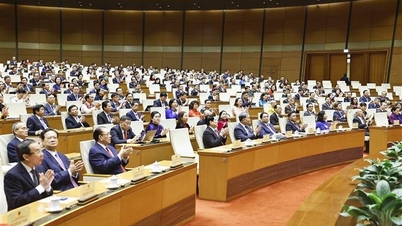
On the afternoon of October 22nd, the National Assembly held group discussions on the draft Law on Education and the draft Law on Vocational Education (amended), with the issue of recognizing vocational education as a level of education within the national education system being of particular interest to many delegates.
Representing the agency reviewing the draft law, delegate Nguyen Thi Mai Hoa, Vice Chair of the Committee on Culture and Society, stated that vocational education with the new model of apprenticeship helps address the great need of learners who do not meet the requirements for high school education.
Quality assurance for general education and vocational training.
Ms. Hoa argued that when identifying vocational training as a new model, the vocational training program needs to be structured in a way that ensures both foundational general education and vocational knowledge. At the same time, it's necessary to consider the university entrance requirements for vocational graduates, given the demand for higher-quality human resources in universities, especially in a society that still values academic degrees.
Representative Phan Van Mai, Chairman of the Economic and Financial Committee, argued that vocational training still has much room for improvement in labor productivity, and therefore it is necessary to build a vocational education ecosystem and clarify the relationship between vocational training institutions, businesses, and learners.
"In Ho Chi Minh City, the Polytechnic University can support mechanical engineering businesses in its area of expertise, and these facilities can serve as training grounds for the Polytechnic University. They can purchase hundreds of billions of dong worth of production equipment to use for both manufacturing and practical training, so the university doesn't need to incur these costs," he said.
Therefore, it is necessary to develop vocational standards based on international standards (ASEAN, OECD, etc.) to control the quality of training. Career guidance in high schools should be reviewed and reformed significantly, potentially including early career guidance in fields such as cosmetology.
"We need to strengthen career guidance in high schools, piloting groundbreaking career guidance and vocational training models. For example, in grade 10, students could learn skills in artificial intelligence or computing. In grade 11, they could learn more, specialize further, or have regulations on special, specific forms of vocational training," Mr. Mai stated.
University is not the only path.
Passionate about this issue, Vice Chairman of the National Assembly Le Minh Hoan recounted a story about a high school in Nam Dinh specializing in agriculture, which teaches using Japanese methods. He had visited the school three times to learn more about it. The school attracts many students from various places.
According to him, while there is now a mindset focused on high-quality human resources, there is sometimes confusion between high-quality education and higher education levels. Having worked in agricultural management and traveled to many localities, he observed that while we train many PhDs and engineers in crop cultivation and animal husbandry, the people actually working in the field are not trained farmers.
According to Mr. Hoan, it's not just about creating academic programs that match students' abilities, but in a transitional economy, there are many needs in the workforce hierarchy, from high-level, medium-level, to low-level.
In Vietnam, for the past several decades, the workforce pyramid has been reversed, with an oversupply of academics and a shortage of skilled workers. This is different from Japan, where localities with a shortage of manpower in a particular industry open academic programs specifically for that field.
According to the Vice Chairman of the National Assembly, after completing vocational training, students can become directors of cooperatives, owners of small farms, open homestays, or owners of agricultural product shops, etc. Importantly, all students are equipped with sufficient knowledge to practice their chosen profession. However, his concern is that implementing this model is not simple, given that society is accustomed to different ways of thinking and viewing vocational education.
"We honor great scientists, academics, professors, doctors, and engineers, but no one honors students studying at vocational schools. Even the scholarship program provides scholarships for poor students who overcome difficulties, but we never think about students studying vocational skills," the Vice Chairman of the National Assembly raised the issue.
Citing a similar situation in Singapore, Mr. Hoan said that they emphasize the most important thing: what profession one chooses to be a useful member of society. In contrast, in Vietnam, there are cases of people failing university entrance exams and feeling... socially isolated, thinking that vocational training is the only last resort.
According to him, university is not the only path; there are many other options such as continuing education at higher levels or vocational training. The important thing is to change mindsets.
Based on the model of Nam Dinh province, Mr. Hoan believes that technical high schools have very important goals, missions, and significance. Therefore, he hopes that this amendment to the law will help resolve operational obstacles for vocational schools and technical high school models, contributing to increased labor productivity and creating knowledgeable workers.
Back to the topic
NGOC AN
Source: https://tuoitre.vn/ong-le-minh-hoan-cac-chuong-trinh-hoc-bong-cho-hoc-sinh-ngheo-co-huong-den-nguoi-hoc-nghe-khong-20251022173848231.htm


























![[Image] Close-up of the newly discovered "sacred road" at My Son Sanctuary](/_next/image?url=https%3A%2F%2Fvphoto.vietnam.vn%2Fthumb%2F1200x675%2Fvietnam%2Fresource%2FIMAGE%2F2025%2F12%2F13%2F1765587881240_ndo_br_ms5-jpg.webp&w=3840&q=75)


















































Comment (0)