

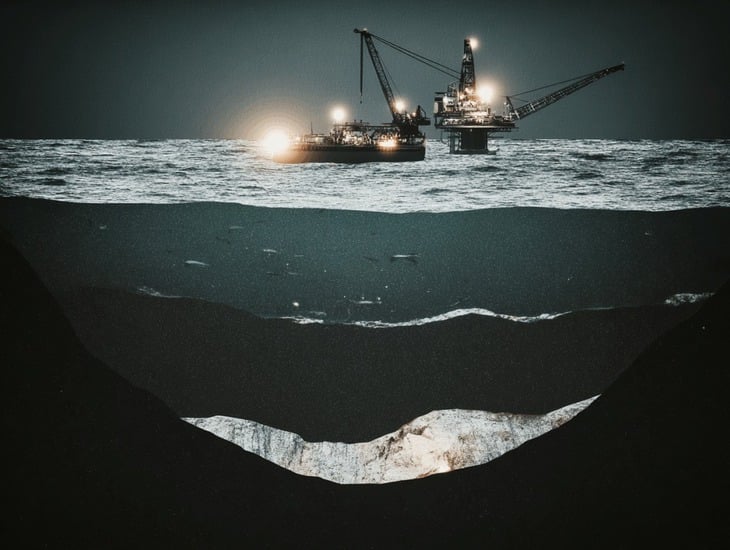
The discovery of a "freshwater treasure" at the bottom of the Atlantic Ocean opens up new horizons for geology , hydrology, and resource management - Photo: ZME Science/Midjourney
A team of international scientists has just announced a groundbreaking discovery: a massive freshwater aquifer lies deep beneath the Atlantic Ocean, stretching along the East Coast of the United States, from New Jersey to Maine.
This is considered one of the most important geological discoveries in decades, opening up hope for a valuable resource in the context of the world facing an increasingly severe freshwater crisis.
A half-century journey to find the "freshwater treasure"
Nearly 50 years ago, during a mineral exploration off the coast of northeastern America, a U.S. government research vessel unexpectedly discovered traces of freshwater deep beneath layers of marine sediment.
Based on that clue, this summer, the international science project Expedition 501 officially began drilling directly on the Atlantic seabed, off the coast of Cape Cod.
Expedition 501 is a $25 million collaborative science project involving more than 12 countries and supported by the U.S. National Science Foundation and the European Union.
In this project, scientists collected more than 50,000 liters of water samples from a depth of nearly 400 meters below the seabed, confirming the existence of a massive freshwater aquifer system hidden beneath the saltwater layer.
"This is just one of many 'secret freshwater treasures' that we've never accessed before," said Dr. Brandon Dugan, a geophysicist and hydrologist at the Colorado School of Mines and co-lead researcher. "One day, they could play a crucial role in saving humanity from the freshwater crisis."
"The sea has fresh water": a scientific mystery gradually being revealed.
Water samples showed salinity levels of only 1-4 parts per thousand, significantly lower than the average 35 parts per thousand of seawater. This suggests that the majority of this water reservoir did not originate from the sea, but may be meltwater from ancient ice ages, groundwater seeping through geological layers, or a combination of both.
The research team will analyze the DNA of microorganisms, mineral composition, and radioactive isotopes in the water to determine the age of the water reservoir. This will help to determine whether it is a renewable water source or a pristine water source that has been "isolated" for thousands of years.
If the water is young, it means that this water reservoir is likely still being replenished by rain or melting ice. This means it could be a sustainable resource.
Hopes and challenges for a thirsty world.
According to a United Nations report, global freshwater demand could exceed supply by up to 40% in the next five years. Meanwhile, rising sea levels, climate change, and industrial activities are causing increasingly severe salinization of coastal waters.
Notably, data centers serving AI and cloud computing are consuming water at an insatiable rate. In Virginia alone, 25% of the state's electricity is used for data centers, a figure projected to double in the next five years. A medium-sized data center can currently consume the same amount of water as 1,000 households.
In this context, the vast freshwater reserves at the bottom of the Atlantic Ocean could be a future savior. However, exploiting this water source raises many complex questions: Who will own and manage this resource? How can it be exploited without harming the marine ecosystem? Is there a risk of "draining" the freshwater, causing an imbalance in the seabed ecosystem?
"We need to be extremely cautious. If we exploit it on a massive scale, there will be unpredictable consequences," warned Dr. Rob Evans, a geophysicist at the Woods Hole Oceanographic Institution.
Scientists believe that if the freshwater reservoir at the bottom of the Atlantic Ocean were properly exploited, it could supply enough water for a large city like New York for 800 years. However, turning this potential into reality requires many more years of research, numerous safety tests, and close cooperation between governments, scientists, and conservation organizations.
Source: https://tuoitre.vn/phat-hien-chan-dong-ho-nuoc-ngot-lon-chua-tung-co-duoi-day-dai-tay-duong-20250910214939051.htm

![[Photo] Prime Minister Pham Minh Chinh holds a phone call with the CEO of Russia's Rosatom Corporation.](/_next/image?url=https%3A%2F%2Fvphoto.vietnam.vn%2Fthumb%2F1200x675%2Fvietnam%2Fresource%2FIMAGE%2F2025%2F12%2F11%2F1765464552365_dsc-5295-jpg.webp&w=3840&q=75)


![[Photo] Closing Ceremony of the 10th Session of the 15th National Assembly](/_next/image?url=https%3A%2F%2Fvphoto.vietnam.vn%2Fthumb%2F1200x675%2Fvietnam%2Fresource%2FIMAGE%2F2025%2F12%2F11%2F1765448959967_image-1437-jpg.webp&w=3840&q=75)











































![[OFFICIAL] MISA GROUP ANNOUNCES ITS PIONEERING BRAND POSITIONING IN BUILDING AGENTIC AI FOR BUSINESSES, HOUSEHOLDS, AND THE GOVERNMENT](https://vphoto.vietnam.vn/thumb/402x226/vietnam/resource/IMAGE/2025/12/11/1765444754256_agentic-ai_postfb-scaled.png)















































Comment (0)