

On the afternoon of October 10th, the Central Ear, Nose, and Throat Hospital held a ceremony to celebrate its 55th anniversary (1969-2024). Minister of Health Dao Hong Lan attended to share the joy with generations of hospital staff and employees.
Fifty-five years ago, on July 14, 1969, Prime Minister Pham Van Dong signed Decision No. 111/CP establishing the Institute of Otolaryngology - the predecessor of the current National Otolaryngology Hospital. Over 55 years of development, from a facility with only 10 beds and nearly 30 staff members, the National Otolaryngology Hospital now has 320 beds and over 400 staff members. Inheriting and building upon the achievements and contributions of previous generations, the National Otolaryngology Hospital continues to develop and consistently lives up to its reputation as the leading hospital in the country for otolaryngology and head and neck surgery, earning the trust and high regard of patients.
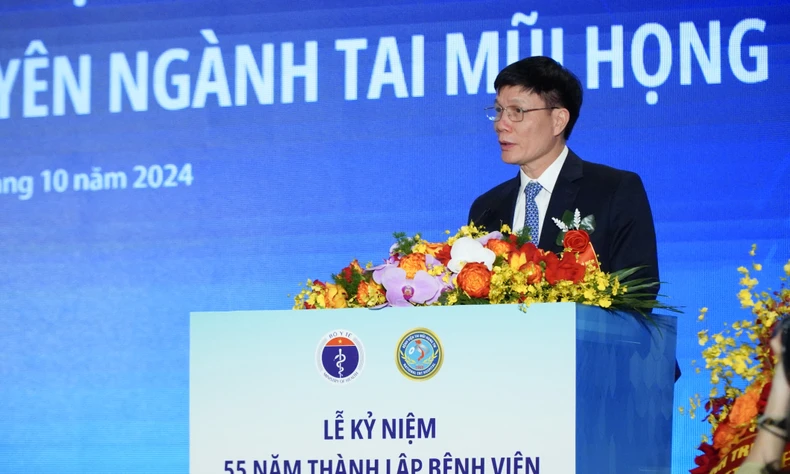 |
Associate Professor, Dr. Pham Tuan Canh, Director of the Central Ear, Nose and Throat Hospital, delivered a speech at the ceremony. |
Medical examination and treatment remains the most important task, with the number of patients seeking medical care constantly increasing. Over the past five years, overcoming the difficulties following the Covid-19 pandemic, the hospital has consistently strived to improve procedures, regulate medical examination and treatment activities, flexibly arrange examination rooms early, offer online appointment scheduling, reduce waiting times, and effectively meet the medical needs of the people.
In addition, the hospital is concerned about the rights of patients, aiming for patient satisfaction with the goal of "putting the patient at the center," placing the quality of medical services first.
Notably, the hospital consistently researches, develops, and updates new, specialized techniques, and applies cutting-edge techniques used for the first time in Vietnam. These include techniques to assist in the diagnosis and treatment of ear and vestibular diseases, and successful surgeries for many pathologies of the inner ear, cerebellopontine angle, and petrous bone. The hospital has successfully applied endoscopic surgery with navigation to treat recurrent nasal and sinus diseases, cerebrospinal fluid leaks after surgery, nasal and sinus tumors invading the skull base, and congenital nasal and sinus diseases in children such as brain and meningeal hernias. Emergency ENT conditions such as bleeding, respiratory distress, infection, and trauma have been promptly addressed, saving the lives of many critically ill patients upon admission.
In recent years, the hospital has invested in many devices to aid in the diagnosis and rehabilitation of speech, swallowing, and breathing; and in reconstructive and cosmetic surgery for congenital and acquired ear, nose, and throat conditions such as auricular hypoplasia, rhinoplasty, airway reconstruction, and reconstruction of head and neck defects. In particular, it has applied flap techniques in surgery for late-stage cancer… Many devices are available for early cancer diagnosis, and a comprehensive range of cancer treatments including surgery, radiotherapy, chemotherapy, and palliative care can be implemented… As a result, the hospital can receive and treat all ear, nose, and throat cancers, even in late stages that previously required referral to specialized oncology facilities.
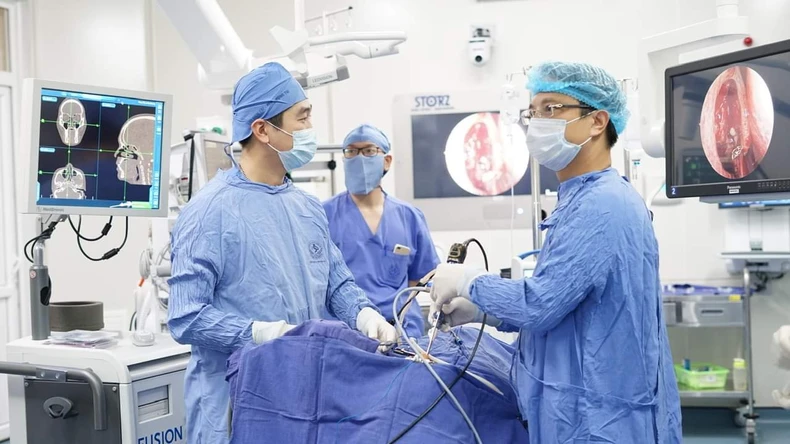 |
Doctors at the Central Ear, Nose, and Throat Hospital perform endoscopic sinus surgery using a navigation system. |
The Surgical Department has 10 modern operating rooms with an ever-increasing capacity, capable of performing 90 to 100 surgeries per day during peak periods. In addition, it has previously invested in advanced equipment such as: a 3D navigation system for endoscopic sinus surgery, a modern surgical microscope, a 64-slice CT scanner, a 1.5 Tesla MRI machine, and an Elektra linear accelerator for radiotherapy…
The National Ear, Nose, and Throat Hospital is the main practice facility of Hanoi Medical University; it collaborates with other medical and pharmaceutical universities and accepts students for internships and practical training. The hospital also places great emphasis on retraining and continuous education to improve the skills of ear, nose, and throat specialists nationwide. From 2019 to the present, the hospital has sent 92 doctors to transfer 56 techniques to doctors at provincial and regional hospitals such as Ha Giang , Hung Yen, Hai Duong, and Thai Nguyen… in endoscopic sinus surgery, laryngeal microsurgery, and emergency ENT procedures… contributing to improving professional skills and the quality of medical care at lower-level hospitals, creating favorable conditions for people to access medical care and reducing the burden on central hospitals.
Speaking at the ceremony, Minister of Health Dao Hong Lan congratulated the achievements of the team of doctors, medical staff, and workers of the Central Ear, Nose, and Throat Hospital. However, in the coming time, the health sector in general and the ear, nose, and throat specialty in particular will face difficulties and challenges; many difficult, rare, and unusual diseases will appear; the demand for high-quality medical examination and treatment from the people will increase; and technology and techniques will change rapidly…
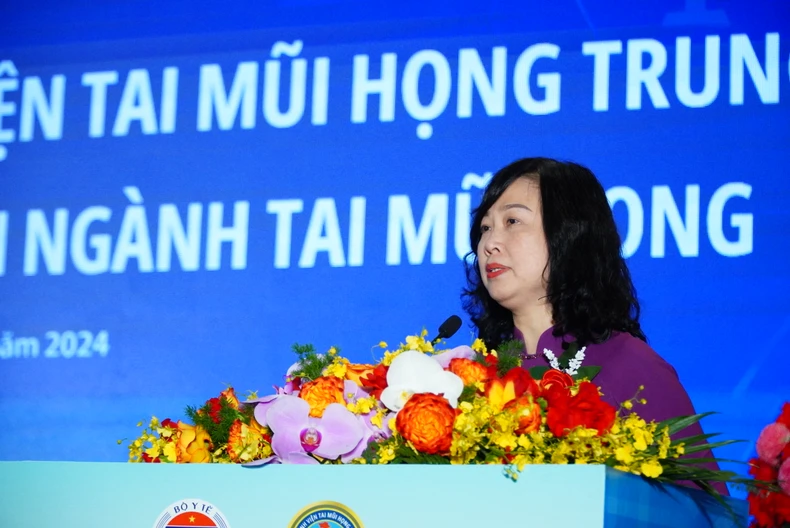 |
Minister of Health Dao Hong Lan delivered a speech at the ceremony. |
To enable the National Ear, Nose, and Throat Hospital to continue fulfilling its role as a leading hospital at the highest level in the ear, nose, and throat system, Minister Dao Hong Lan requested the Board of Directors and the entire hospital staff to effectively implement the health policies and guidelines issued in the past, especially the Law on Medical Examination and Treatment; Government Decree No. 96/2023/ND-CP detailing some provisions of the Law on Medical Examination and Treatment; and related guiding circulars of the Ministry of Health.
The hospital needs to continue innovating and improving the quality of medical examination and treatment, ensuring optimal use of medical supplies, equipment, and medicines to serve patients, and striving to provide the best possible experience for patients when they come to the hospital. It should also promote the specialization and professionalization of its medical staff, serving patients from the initial reception, admission, care, treatment, recovery, and follow-up care at home after discharge.
Simultaneously, we will strengthen the implementation of guidance and support for lower-level healthcare facilities, providing professional assistance and transferring technology to these facilities to gradually improve their capacity and quality of medical examination and treatment, thereby reducing the burden on higher-level facilities. We will continue to strengthen international cooperation to exchange expertise and technology, apply advanced science and technology in the implementation of new and specialized techniques, and conduct research and training of healthcare personnel.
On the other hand, it is necessary to stop applying information technology and digital transformation in the implementation of medical examination and treatment processes; cashless payments; telemedicine; and review and minimize administrative procedures that cause inconvenience to patients.
Source: https://nhandan.vn/phat-huy-tot-vai-role-la-benh-vien-tuyen-cuoi-dau-tau-trong-he-thong-tai-mui-hong-post836052.html


![[Photo] Prime Minister Pham Minh Chinh holds a phone call with the CEO of Russia's Rosatom Corporation.](/_next/image?url=https%3A%2F%2Fvphoto.vietnam.vn%2Fthumb%2F1200x675%2Fvietnam%2Fresource%2FIMAGE%2F2025%2F12%2F11%2F1765464552365_dsc-5295-jpg.webp&w=3840&q=75)






![[Video] National Assembly approves investment plan for Gia Binh International Airport to 5-star standard.](https://vphoto.vietnam.vn/thumb/402x226/vietnam/resource/IMAGE/2025/12/12/1765524874728_dung00-11-54-07still004-jpg.webp)






















































Comment (0)