

Successful household businesses are the main driving force for poverty reduction.
The movement "Farmers competing in excellent production and business, uniting to help each other get rich and sustainably reduce poverty" has become a prominent feature in the activities of the Hanoi Farmers' Association over the years. With the motto "each member is a creative entity," the Association at all levels has promoted the dissemination of information and encouraged members to innovate their production thinking, apply new technologies, and build economic models suitable to the conditions of each locality. As a result, to date, more than 283,000 farmer households across the city have registered as excellent producers and business owners, accounting for 64.6% of the total membership – a figure that clearly demonstrates the vibrant and widespread spirit of competition among the capital's farmers.

The efficient livestock farming model of Mr. Nguyen Trong Hieu's family in Bat Bat commune. Photo: Thanh Tuan
A prime example is the economic model of Mr. Nguyen Trong Hien, a farmer from Bat Bat commune. In 2008, when the market was still volatile, Mr. Hien boldly started his business on his homeland with a comprehensive economic model. Starting with a small initial capital, he invested in a livestock farming system, animal feed services, and transportation. Over the years, thanks to his mastery of new techniques and his willingness to take risks, the model has developed into a 4.2-hectare production area with a total investment of 10 billion VND. This includes a closed-loop system for raising over 300 breeding and fattening pigs, applying biotechnology to treat waste and ensuring environmental standards.
Not only is Mr. Hien a successful businessman, but he is also a pioneer in applying high technology to production, investing in cooling systems, electric fans, lightning protection, and backup generators worth over 300 million VND. In particular, his model of waste treatment using biological products and biogas helps save energy, reduce pollution, and contribute to sustainable development.
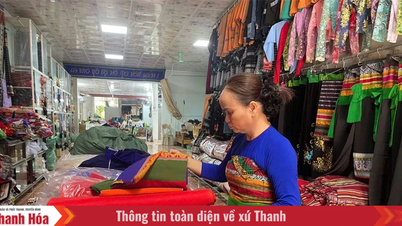
What is admirable is that Mr. Hien always considers his success to be linked to the overall development of the community. He provides animal feed to nearly 150 households in the surrounding area, offers technical guidance, shares disease prevention experiences, and even lends livestock to poor households on deferred payment terms. Thanks to this, many households have escaped poverty and have stable incomes. Besides livestock farming, he also opened an industrial garment factory with 60 sewing machines, creating jobs for 30 local workers with incomes of 7-10 million VND per month.

The garment factory owned by Mr. Nguyen Trong Hieu's family in Bat Bat commune provides employment for many local workers. Photo: Thanh Tuan
From 2021 to 2024, he was consistently recognized as an "Outstanding Household in Production and Business at the City Level," and received commendations from the Hanoi People's Committee. His example clearly demonstrates the effectiveness of the emulation movement, affirming the role of Hanoi's farmers in developing the rural economy while supporting each other to achieve sustainable poverty reduction and prosperity.
Mutual support – training – preferential capital: Three breakthroughs helping Hanoi farmers overcome difficulties and achieve sustainable wealth.
Over the years, alongside launching emulation campaigns for excellent production and business practices, the Hanoi Farmers' Association has always focused on practical support solutions to help its members develop their economy and achieve sustainable poverty reduction. Data from various levels of the Association shows that the scale and spread of the movement are increasingly widespread. At the central level, 860 households have achieved the title of excellent producers and business operators; at the city level, 5,120 households; at the district level, 48,068 households; and at the commune level, up to 229,230 households. The number of households registering to participate in the movement each year has consistently remained high: 266,484 households in 2023, 259,715 households in 2024, and 240,700 households in 2025. Following the year-end review, the entire city recognized 181,901 households as achieving the title of excellent production and business in 2023 and 129,862 households achieving the title in 2024. This is the core force creating new momentum for the rural economy of the capital city.

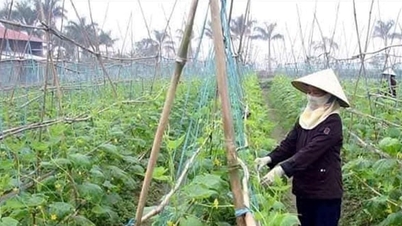
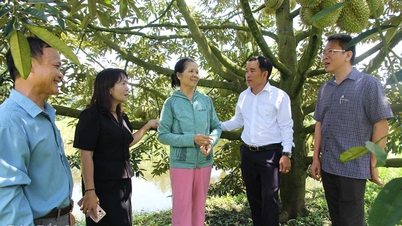
Farmers in Hanoi have been supporting each other, helping thousands of farmers escape poverty sustainably. Photo: Son Tung
A highlight of the movement is the spirit of mutual support and development. The various levels of the Farmers' Association mobilized members to provide 66,951 days of labor, donated 6,019 seedlings and livestock worth nearly 13.9 billion VND, and supplied 15,212 tons of fertilizer to farmers. Thanks to this direct assistance, 14,742 households escaped poverty, and many continued to prosper, becoming exemplary models at the grassroots level. In addition, Hanoi farmers contributed tens of billions of VND to social funds, supporting the construction of 212 charitable houses, houses of compassion, and farmers' homes with a total cost of over 3.4 billion VND, clearly demonstrating the community responsibility and profound humanitarian nature of the movement.
Alongside material support, vocational training and technology transfer have been identified as key solutions to help farmers improve their production capacity. Farmers' associations at all levels have proactively coordinated with the Hanoi Department of Agriculture and Environment, businesses, vocational training centers, and specialized institutes and universities to open training courses closely aligned with practical needs. Training methods are diverse, ranging from in-person learning, model-based learning, online learning, to study tours within and outside the city. In particular, the "hands-on" and "farmer-to-farmer" methods have helped trainees easily grasp and apply the knowledge, bridging the gap between theory and practice. After training, many members have started agricultural businesses in their localities, gradually mastering techniques, forming cooperatives and associations, increasing their income, and contributing back to the community.
Another important pillar is credit and capital support for farmers. The City's Farmers' Support Fund has been streamlined towards professionalism, transparency, and operation in accordance with regulations. The process of reviewing, disbursing, and recovering funds is strictly managed, with no bad debts or overdue loans occurring for many consecutive years. In line with the central and city's policy on organizational restructuring, on July 1, 2025, the city took over all district-level funds, totaling VND 158.97 billion, and transferred them to the City's Farmers' Support Fund for unified management. Currently, the Fund's capital stands at VND 844.699 billion, with a total outstanding loan balance of VND 555.534 billion. This is a crucial resource that helps tens of thousands of farmers access preferential loans to expand production.
Besides the Farmers' Support Fund, the Association also closely cooperates with the Social Policy Bank and the Agricultural and Rural Development Bank to implement preferential credit programs with convenient procedures. Many high-tech agricultural production models, agricultural product consumption chains, and circular economy models have been formed from these loans, contributing to the development of Hanoi's rural economy in a more efficient and sustainable direction.
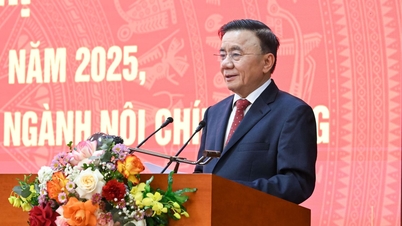
According to Pham Hai Hoa, Chairwoman of the Hanoi Farmers' Association, the achievements in the movement of skilled farmers in production and business and the sustainable poverty reduction program in recent times have affirmed the great efforts of the Association at all levels and the self-reliance and innovation spirit of farmers in the capital city. Ms. Hoa believes that the fact that tens of thousands of households have risen out of poverty, and many rural economic models have developed towards commodity production and the application of advanced technology… are the clearest evidence of the effectiveness of the "farmer-centered" approach, creating an important foundation for improving the material and spiritual lives of people in suburban areas.
Chairwoman Pham Hai Hoa emphasized that sustainable poverty reduction must shift from individual support to comprehensive support, linking livelihoods with vocational training, science and technology, preferential credit, and market linkages. Hanoi will continue to maintain the movement of skilled farmers in production and business as an important driving force, while strengthening the "farmers helping farmers" model to spread the spirit of mutual support and balanced development across regions. In addition, the Association will closely coordinate with the Department of Agriculture and Environment, businesses, institutes, and schools to provide in-depth vocational training, training tailored to market needs, focusing on high value-added fields such as digital agriculture, circular economy, urban agriculture, and deep processing.
Source: https://hanoimoi.vn/nong-dan-thu-do-chung-suc-thoat-ngheo-ben-vung-726557.html




































































Comment (0)