

On the evening of January 2nd, Mr. Nguyen Le Vu, Deputy Director of the Department of Culture, Sports and Tourism of Phu Yen province, announced that the Kala relief sculpture discovered at Ba Mountain (Phu Yen) has been recognized as a national treasure by Decision No. 1712/QD-TTg signed by Deputy Prime Minister Le Thanh Long.
The Kala relief is a work of stone sculpture art belonging to the Champa culture, discovered in 1993 in an excavation pit at the Nui Ba site, My Thanh village, Hoa Phong commune, Tay Hoa district (Phu Yen province).
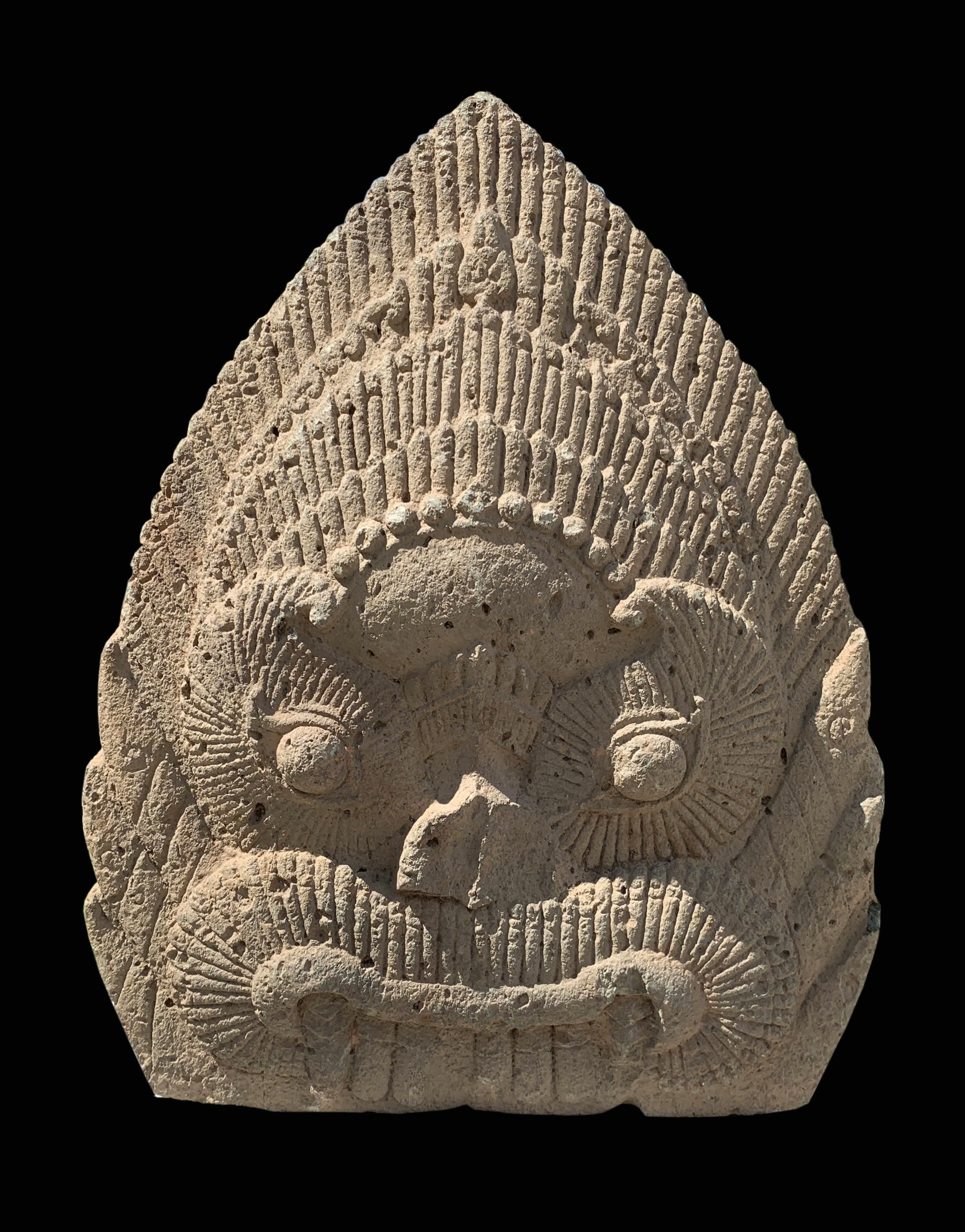
The Kala relief sculpture, discovered at Ba Mountain (Tay Hoa District, Phu Yen Province), has been recognized as a national treasure.
PHOTO: PHU YEN PROVINCE DEPARTMENT OF CULTURE, SPORTS AND TOURISM
The bas-relief, crafted from Triolitic Dacite stone, is 60 cm high, 44 cm wide at the base, 17 cm thick at the base, 11 cm thick at the top, and weighs 105.5 kg.
The Kala relief is carved on a flat, ear-shaped stone block with a pointed top. The front of the stone block depicts Kala's face looking straight ahead. Kala has a wide mouth with 88 large, long, raised teeth protruding outwards, including two canine teeth and six incisors; the two canine teeth on either side are longer and sharper. The upper lip is curved, and the whiskers around the mouth are thick and arranged in straight lines.
Kala has three short horns growing from the bottom on each side of its mouth. Its nose is large but broken, with a short, thick bridge. Its eyes are large, round, and protruding, with the outer corners slanted upwards. The eyelashes around its eyes are thick, with the ends curled into a spiral shape. Its forehead is prominent, adorned with a string of round beads. Its mane is thick, forming four layers. The back of its face is bare, showing traces of numerous chisel marks intended to flatten the surface.
After its discovery, the Kala relief was brought to the Phu Yen Provincial Museum for preservation and display. Based on research results, it can be confirmed that the Kala relief dates back to the 14th century and belongs to the Thap Mam sculptural style (also known as the Binh Dinh style).
























































































Comment (0)