

Expected to reach 4 million visitors per year.
The Vietnam Civil Aviation Authority has just submitted to the Ministry of Transport the master plan for Pleiku Airport for the period 2021-2030, with a vision to 2050.
According to the Vietnam Civil Aviation Authority, under the master plan for the development of the national airport system for the period 2021-2030, with a vision to 2050, approved by the Prime Minister, Pleiku Airport is projected to reach a designed capacity of 4 million passengers per year by 2030. Further expansion is planned to reach 5 million passengers per year by 2050.
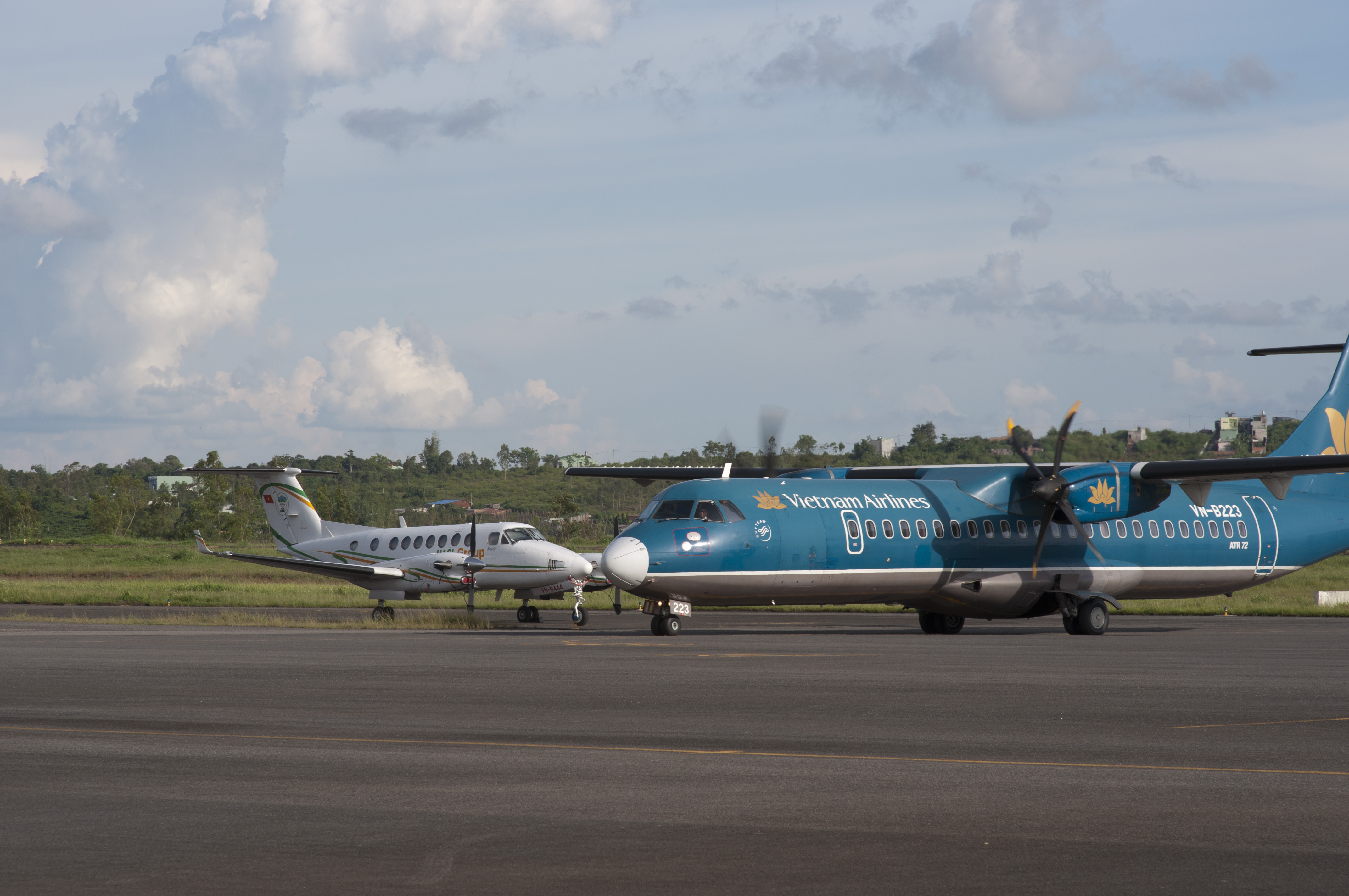
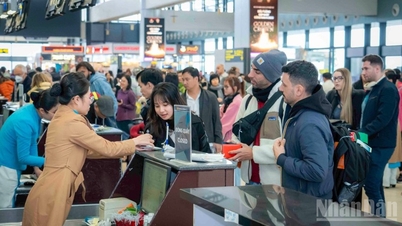
According to the master plan for 2030, Pleiku Airport will have a capacity of approximately 4 million passengers per year. (Illustrative image).
To ensure that the Pleiku Airport master plan (which has specialized technical characteristics) is consistent with the national master plan for the development of the airport system, it is necessary to review and adjust the Pleiku Airport master plan.
Pleiku Airport, located in Thong Nhat Ward, Pleiku City, Gia Lai Province, is currently a 4C-class airport. It has a single runway 2,400m long and 45m wide, and five aircraft parking positions capable of handling Airbus A320, A321, and similar aircraft. The passenger terminal currently covers over 3,100m² and has a capacity of 600,000 passengers per year.
According to the Vietnam Civil Aviation Authority, the Pleiku Airport Master Plan for the period up to 2020, with a vision to 2030, was approved by the Ministry of Transport in 2010. After more than 10 years of implementation, many targets and parameters have been achieved, and some infrastructure has reached its capacity limit, requiring a new plan with a longer planning period.
In recent years, Pleiku Airport has experienced very rapid growth, with some key infrastructure components becoming overloaded and the volume of operations exceeding previous forecasts (in 2019, Pleiku Airport handled 726,526 passengers/year).
Some existing airport facilities do not meet the operational safety standards of the International Civil Aviation Organization (ICAO) (such as the distance between parallel taxiways and runways, aircraft parking areas relative to runways, etc.).
Therefore, it is necessary to review and update the Pleiku Airport master plan to ensure compliance with ICAO operational safety standards, convenience in operation, and long-term development.
The planning for Pleiku Airport for the period 2021-2030, with a vision to 2050, is considered necessary to ensure consistency with the overall national airport and airfield development plan for the period 2021-2030, with a vision to 2050, and to meet the requirements of socio-economic development, national security and defense, and the growth of the aviation industry.
More than 383 hectares of land are needed for the planned Pleiku airport.
According to the plan, Pleiku Airport will be a domestic airport, used jointly by civilian and military personnel.
Regarding planning objectives, the Civil Aviation Authority proposes that, during the period 2021-2030, Pleiku Airport be a 4C-class airport (according to the International Civil Aviation Organization (ICAO) standard code) and a Class II military airport. Its capacity will reach 4 million passengers per year and 4,500 tons of cargo per year. The airport will have 14 aircraft parking positions and will operate A320/A321 aircraft and equivalent or smaller aircraft.
By 2050, Pleiku Airport is envisioned to have a capacity of 5 million passengers per year and 12,000 tons of cargo per year. It will have a total of 18 aircraft parking positions, accommodating A320/A321 aircraft and smaller or equivalent types.
Regarding the runway system, by 2030, the planned runway will be oriented 09-27, with dimensions of 3,000m x 45m (extending the existing runway 27 by an additional 600m), and a 7.5m wide paved shoulder, ensuring efficient commercial operation of Code C aircraft and equivalents. The current status will remain unchanged until 2050.
Regarding the taxiway system, by 2030, a new parallel taxiway will be planned, located approximately 172.5m north of the runway; seven connecting taxiways will be built from the runway to the parallel taxiway, and two connecting taxiways will be built from the parallel taxiway to the aircraft parking apron. Additionally, two rapid exit taxiways will be planned to ensure that landing aircraft can quickly exit the runway. The taxiways will be 18m wide, with 3.5m wide paved shoulders on each side.
The vision for 2050 includes adding another taxiway from the parallel taxiway to the aircraft parking apron, with a width of 18m and a 3.5m wide paved shoulder on each side. In addition, a comprehensive system of facilities and technical infrastructure will be constructed to ensure flight operations alongside the runway.
The plan also includes the construction of a new air traffic control tower and flight operations center on a plot of land approximately 10,000 square meters in size.
In addition to the main components, the plan also outlines aspects such as approach lighting systems, ILS landing support systems, meteorological areas, as well as general technical infrastructure, parking systems, power supply, lighting, water supply and drainage systems, etc.
Regarding aircraft repair and maintenance service facilities (hangars), in the period up to 2030, a location for constructing a hangar will be reserved in the A-17 development reserve land area, and the hangar and pre-hangar parking apron will be built simultaneously when needed.
For the repair and maintenance of aircraft and aviation equipment, a facility for repairing and maintaining aircraft and aviation equipment (off-campus parking garage) with an area of approximately 900 m2 and a matching road and yard will be constructed. The off-campus parking garage will be located on a plot of land with an area of approximately 4,000 m2.
The total planned area for the entire airport by 2050 is over 383 hectares.
According to the Vietnam Civil Aviation Authority, the Pleiku Airport Master Plan for the period 2021-2030, with a vision to 2050, was researched by a consulting unit based on statistical analysis of existing operational data from airports in Vietnam, economic growth data, tourism, trade and services, and other sectors influencing the development of civil aviation at Pleiku Airport.
In addition, the study also relies on the development planning orientations of various sectors, provinces, regions, and the entire country to research forecast data, serving as a basis for planning the scale of functional areas for the airport.
The chosen option has been thoroughly researched and advised, ensuring optimal planning of functional zones, cost savings in construction, and feasibility in investment and construction.
The proposal suggests that Pham Ngoc Thach Street (the main access road to Pleiku Airport) should have each lane 10.5m wide, sufficient for three lanes of traffic. A 10m wide median strip with trees should be placed between the lanes, and sidewalks 3m wide on each side should be provided.
Source: https://www.baogiaothong.vn/quy-hoach-san-bay-pleiku-den-nam-2030-don-4-trieu-hanh-khach-nam-192240820124315256.htm


![[Photo] Closing Ceremony of the 10th Session of the 15th National Assembly](/_next/image?url=https%3A%2F%2Fvphoto.vietnam.vn%2Fthumb%2F1200x675%2Fvietnam%2Fresource%2FIMAGE%2F2025%2F12%2F11%2F1765448959967_image-1437-jpg.webp&w=3840&q=75)
















































![[OFFICIAL] MISA GROUP ANNOUNCES ITS PIONEERING BRAND POSITIONING IN BUILDING AGENTIC AI FOR BUSINESSES, HOUSEHOLDS, AND THE GOVERNMENT](https://vphoto.vietnam.vn/thumb/402x226/vietnam/resource/IMAGE/2025/12/11/1765444754256_agentic-ai_postfb-scaled.png)













































Comment (0)