

If one day you find yourself in a very distant, unfamiliar place, suddenly hearing a lullaby, a folk song, and being surrounded by the colors of your national flag, you would surely be deeply moved and proud. Our delegation experienced that feeling, that sweet melody, when we visited and worked at the Camilo Cienfuegos Capdevila Cadet School, part of the Havana Military District - Western Army Group, Ministry of the Revolutionary Armed Forces of Cuba.
As soon as we arrived at the school gate and stepped out of the car, we were greeted by the gentle sounds of traditional Vietnamese folk music. The Camilo Cienfuegos Capdevila Cadet School is located in the suburbs of Havana, amidst ancient trees and lush, fruit-filled gardens. The familiar sounds of folk songs about love for one's homeland and romantic love transported us back to the waterways of Southern Vietnam, where boats, three-leaf canoes, coconut-scented hair, checkered scarves, and the sound of the zither carried the voices of soldiers to battle with the ebb and flow of the tides. It was in this setting that we felt more strongly the harmonious blend of sentiment and ideal, of culture and revolution—something both Vietnam and Cuba cherish and preserve...
Major General Raúl Pérez Asvila, Commander of the Havana Military District, and Lieutenant Colonel Jorge Legrá Borges, the school's principal, greeted us. Major General Đoàn Xuân Bộ shook hands with Major General Raúl Pérez Asvila and sincerely expressed:
- Southern Vietnamese folk music is a cultural heritage of the Southern region, the cradle of revolutionary traditions, the land of the Fatherland, leading the way in the national liberation wars and the reunification of Vietnam. Thank you, comrades, for giving us a familiar feeling, as if we were in our homeland!
Major General Raúl Pérez Asvila replied:
- The patriotic spirit of the Vietnamese people is forged from the nation's long-standing historical and cultural traditions. We always regard Vietnam as a symbol of willpower, resilience, and an indomitable fighting spirit, and we use that as a lesson for generations of students in schools like ours...
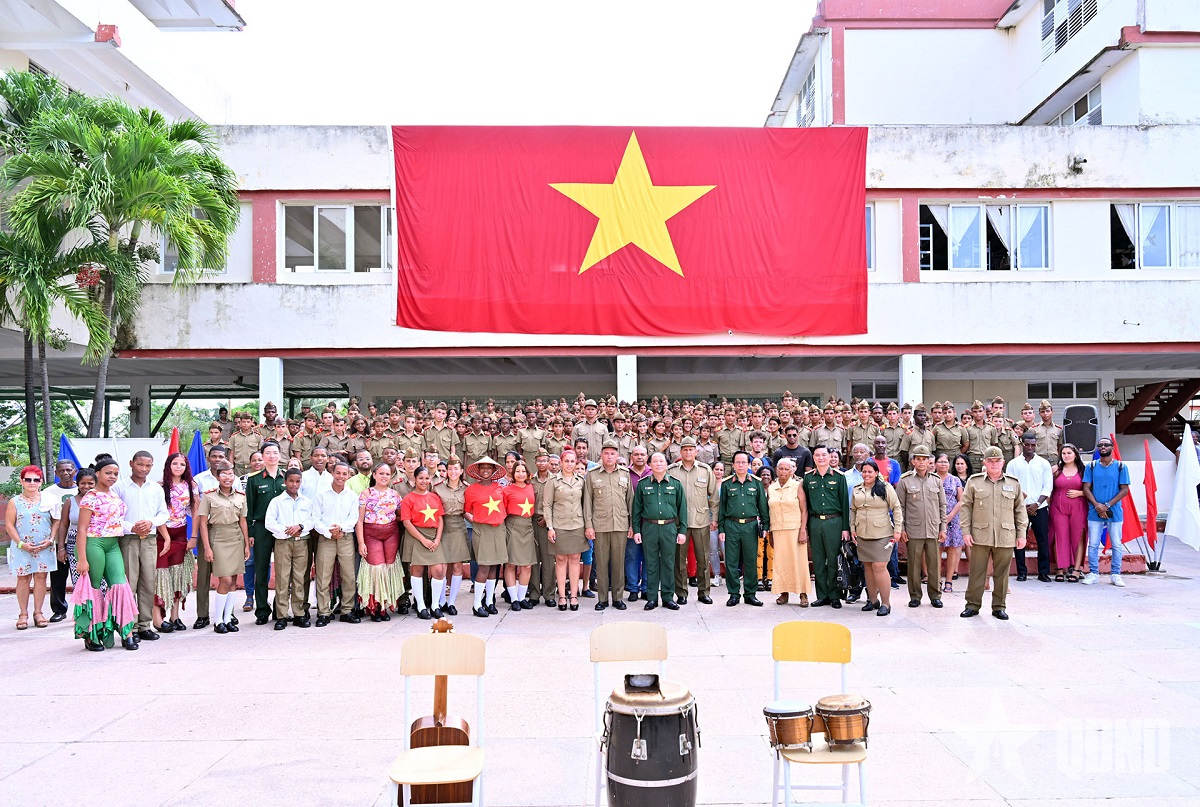
We entered the school. On the main platform in the spacious courtyard, a large Vietnamese flag, dozens of square meters in size, stood out. The solemn and dignified appearance of the Vietnamese national flag evoked a strangely sacred feeling. The flag symbolizes the sacred love for the homeland and immense national pride. In any circumstance, its appearance provides a tremendous source of spiritual motivation. And at this very moment, the image of the Vietnamese flag appearing in the most solemn place in the barracks of a foreign military unit stirred a powerful surge of emotion and pride. We silently thanked our comrades and close brothers for their respectful, sincere feelings and the subtlety in their diplomatic culture. Beneath the shadow of the flag and on either side of the platform, groups of officers, soldiers, and cadets in neat uniforms stood at attention, saluting to the stirring sound of drums and music...
Visiting a biology class in the specialized classroom, we were very impressed by the visual teaching methods and techniques used. Animals, medicinal plants, and vegetables from the plant ecosystem were created using stuffed animal techniques and simulations, helping students study and develop survival skills in challenging situations. “We are trained in survival skills so that even if we get lost in a deep forest or on a deserted island, we can still turn readily available natural resources into food and medicine to preserve our lives and maintain our fighting strength,” one student explained about the visual teaching tools.
|
The delegation from the People's Army Newspaper and the officers, teachers, and students of the Camilo Cienfuegos Capdevila Cadet School under the banner of the national flag. Photo: TRONG HAI |
In a conversation with us, Major General Raúl Pérez Asvila reiterated President Ho Chi Minh's testament: "Cultivating a revolutionary generation for future generations is a very important and necessary task," emphasizing the goals and training requirements of the Cadet School model. Accordingly, in the education and cultivation of revolutionary ideals for young people, Cuba prioritizes training from the grassroots. Lieutenant Colonel Jorge Legrá Borges, the school's principal, further stressed: "We train students for holistic development, cultivating knowledge, courage, patriotism, and the ability to adapt to all challenges, so that they may later become cadres and officers serving the Fatherland and the people."
The Camilo Cienfuegos Capdevila School is part of the Cadet School system founded by General Raúl Castro in 1966. For more than half a century, these schools have produced generations of outstanding officers who have made excellent contributions to the building and defense of the Fatherland, protecting the achievements of the Cuban revolution, and fostering international friendship and solidarity.
From the cradle of the Cadet School system, many officers have matured and developed, becoming high-ranking commanding officers in the main units of the Cuban Revolutionary Armed Forces. The 1011th Tank Division, known as the "Steel Fist" in the history of the Cuban Revolutionary Armed Forces' struggle to defend the Fatherland and fulfill international obligations, is one such exemplary unit. Many high-ranking officers and commanding officers in the Division's agencies and units throughout various periods were educated, trained, and matured from the cradle of the Cadet School system. Once holding important responsibilities in their units, they continued to pass on their revolutionary spirit and nurture the next generation...
During our visit to the 1011th Tank Division, we were guided on a tour of the museum, which includes an outdoor exhibition area and a traditional hall managed and accessed using digital platforms. Comrade Neil Sarmiento Reinaldo, museum manager of the 1011th Tank Division, meticulously introduced us to the tanks that contributed to the glorious victories in the revolutionary cause of the Cuban people and revolutionary armed forces. In the traditional hall, valuable documentary films about the 60-year history of building, fighting, and maturing, along with historical documents and artifacts from various periods, clearly depicted the stature and combat readiness of the unit. Through our conversation with Colonel Robendo Navarro Cabneja, Commander of the 1011th Tank Division, we clearly saw the similarities in the education, training, and combat readiness of our unit with units in the Vietnam People's Army. Here, political and ideological education for officers and soldiers always begins with the foundation of history and tradition. Before a soldier places their finger on the trigger and aims their gun at the target, they already possess in their heart and mind a spirit of dedication and sacrifice. And this source of strength is constantly nurtured and developed. This helps explain why, in the context of countless socio-economic difficulties, the revolutionary armed forces of Cuba never neglect or underestimate the task of training and combat readiness. From the traditional exhibition room to the lecture halls and training grounds... within the barracks of the 1011th Tank Division, there is a continuous and comprehensive process of education and training for the trainees. The division's base is also a solid, deep defensive fortress on the coast. Tank soldiers are not only thoroughly trained in tank combat skills but also proficient in the use of anti-tank weapons, ready to maneuver and adapt to various combat situations. Having directly witnessed the unit's martial arts training and live-fire exercises on the training ground, where the tank soldiers successfully destroyed targets with the first shot, we were truly impressed by their spirit, willpower, and courage.
On the training ground of the 1011th Tank Division, there is a sacred space displaying a large stone along with an image of leader Fidel Castro. It is a memento commemorating that, during his lifetime, the great leader of the Cuban people once visited this place, directly inspecting the training of the soldiers and urging them to fight for their country. Today, amidst numerous difficulties and challenges, his image and ideology continue to shine brightly like a red flag, guiding the entire Cuban nation to overcome hardships and uphold the achievements of the revolution with the spirit of "Homeland above all." Suddenly, the verses from over six decades ago by the poet To Huu resonate even more deeply: "Here is Cuba, shining with the red flag / Cuba marches forward on the ocean waves / Majestic like the battleship Aurora!"
Source: https://www.qdnd.vn/phong-su-dieu-tra/phong-su/song-cung-dao-lua-dao-say-ky-2-duoi-bong-dai-ky-954727






























































Comment (0)