

In Singapore , Shannon Lim quit her office job to become a farmer in 2011. She runs a seafood farm, grows vegetables, and offers classes on crab farming at home.
Imagine you're preparing a seafood dinner at home, but instead of buying crab from the market, you can simply grab one from a mini-farm in the corner of your kitchen. This is the vision of "urban farmer" Shannon Lim, 37, for her students.
Lim, the founder of OnHand Agrarian, organizes home-based food cultivation classes in Singapore, including a course on raising sea crabs. For S$680 (US$510), students participate in a 10-hour, two-day course, which includes the cost of building a "crab apartment" and transportation. Students can bring friends if the class size is not too large.
The "crab apartment" is a modified seven-tiered plastic storage unit. It contains water and is equipped with a pump and filter for the crabs to live in. Additionally, it includes a UV sterilizer and algae that decompose organic waste, preventing unpleasant odors.
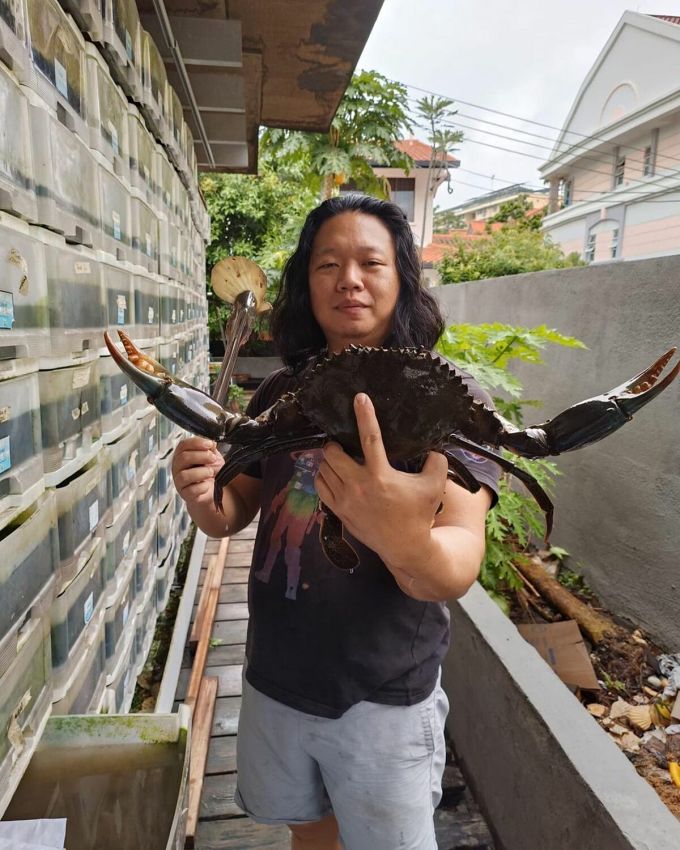
Shannon Lim holds her pet crab next to the "crab apartment complex" on the left. Photo: Instagram your_friendlyfarmer
Each crab is raised in a separate compartment, weighing from a few hundred grams to nearly 2 kg or sometimes more. The crabs that come in are small or thin because shops have been raising them for a long time and, due to lack of customers, have to sell them at a low price. "Then we start fattening them up again," he said.
Lee Ray Sheng, 24, first learned about crab farming in boxes a few years ago when he visited another farm. A few months ago, he stumbled upon a video of Lim's class on social media and signed up to participate.
"First of all, I love eating crab. Secondly, I definitely love raising crabs and eating them," he explained his reason for taking the course. He brought home palm-sized crabs from the class and estimated they had grown by about 50% in two months. "Crabs eat everything, so the easiest way is to go to a fishmonger and ask for some fish," Lee said. A passionate kayaker, Lee also collects shellfish from floating safety barriers off the coast of Singapore to feed the crabs.
Lim has taught around 50 students how to raise crabs since before the pandemic and wants to encourage more Singaporeans to become "urban farmers." One piece of advice he offers is not to name the crabs if you want to eat them, to avoid forming attachments. "I want to see more Singaporeans become food-self-sufficient because we are too dependent on Malaysia," he said.
Before becoming a farmer, Shannon Lim was an office worker in financial planning and market research. In 2011, with S$160,000 (over US$120,000) in hand, Lim quit her job to start a farming startup.
According to Temasek, Lim designed the first "Integrated Multinutrient Recirculating Aquaculture System" (IMTRAS) to recycle waste from one organism into food for another. OnHand Agrarian's goal is to produce cheaper and more sustainable seafood using basic science without disrupting the marine ecosystem.
Lim's farm started raising about 2,000 ornamental and edible fish, such as grouper, in his backyard in Changi using the IMTRAS system. Without a license to sell them, he gave the fish away to friends and neighbors.
Two years later, OnHand Agrarian's operations became more professional. They had a raft farm near Pulau Ubin island off the northeast coast of Singapore, about a 5-minute boat ride from Lorong Halus pier on the mainland.
The floating farm is one of three operating locations for OnHand Agrarian. Regarding crabs specifically, Lim started raising them in plastic containers around 2016, but that wasn't his invention. Years ago, he saw a post on a forum about raising crayfish in plastic containers and adapted the method to raise crabs.
Besides offering crab farming classes, OnHand Agrarian is also raising 200 crabs for clients. His home farm also raises some fish, ducks, and various vegetables. Lim has also undertaken projects to help hotels, schools, and individuals establish farming systems.
For those who don't want to do it themselves, Lim offers seafood and vegetables on a subscription-based package. The standard package costs S$180 (US$136) per month, for 10 kg of seafood and vegetables, divided into two deliveries.
Lim's passion for farming stems from stories his grandparents told him about World War II, which helped shape his thinking about food security. "It influenced my view that we should be a little more prepared for the strange things that might happen," he said.
Lim has big dreams for home-based crab farming. He hopes more people will learn how to raise crabs and that Singapore will have its own crab hatchery. Crabs cannot mate and reproduce in a caged environment. Therefore, the hatchery can supply young crabs to farmers for rearing.
Explaining his focus on crabs, Lim said that many Singaporeans enjoy eating crab, and cleaning and preparing them is easier than scaling or filleting fish. Shrimp and fish can also live in burrows, so Lee plans to research and perfect the method of raising them in boxes like crabs. "If possible, I would also love to raise lobsters," Lim said. However, he added that raising lobsters at home is much more difficult because their living environment requires more meticulous control.
Phiên An ( according to CNA, Temasek )
Source link






















![[Photo] Prime Minister Pham Minh Chinh holds a phone call with the CEO of Russia's Rosatom Corporation.](/_next/image?url=https%3A%2F%2Fvphoto.vietnam.vn%2Fthumb%2F1200x675%2Fvietnam%2Fresource%2FIMAGE%2F2025%2F12%2F11%2F1765464552365_dsc-5295-jpg.webp&w=3840&q=75)












































Comment (0)