

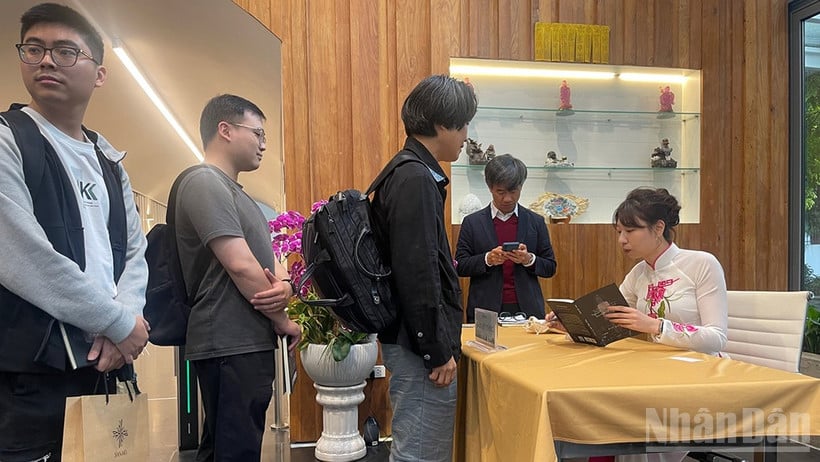
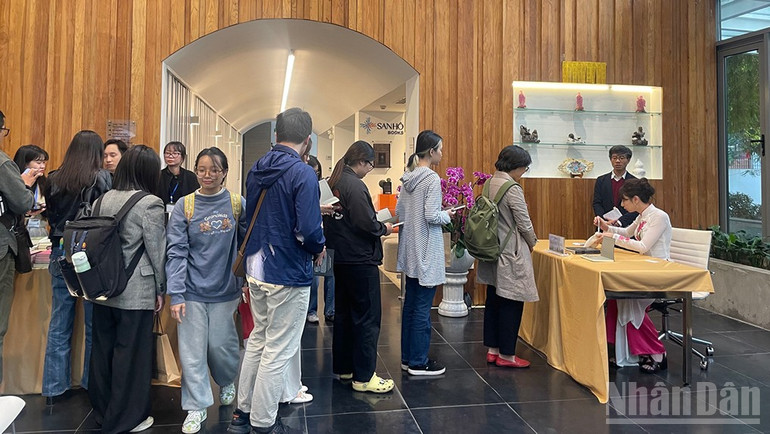
At the meeting with Hanoi readers on the occasion of the publication of the book “Tokyo Tower of Empathy” in Vietnam, organized by the Japan Foundation Center for Cultural Exchange in Vietnam (International Exchange Fund) in collaboration with San Ho Books, Rie Qudan wore a white ao dai with pink lotus patterns, making her look no different from a Hanoi girl.
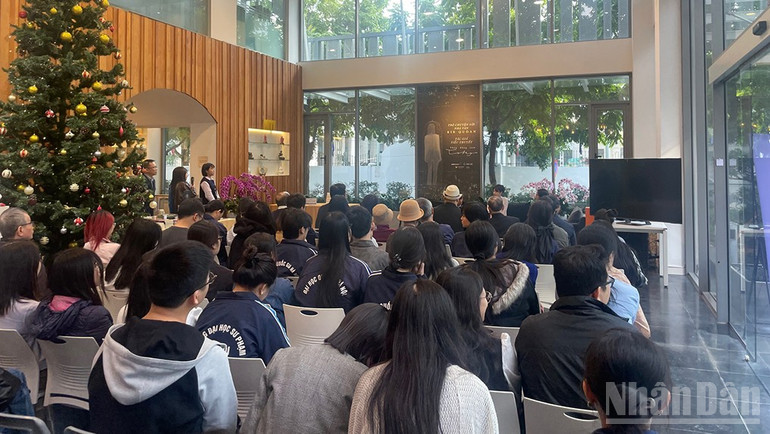
Readers attending the event to meet and chat with the female writer were mostly young readers, many of whom were students, and some of whom were nurturing the dream of writing.
Rie Qudan is one of the prominent figures in contemporary Japanese literature, widely known as the author who won the Akutagawa Prize, one of Japan's most prestigious literary awards.
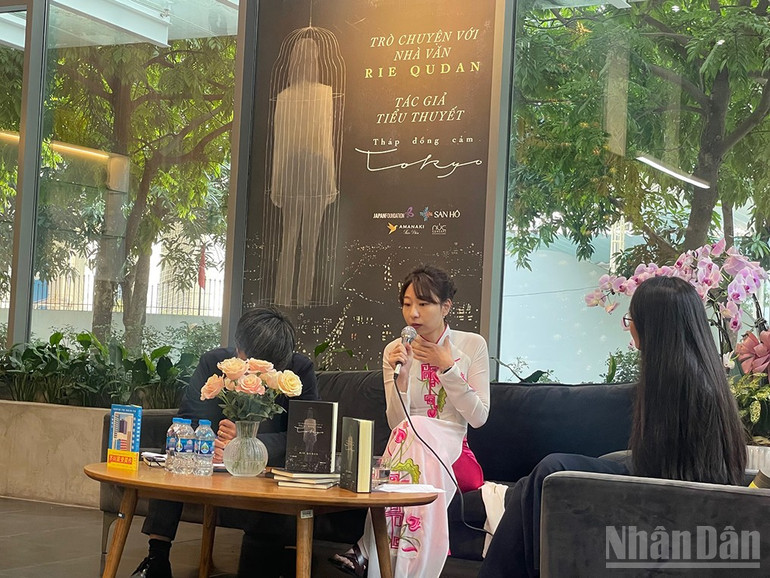
She is highly appreciated for her unique storytelling style, which comes from her ability to observe society with a sharp eye. The world she depicts often has hidden tension behind a calm tone, with deep layers of loneliness and multi-layered emotions evoked from very ordinary details, thereby giving readers strong discoveries and empathy. Although only a young writer, Rie Qudan has quickly become a potential writer opening new horizons for contemporary Japanese literature.
“Tokyo Tower of Empathy” is the book that won the Akutagawa Prize, and also caused a stir in the Japanese literary world when author Rie Qudan said that she used about 5% of the content from artificial intelligence (AI) in the writing process.
Set in Tokyo, Japan, “Tokyo Tower of Empathy” is a delicate portrayal of the oscillations between individual life and the cracks of modern society. The work suggests the invisible distance between people, the boundaries that silently form in communication, and the possibility of empathy in an increasingly complex world.
The work revolves around the life of female architect Sara Machina, who was a victim of violent crime. Sara was assigned to design a tower for convicted criminals. The tower is a symbol of the humane spirit of Japanese society when it imprisons criminals with sympathy, giving them a relatively comfortable life.
The Akutagawa Prize jury called it a work that “crosses genre boundaries,” part novel, part linguistic and philosophical experiment in the age of AI. Western readers saw it as a chilling prophecy of a society where people are losing the ability to understand each other even as language remains intact.
Sharing about the process of using AI in her writing, Rie Qudan said that the 5% AI figure in the book "Tokyo Tower of Empathy" was just her personal estimate, and she did not expect this to attract so much attention from people.
In the book, Rie Qudan used ChatGPT to name the tower and was given 7 names, but ultimately did not use them. The author also said that sometimes she asked the AI to output a paragraph that she wanted, and if she was not satisfied, she would ask the AI to redo it.
Rie Qudan also shared that she was commissioned to write a short story called “Rain and Clouds” which used 95% of the results of AI. “After closing this project, in the summary, we came to the conclusion that AI tools could not overcome the limits in the field of writing, that is, 100% AI. There are many explanations, but the key reason is that AI does not have the same intrinsic desire to write as humans” - the author shared.
According to Rie Qudan, humans have many desires, but the desire to create is a very different form. Until people analyze the process of human creative desire, AI will not be able to overcome the limits in the field of literary and artistic creation. "When the human creative process is analyzed and the model is put into AI, AI will begin to have an intrinsic desire, naturally liking to create, then it will be 100% able to create on its own" - the female author analyzed.
Rie Qudan also believes that, according to her, AI does not take away the identity of the writer, but for her, AI helps her understand herself better, understand what she wants in her writing, something that when writing, authors often do not pay attention to. Currently, many writers tend to use AI in their writing and do not lose their personal creativity.
Working with AI, Rie Qudan also feels more comfortable being served whenever she needs it, and not having to be reserved, not having to choose a language when communicating, being able to exchange freely and frankly, and having more opportunities to look deeper inside herself. These are the advantages of AI in writing that some writers today favor.
However, for Rie Qudan, AI is still just a useful tool in the creative process. AI cannot replace the intrinsic desires of humans, such as the desire to create, the desire to be recognized..., factors that contribute to the identity of the writer" - Rie Qudan said.
Source: https://nhandan.vn/tac-gia-nhat-ban-rie-qudan-ai-va-hanh-trinh-sang-tac-van-hoc-post927960.html


![[Photo] Cat Ba - Green island paradise](/_next/image?url=https%3A%2F%2Fvphoto.vietnam.vn%2Fthumb%2F1200x675%2Fvietnam%2Fresource%2FIMAGE%2F2025%2F12%2F04%2F1764821844074_ndo_br_1-dcbthienduongxanh638-jpg.webp&w=3840&q=75)



















![[Video] Prevent disease outbreaks after floods](https://vphoto.vietnam.vn/thumb/402x226/vietnam/resource/IMAGE/2025/12/04/1764833541876_720-jpg.webp)
















![[VIMC 40 days of lightning speed] Da Nang Port: Unity - Lightning speed - Breakthrough to the finish line](https://vphoto.vietnam.vn/thumb/402x226/vietnam/resource/IMAGE/2025/12/04/1764833540882_cdn_4-12-25.jpeg)













































Comment (0)