

South Korea hopes to boost tourism from the APEC conference.
In late October, an event attracting worldwide attention is the APEC Summit, which will take place in South Korea. Beyond high-level talks and economic initiatives, this summit is also seen as a fantastic opportunity for tourism in the host city – the ancient city of Gyeongju.
With a history spanning nearly 2,000 years and a former capital of a great dynasty, Gyeongju is now considered one of South Korea's top destinations for historical and cultural sites. Last year, the city attracted over 42 million domestic and international tourists. Consumer services in Gyeongju have also seen a growing number of foreign customers in recent years. City officials and residents alike are placing high hopes on promoting the city as an international destination following this APEC summit.
Kim Young-Hwan, a restaurant owner in Gyeongju, said, "I feel very proud that many world leaders will be coming to Gyeongju. It is a top historical site in Korea, and that attracts many tourists every year."
Mayor Joo Nak-Young of Gyeongju shared: "Gyeongju deserves to be called the Rome or Athens of Korea, with its incredibly rich myths and legends. If its diverse tourism and cultural infrastructure is developed, I believe the city will become a world-class tourist center."
The story of Gyeongju is just one of many examples of how countries, localities, or tourist destinations are seeking to capitalize on the economic, consumer, and tourism opportunities that come from hosting large-scale events. Looking at the success of some recent cultural, entertainment, and sporting events, this ambition is not without basis.
Over the past year, a term has become familiar to many major international newspapers: "Swiftonomics." This term refers to the sharp increase in consumer spending, such as on food and accommodation, at venues where American pop star Taylor Swift holds concerts. A Mastercard study showed that, in the US alone, sales at restaurants around Taylor Swift concert venues increased by an average of 68%, while accommodation sales increased by over 47%.
A more recent example is neighboring Singapore in Southeast Asia. Since 2008, the Lion City has been one of the venues for the Formula 1 World Championship. According to Singaporean officials, the F1 race has brought in 720,000 tourists and economic benefits totaling approximately US$1.7 billion for the country.
Countries invest in attracting events to boost consumption.
In China, not only are opportunities created by organizing events such as international sporting tournaments being seized, but many localities have also transformed these events into part of a well-planned campaign to stimulate consumer spending, thereby driving local economic growth.
Wuhan, Hubei province, has generated 694 million yuan, equivalent to 97 million USD, in sports-related consumer revenue since September. This figure represents a 30% increase compared to the same period last year, thanks to a series of vibrant international sporting events held locally, such as the 2025 Wuhan Open Women's Tennis Tournament.
Taking advantage of these sporting events, Wuhan also launched a series of consumer stimulus activities, including the Wuhan Festival and the distribution of 10 million RMB worth of vouchers for sports-related activities. These sports product promotion events attracted over 1.9 million visitors.
Ms. Wu, a tennis fan, shared: "Attending tennis matches not only allows us to cheer on our favorite athletes but also gives us the opportunity to learn about various products that interest us. In addition, there are interactive tennis-related games, which provide a very enjoyable experience."
Meanwhile, in Shanghai, the 2025 International Adventure Sports Festival took place in mid-October, attracting a large audience. In addition to sporting activities, the event featured games, food services, and a fair, bringing together over 220 brands and contributing to a complete "sports-infused lifestyle" consumer ecosystem.
Mr. Chen Anda, Deputy General Manager of Shanghai West Bund Development Company, commented: "Thanks to the competition and the rich series of cultural, commercial, sports, and tourism activities throughout the autumn, this area has truly become an ideal destination where culture, tourism, commerce, sports, and exhibitions blend perfectly."
Another strategy adopted by many localities in China is the ticket stub economic model, in which ticket stubs for sporting and entertainment events can also be used to receive discounts at restaurants, shopping malls, and tourist attractions.
One female visitor shared: "It feels like being at a festival. I came here to see the concert, but I can also discover new places to eat and shop, and visit the museum for free."
Data from travel service platforms shows that an event ticket based on this model not only saves travelers an average of 15 to 30% on costs but also stimulates secondary spending of 1.5 to 2 times the ticket price. This will be an effective solution for businesses to increase customer loyalty and maximize the economic potential of events.
Many countries, or even localities and tourist destinations, have invested heavily in attracting events. This investment isn't just about bringing events in, but also about maintaining regular and continuous organization to maximize economic benefits. For example, with the "ticket economy" model in China, following the success of the amateur football tournament in Jiangsu province, nine other provinces and cities in the country have also organized annual provincial-level amateur football tournaments combined with consumer stimulus programs.
Returning to Singapore, the country last year announced an exclusive deal with singer Taylor Swift, making it the only Southeast Asian destination for the American star's The Eras Tour, for an undisclosed sum. Singapore also spends over $100 million annually on its annual Formula 1 Grand Prix, with 60% of that funded by the government.
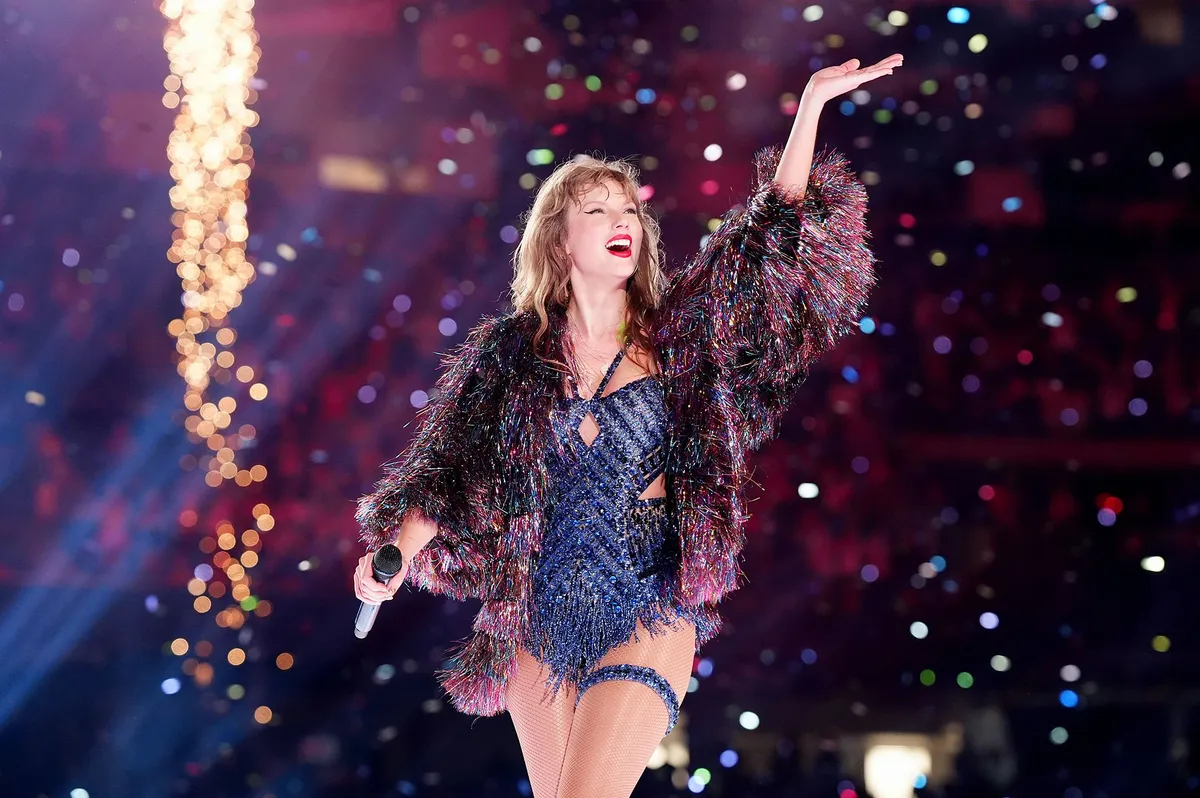
Taylor Swift's The Eras Tour in the UK last June caused inflation in the country's service prices to skyrocket to 5.7%.
The downside of boosting consumption through events.
However, investments in organizing events do not always yield great success. Besides the benefits for tourism and consumption, the "event economy" also has the potential for negative impacts on the local economy.
During the 2024 Olympic Games, many restaurant owners and taxi drivers in Paris, France, were anticipating a massive influx of tourists to boost their summer businesses. Instead, they found themselves facing significantly more difficulties.
Alain Fontaine, president of the French Association of Restaurant Owners, said: "Restaurant revenues in Paris have fallen by 20-30%. Areas near stadiums have seen a drop of 60-80%. My restaurant, for example, has lost about 21% during this period."
Taxi driver Lamia Toukabri shared: "A large number of taxis were mobilized because we expected a lot of tourists. But it turned out that the number of tourists was much lower; I lost 40-50% of my revenue, not enough to break even."
Despite high expectations, hosting the Olympic Games did not significantly boost economic and consumer activity in the City of Lights. According to experts, while the Olympics attracted a certain number of new tourists, this was offset by a decrease in regular visitors, who avoided Paris during the event. This is also the group that typically spends on consumer goods and services within the city.
Some recent major sporting events have also shown that their economic impetus is not as high as expected. For example, the Euro 2024 football championship in Germany is estimated to generate around €7.4 billion in revenue and a short-term growth of 0.1% – a figure not particularly large for Europe's leading economy. Meanwhile, many events require very large initial investments and can create a long-term burden on the economy. The lesson from the 2004 Athens Olympics, which plunged Greece into a public debt crisis, is a prime example.
Even if the event economy truly boosts consumption and tourism, experts warn of potential negative impacts, particularly pressure on prices. A prime example is Taylor Swift's The Eras Tour in the UK last June, which caused inflation in the country's service prices to surge to 5.7% – a phenomenon dubbed "Swiftflation" by the press.
Source: https://vtv.vn/tan-dung-su-kien-de-kich-thich-tieu-dung-10025102811205236.htm
![[Photo] National Assembly Chairman Tran Thanh Man arrives in Türkiye to attend IPU-152](https://vphoto.vietnam.vn/thumb/1200x675/vietnam/resource/IMAGE/2026/04/15/1776261003665_tnk10-jpg.webp)
![[Photo] Mrs. Ngo Phuong Ly meets and exchanges views with Mrs. Peng Li Yuan](https://vphoto.vietnam.vn/thumb/1200x675/vietnam/resource/IMAGE/2026/04/16/1776277858080_phu-nhan-1-jpg.webp)
![[Photo] National Assembly Chairman Tran Thanh Man attends the opening session of IPU-152](https://vphoto.vietnam.vn/thumb/1200x675/vietnam/resource/IMAGE/2026/04/16/1776277863731_ctqh5-jpg.webp)
![[Photo] My Son at night: A thousand-year-old heritage site amidst the Milky Way](https://vphoto.vietnam.vn/thumb/1200x675/vietnam/resource/IMAGE/2026/04/15/1776261039184_ndo_br_chon6-jpg.webp)
![[Photo] The General Secretary, President and his wife meet with Vietnamese-Chinese friendship leaders.](https://vphoto.vietnam.vn/thumb/1200x675/vietnam/resource/IMAGE/2026/04/15/1776264829725_vna-potal-tong-bi-thu-chu-tich-nuoc-to-lam-gap-mat-nhan-sy-huu-nghi-viet-nam-trung-quoc-8703641-3130-jpg.webp)

























































Comment (0)