

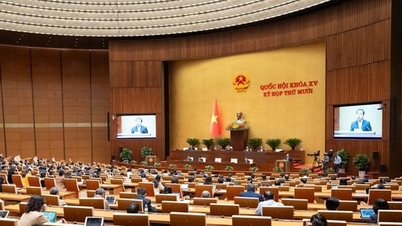
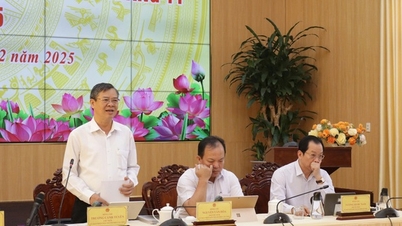
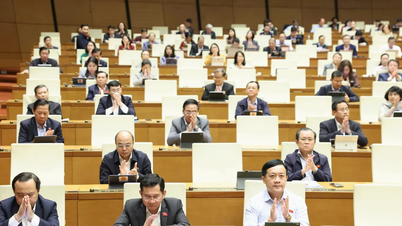
On the morning of December 5, the National Assembly discussed in the hall the investment policy for the National Target Program (NTPP) for the period 2026-2035. The consolidation of three current programs into one comprehensive program is considered an institutional breakthrough, but the capital structure and the ability to mobilize resources are becoming the focus of attention when a series of delegates expressed concerns about the heavy counterpart burden on poor localities, especially ethnic minority and mountainous areas.
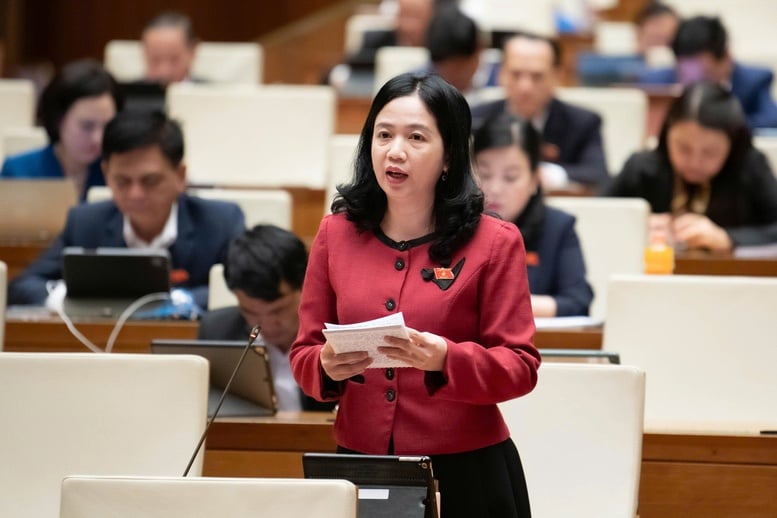
Delegate Dieu Huynh Sang ( Dong Nai ) requested the Drafting Committee to review and avoid duplication, clearly define the responsibilities of the presiding agency and the coordinating presiding agency in organizing implementation.
Need to strongly adjust capital structure
According to the Government's Report, the total capital demand for the National Target Program for the 2026-2030 period is about 500 trillion VND. However, the central budget only plans to allocate 100 trillion VND, equivalent to 20%, while the local budget must match up to 400 trillion VND. Delegate Ha Sy Huan ( Thai Nguyen ) said that this ratio puts great pressure on poor provinces, where the poverty rate is high, revenue sources are limited and it is difficult to balance capital.
Delegate Mai Van Hai (Thanh Hoa) cited the difference between the two periods. In the 2021-2025 period, the total central budget capital for the three programs was more than 190 trillion VND. In the new period, this figure decreased to 100 trillion VND, while the local counterpart requirement more than doubled. "Many mountainous provinces do not have enough revenue to cover expenses, the main source of investment is land use fees. But now the locality only enjoys 80% to 85% of this source, making the ability to balance even more difficult," the delegate analyzed.
Many opinions expressed concerns about the feasibility of the capital structure putting the burden on localities. Delegate Ho Thi Minh (Quang Tri) pointed out: With a total capital demand of 1.23 million billion VND for the period 2026-2030, the central government capital accounts for only 8%, the local budget 33% and mobilized from businesses and people up to 28%. "In ethnic minority and mountainous areas, the request for a 33% counterpart is almost impossible and poses a risk of overdue debt for basic construction," the delegate warned, and at the same time proposed to exempt the counterpart for poor communes and areas frequently affected by natural disasters in the Central and Central Highlands regions.
Delegate Ha Sy Dong (Quang Tri) also analyzed that the minimum capital requirement is 240 trillion VND but only about 100 trillion VND has been balanced, reaching only 41.5%. Meanwhile, the requirement to mobilize 33% local capital and 28% from enterprises is very difficult to implement. Delegate Dieu Huynh Sang (Dong Nai) emphasized that the counterpart ratio is four times the central capital is "inappropriate", suggesting that the central budget must play a decisive role to ensure focused and key investment.
From that reality, the majority of delegates recommended the need to strongly adjust the capital structure towards increasing the proportion of the central budget, reducing the counterpart burden for disadvantaged localities, and at the same time designing a mechanism to mobilize capital from businesses and the community but must be suitable to the actual capacity of each region.
Avoid spreading and leveling
Along with the issue of capital structure, the principle of resource allocation is also of special interest to delegates. Delegate Hoang Quoc Khanh (Lai Chau) said that resources are limited so it is necessary to focus on the core poor areas, avoiding spreading and leveling. However, the current principles are still general, lacking clear quantitative criteria. Delegate Ha Sy Huan suggested quantifying the allocation criteria, clearly defining the beneficiaries, based on the level of difficulty, the rate of poor households and the number of unmet criteria of the program.
Delegate Ha Sy Dong proposed that at least 70% of the central budget capital must be prioritized for ethnic minority and mountainous areas, of which at least 40% must be for particularly difficult areas, to ensure focused investment.
Many opinions suggested increasing the locality’s initiative in reviewing and determining investment tasks, while learning from previous experiences to avoid fragmentation, prolongation, and inefficiency. Mobilizing 28% of capital from businesses and people, as delegate Ho Thi Minh commented, is a big challenge in the core poor areas.
In addition to the capital structure, the delegates also analyzed in depth the goals and tasks of the Program. Delegate Ho Thi Minh said that some targets were too high and difficult to implement when many tasks in the previous phase had not been completed, especially projects on clean water, residential land, and production land. The delegates suggested strong investment, not small-scale projects such as drilling wells or supplying water tanks, but rather long-term strategies such as investing in the national grid model for clean water.
Delegate Hoang Quoc Khanh emphasized the need to allocate resources to urgently address landslides and flash floods in mountainous provinces. He suggested clearly defining the target rate of high-risk villages and hamlets to be safely arranged and resettled as a legal basis for capital allocation.
Delegate Mai Van Hai (Thanh Hoa) proposed clarifying the basis for establishing multidimensional poverty targets, new rural areas and modern new rural areas. When the new set of criteria is not yet complete, the determination of targets must be cautious, based on science and practice, and avoid setting them too high compared to the local capacity.
Delegate Ha Sy Dong also expressed concern about the risk of duplication and omission in the classification of areas when the criteria for ethnic minority areas have just been issued but have not yet been determined, while the criteria for new rural areas and poverty reduction are still being drafted. The delegate suggested completing a synchronous criteria system as a basis for consistent implementation.
Many delegates emphasized the need to develop a new, common and clearly stratified set of criteria for the 2026-2035 period, from goals to tasks, especially in the contents related to multidimensional poverty reduction, modern new rural areas and income levels of ethnic minorities. Delegate Dieu Huynh Sang noted that many proposed indicators lack practical basis and need to be calculated in accordance with financial resources.
Regarding the implementation model, delegates proposed to thoroughly overcome the problems of the previous stage such as complicated procedures, unclear decentralization, and slow guidance. Delegate Ha Sy Dong proposed strong decentralization to localities, especially the commune level, in deciding on the project list and organizing implementation, because the commune level clearly understands the actual situation, needs, and characteristics of the area. At the same time, there should be a mechanism to protect cadres who dare to think and dare to do to avoid the fear of mistakes and responsibility.
Delegate Ha Sy Huan highly appreciated the fact that the draft has decentralized the decision on resource allocation to the provincial People's Council, but said that the procedures are still cumbersome and lack initiative. The delegate suggested boldly delegating power to the commune level to implement the motto "locality decides, locality acts and locality is responsible", while the provincial level plays the role of orientation, supervision and technical support.
Many opinions also requested the addition of a special mechanism to respond urgently to natural disasters, allowing the Chairman of the local People's Committee to decide on implementing resettlement and livelihood solutions without having to wait for procedures of the Law on Public Investment, to ensure timeliness in handling consequences.
Regarding the coordination mechanism, delegate Vu Xuan Hung (Thanh Hoa) proposed establishing a close coordination regulation between ministries and branches, especially with projects located in sensitive areas of national defense, security and religion.
Delegates said it is necessary to clearly define responsibilities between central and local agencies; agree to assign the Ministry of Agriculture and Environment as the focal agency, while the specific component for ethnic minority and mountainous areas should be assigned to the Ministry of Ethnic Minorities and Religions to preside over.
Delegate Dieu Huynh Sang also proposed clearly defining the responsibilities of each agency and the monitoring mechanism to avoid spreading and ensure that the 118 ethnic policies integrated into the program are effectively implemented.
The consolidation of three National Target Programs into one comprehensive program was highly agreed upon by delegates, considering this an important solution to concentrate resources, reduce overlap, dispersion and be suitable for the two-level local government model. For mountainous provinces and ethnic minority areas, the program is of special importance, being a leading resource in building essential infrastructure, sustainably reducing poverty, narrowing the development gap and maintaining national defense and security.
However, in order for the 2026-2035 program to be feasible and most effective, delegates agreed that the Government needs to review the capital structure in the direction of increasing the leading role of the central budget, adjusting the allocation criteria in a quantitative and concentrated direction, avoiding dispersion; perfecting the system of indicators and classification mechanisms; and at the same time promoting decentralization and delegation of powers associated with clear responsibilities and coordination mechanisms. Only then will investment resources truly reach the core poor areas, bringing about substantial, sustainable and comprehensive changes for ethnic minority and mountainous areas.
Nhat Nam
Source: https://baochinhphu.vn/tap-trung-nguon-luc-cho-cac-vung-loi-ngheo-102251205113305898.htm


![[Photo] Cat Ba - Green island paradise](/_next/image?url=https%3A%2F%2Fvphoto.vietnam.vn%2Fthumb%2F1200x675%2Fvietnam%2Fresource%2FIMAGE%2F2025%2F12%2F04%2F1764821844074_ndo_br_1-dcbthienduongxanh638-jpg.webp&w=3840&q=75)








































































Comment (0)