

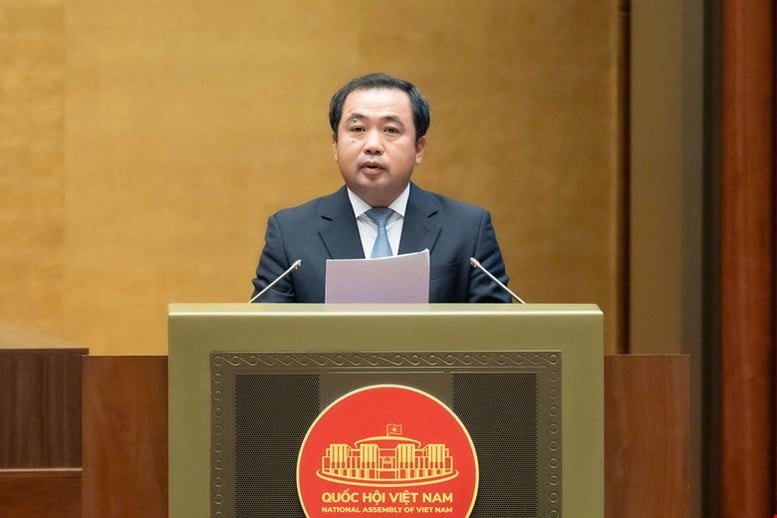
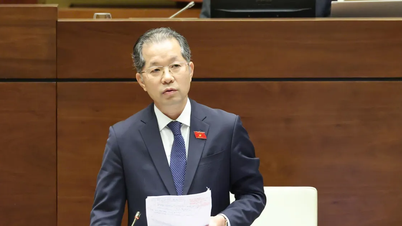
Minister of Agriculture and Environment Tran Duc Thang explained and clarified many issues mentioned by National Assembly deputies.
The National Assembly discussed in the hall the investment policy of the National Target Program (NTPP) on new rural areas, sustainable poverty reduction, and socio -economic development in ethnic minority and mountainous areas until 2035 this morning (December 5). Many delegates said that the integration of the three current NTPs into one comprehensive program is considered an institutional breakthrough, helping to overcome the situation of resource dispersion and budget overlap.
At the meeting, Minister of Agriculture and Environment Tran Duc Thang explained and clarified many issues mentioned by National Assembly deputies.
Regarding the policy of integrating three programs into one, Minister of Agriculture and Environment Tran Duc Thang said that the majority of National Assembly deputies agreed with this to overcome the shortcomings and limitations of the previous period. However, there are still concerns that the merger may reduce policies and investment resources for ethnic minority and mountainous areas.
The Minister affirmed that the policy of merging the three programs demonstrates the determination to realize the goals of the Party and State, "making people have a prosperous and happy life, especially in ethnic minority and mountainous areas". The Government emphasized three important points, that is, in addition to the general goals, the program will focus on prioritizing new rural construction, sustainable poverty reduction and socio-economic development in ethnic minority and mountainous areas. Improve implementation efficiency, avoid overlapping and duplication of policies, and thoroughly decentralize to localities. Extend the support period to 2035 (instead of 2030 as in the current program) to concentrate long-term, synchronous and more effective resources.
Minister Tran Duc Thang emphasized: "The integration does not reduce policies or narrow the scope of support, but creates conditions for more concentration and priority for ethnic minority and mountainous areas."
Regarding the target of striving for about 65% of communes to meet new rural standards by 2030, while in the 2021-2025 period the whole country has reached nearly 80%, the Minister said that according to the review results of localities, after the merger, the whole country has about 65.6% of communes capable of meeting new rural standards according to the criteria for the 2021-2025 period. However, the New Rural Criteria for the 2026-2030 period will be issued in December 2025 in the direction of inheriting, supplementing and enhancing the Criteria for the 2021-2025 period.
According to the review of the Ministry of Agriculture and Environment, currently, about 42% of communes basically meet the regulations of the new Criteria for the period 2026-2030 and are expected to be recognized as meeting the standards in 2026-2027. The remaining communes (about 25%), mainly in disadvantaged areas, ethnic minority and mountainous areas, will be prioritized with resources to achieve new rural standards by 2030. Thus, the goal of striving for about 65% of communes to meet new rural standards by 2030 is feasible.
Regarding the investment capital for the program, two major issues that delegates are concerned about are that the central budget capital allocation (VND 100,000 billion) is low while the local counterpart capital regulation (VND 400,000 billion) is too large, exceeding the balancing capacity of localities, especially disadvantaged localities. Regarding the issue raised by delegates, the Government agrees with the delegates' opinion that the central budget capital allocation of VND 100,000 billion is limited, especially when the program has a nationwide scope, covering almost all the contents of socio-economic development in rural areas, with priority given to ethnic minority and mountainous areas.
However, the Minister said that in the 2026-2030 period, in addition to this program, there are 4 other national target programs being implemented in the area. Along with that are other capital sources such as: the Sustainable Development Program for the Mekong Delta; the Program for stabilizing population in mountainous areas and difficult areas (included in the draft Resolution of the 14th Congress); social policy credit capital, commercial credit capital for investment in agriculture, farmers, and rural areas; capital from enterprises and mobilizing voluntary contributions from the community.
Taking note of the delegates' opinions, the Minister emphasized: "To achieve the goals and tasks of the program, during the operation process, the Government will continue to balance the central budget to report to the National Assembly to prioritize additional allocations appropriate to actual conditions."
At the same time, the Government will absorb the opinions of the National Assembly Standing Committee, the Nationalities Council and the National Assembly Committees as well as National Assembly deputies, and continue to review and balance to determine the most appropriate budget capital level for localities.
According to the Minister, the Program is designed into two clear components: a general component implemented nationwide; a specific component specifically for ethnic minority and mountainous areas. Each specific task is only arranged in one component based on the principle of clear content, clear resources, clear beneficiaries, and at the same time, reviewed with other National Target Programs to avoid duplication of investment and to not miss poor communes and especially difficult areas.
Regarding the issuance of guiding documents, the Government assigned the Ministry of Agriculture and Environment to preside over and coordinate with the Ministry of Ethnic Minorities and Religions and relevant ministries and branches to unify the issuance of guiding documents for program implementation, ensuring consistency and clarity of content immediately after the National Assembly approves the investment policy.
Regarding decentralization and delegation of power, the program is designed in the spirit of maximum decentralization to localities, along with resource allocation on the principle of "local decision, local action, local responsibility", the Central Government plays the role of management, promulgates mechanisms, and strengthens inspection and supervision. The supervision mechanism is also established at three levels (Central, provincial, communal), promoting the role of the people as subjects in supervision, ensuring publicity, transparency and enhancing accountability of authorities at all levels.
Hai Lien
Source: https://baochinhphu.vn/tap-trung-va-uu-tien-hon-cho-phat-trien-vung-dong-bao-dan-toc-thieu-so-va-mien-nui-102251205150418925.htm

![[Photo] Cat Ba - Green island paradise](/_next/image?url=https%3A%2F%2Fvphoto.vietnam.vn%2Fthumb%2F1200x675%2Fvietnam%2Fresource%2FIMAGE%2F2025%2F12%2F04%2F1764821844074_ndo_br_1-dcbthienduongxanh638-jpg.webp&w=3840&q=75)



















![[Photo] 60th Anniversary of the Founding of the Vietnam Association of Photographic Artists](/_next/image?url=https%3A%2F%2Fvphoto.vietnam.vn%2Fthumb%2F1200x675%2Fvietnam%2Fresource%2FIMAGE%2F2025%2F12%2F05%2F1764935864512_a1-bnd-0841-9740-jpg.webp&w=3840&q=75)


























































Comment (0)