


Reporter: Writer Le Quang Trang, in the literary flow of the past 50 years since 1975, in your opinion, what contributions have young writers made and have they been able to keep up with the changes of society and life today?
Writer Le Quang Trang: I see that Vietnamese literature after 1975, that is, in the past 50 years, has had a very brilliant development, especially in the last 20 years, and when 4.0 technology began to develop rapidly.
The young generation like us has a worthy inheritance and has a promotion of what the previous generation has worked hard to cultivate in terms of genre, form, art... Young writers in recent times, when absorbing the quintessence of foreign literature as well as having more open dimensions, their works are closer to life and especially in today's turbulent life, have opened up many issues for you to ponder. There has never been a time when the young writing force is as large and of such quality as today.
However, besides those advantages, there are also challenges. In the time when we live at such a fast pace, and are dominated by social networks, literature is a genre that needs time, needs a calm and predictive nature, do you have enough determination, time and absorption to mature your work?
But besides that, there is also the problem of whether our works are still relevant if there is a period of retreat and quiet. These are the problems facing young literature today.
However, I think that, with the general trend of the times and the progress of young literature in our country, we can still believe that the young generation will inherit the achievements of the past and make great strides. Especially in the era of national development, recent times have posed many new issues for you to have time to listen and reflect on your work.

Reporter: Currently, in addition to the challenges you just mentioned, what difficulties are young writers facing and how can they overcome them to produce works that leave a personal mark or an impression on readers?
Writer Le Quang Trang: Young writers today actually have many difficulties. First is the issue of preserving identity. Our national identity is very rich and diverse, tempered through challenges, and exposed to fluctuations and changes of time. However, how to preserve identity while reaching the tastes of the market and meeting the needs of readers is also a difficulty for young writers.
To overcome this difficulty, young writers must research, explore, and live fully with their identity and work. However, the saying "Bread and butter is no joke for poets" still haunts writers up to now. In foreign countries, copyright protection for authors is quite good. But in Vietnam today, the legal corridor still has limitations. Therefore, most authors cannot fully live off their copyright, that is, live fully with their profession. Most of you have to live on a side job. Therefore, although there is quality and determination, having a consistent motivation to wholeheartedly pursue your career is a difficulty for many young writers.
Reporter: So now what should young writers do to escape those difficulties?
Writer Le Quang Trang: I think that in any profession, including literature, we need to specialize in our profession. Young writers should also choose for themselves a path, a focus area, their strengths to follow consistently. Only then will we have enough time and energy to focus, dig deep, produce good works and from there conquer readers and gain a foothold.
For example, Nguyen Ngoc Tu, she still persistently pursues stories around the writing land in the Southwest region and only sticks to one prose genre, thus forming a position in the Southwest literature, a place to stand over time. Taking on many issues, especially for young people, is like standing in the middle of the water without choosing a path, going through too many experiences and losing a lot of time instead of focusing on a "land", turning it into "land" of one's own. That is also a big problem for young writers.
Reporter: For young writers, literary awards are an encouragement and support, but do they ever become pressure for them to overcome?
Writer Le Quang Trang: I think there are both. The award is both a source of motivation and pressure. Because when young people write, the first thing they need is recognition to know where they stand in order to develop.
Awards are also a way for us to create recognition and let young writers know where they stand and what they need to try harder. However, if young people are not alert to awards, they will easily fall into a cycle, find it difficult to develop further and overcome the shadow of awards, and find it difficult to write better.
For me, after receiving some awards, it means that I have finished my journey of “giving birth”, and my mission for that work. I will enter the journey of “conceiving” another work.
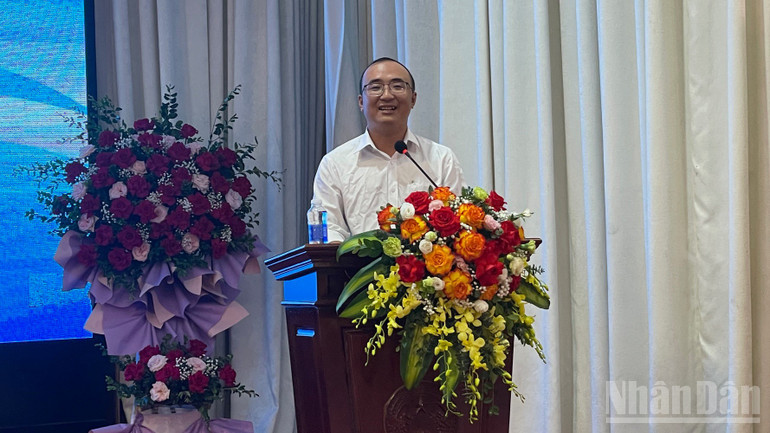
Reporter: There are not many literary voices that are characteristic of different regions today, especially young voices. As a young writer, what do you hope for in terms of changes in mechanisms and policies to support the development of literary voices that are characteristic of regions?
Writer Le Quang Trang: I was born and raised in An Giang, the border area between Vietnam and Cambodia. My hometown has 4 ethnic groups: Kinh, Cham, Hoa and Khmer, and I can hear both Kinh and Khmer. Therefore, I find the cultural identity of each ethnic group very beautiful, very rich and diverse. Not only does it have the meaning of preserving the traditions of the nation, the cultural identity and language of each ethnic group also have many cultural, political , economic factors...
However, from the perspective of the Southwest region, it seems that these voices in literature are still very thin. Specifically, Khmer ethnic literature, Cham ethnic literature, and Chinese literature are not much. There are many reasons, but the main reason is the lack of systematic investment and the lack of specific support mechanisms. Where will ethnic creators find outlets for their works? Without outlets and places to receive their works, they cannot create for a long time, so there will be no continuity, no treasure trove to preserve, and future generations will not continue writing.
For example, the Khmer people in An Giang . In the past, there were many people who wrote about Khmer literature, so the next generations had works to read, and there was continuity. But in An Giang today, the number of Khmer authors is very small, only about 1 or 2 people. If those people are no longer there, the stream of Khmer literary creation will be interrupted.
Therefore, I think that mechanisms are needed for ethnic authors, especially young authors. In addition to economic , cultural and social development projects for ethnic minority areas, there is also a need for more specific development projects for literature and art. In addition to preservation and museums for artisans, artists should also have mechanisms to be able to live and create by their profession, so that they have the motivation to "stick around" and preserve their ethnic identities. This also contributes to creating a diverse picture for the country's literature.
Reporter: Thank you writer Le Quang Trang.
Source: https://nhandan.vn/nha-van-tre-le-quang-trang-luc-luong-cay-but-tre-dong-nhung-gap-nhieu-thach-thuc-post928287.html
![[Photo] National Assembly Chairman Tran Thanh Man attends the VinFuture 2025 Award Ceremony](/_next/image?url=https%3A%2F%2Fvphoto.vietnam.vn%2Fthumb%2F1200x675%2Fvietnam%2Fresource%2FIMAGE%2F2025%2F12%2F05%2F1764951162416_2628509768338816493-6995-jpg.webp&w=3840&q=75)


![[Photo] 60th Anniversary of the Founding of the Vietnam Association of Photographic Artists](/_next/image?url=https%3A%2F%2Fvphoto.vietnam.vn%2Fthumb%2F1200x675%2Fvietnam%2Fresource%2FIMAGE%2F2025%2F12%2F05%2F1764935864512_a1-bnd-0841-9740-jpg.webp&w=3840&q=75)












![[Photo] National Assembly Chairman Tran Thanh Man attends the VinFuture 2025 Award Ceremony](https://vphoto.vietnam.vn/thumb/402x226/vietnam/resource/IMAGE/2025/12/05/1764951162416_2628509768338816493-6995-jpg.webp)
![[Infographic] Air pollution and recommendations from the Ministry of Health](https://vphoto.vietnam.vn/thumb/402x226/vietnam/resource/IMAGE/2025/12/05/1764950568593_screen-shot-2025-12-05-at-222015-png.webp)




















































Comment (0)