

Thirteen foreign investors and 15 domestic businesses investing in solar power have submitted official petitions regarding the commercial operation of their projects without prior acceptance testing, fearing they will no longer be eligible for the initial electricity selling price.
Thirteen foreign investors and 15 domestic businesses investing in solar power have submitted official petitions regarding the commercial operation of their projects without prior acceptance testing, fearing they will no longer be eligible for the initial electricity selling price.
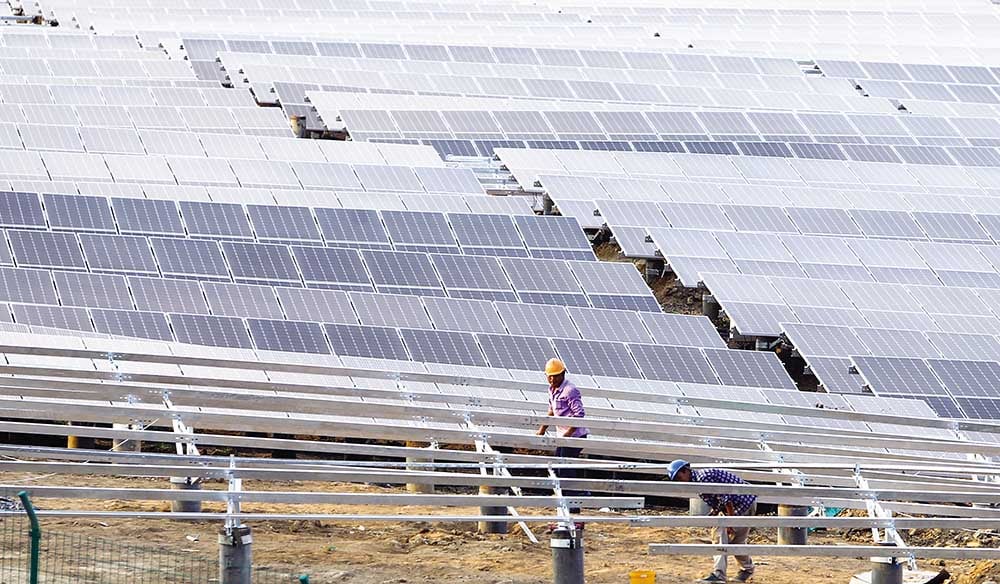 |
| Many solar power plants are worried about not enjoying the initial electricity price. |
Commercial operation but no acceptance approval yet
The businesses' petition focuses primarily on the fact that they have been recognized as having a Commercial Operation Date (COD) and are selling electricity at the electricity prices stipulated in Decision 17/2019/QD-TTg (FIT1 price) and Decision 13/2020/QD-TTG (FIT2 price), but have not yet received written approval from the competent authority regarding the results of the inspection and acceptance (acceptance approval) at the time of COD.
In their petition, the businesses stated that, despite complying with renewable energy regulations in effect at the time the plants received COD (Commercial Operation Date), many projects have experienced indefinite payment delays or only received partial payments since September 2023 under power purchase agreements (PPAs) signed with EVN, without any clear legal basis other than what was mentioned in Inspection Conclusion No. 1027/KL-TTCP.
The financial impact of this situation is significant, with some projects already facing the prospect of defaulting on their debt obligations to domestic and international lenders.
It is necessary to reiterate here that Conclusion No. 1027/KL-TTCP of the Government Inspectorate in April 2023 highlighted the issue of renewable energy projects that had been recognized as Commercial Operation Date (COD) and were enjoying FIT1 and FIT2 rates, but lacked the necessary legal documentation. Specifically, they did not have the acceptance certificate at the time of CO and were not eligible for FIT1 and FIT2 rates.
Recommendations from investors
Confirm and enforce the initially approved COD date of affected projects.
Ensure EVN fully fulfills its contractual obligations under the signed PPAs by making full and timely payments to affected projects, avoiding financial strain on the projects.
Circular 10/2023/TT-BCT shall not be applied retroactively to projects that have COD before the effective date of this Circular.
The inspection conclusion also stated that this had caused damage to Vietnam Electricity Group (EVN) - a 100% state-owned unit.
To remedy the situation, the Ministry of Industry and Trade proposed that projects currently enjoying FIT rates that have violated regulations as concluded by the inspection (due to not fully meeting the conditions for enjoying FIT rates) will no longer be eligible for preferential FIT rates and will have their electricity purchase and sale prices recalculated according to regulations. Simultaneously, any improperly received preferential FIT rates will be recovered through offsetting payments for electricity purchases.
According to a report by the Ministry of Industry and Trade, 173 grid-connected solar and wind power plants/parts of plants are experiencing this situation.
At the most recent meeting of the relevant authorities to resolve difficulties for renewable energy projects on February 26, 2025, EVN mentioned the number of related projects and categorized them into specific groups.
These groups include those currently enjoying FIT1 pricing and having received acceptance approval before July 1, 2019 - the end date of FIT1; those enjoying FIT2 pricing and having received acceptance approval before January 1, 2021 - the end date of FIT2; those enjoying FIT1 pricing but having received acceptance approval during the FIT2 pricing period; and finally, those enjoying either FIT1 or FIT2 pricing but having received acceptance approval after December 31, 2020 - the last day to enjoy FIT2 pricing; and even projects that have yet to receive acceptance approval.
Notably, the number of power plants currently benefiting from FIT1 and FIT2 electricity pricing, but with acceptance dates after December 31, 2020, is quite significant, reaching over 90 projects out of the 173 projects mentioned.
The fact that COD solar power plants will no longer enjoy the same electricity prices as they are currently enjoying is also causing businesses to panic.
The challenge of finding a way out.
In a petition sent to several high-ranking leaders, 13 foreign investors, along with 15 domestic businesses and one association, argued that the Ministry of Industry and Trade's or provincial-level competent authority's approval of the completion of construction projects was not a prerequisite for achieving Commercial Operation Date (COD) at the time FIT1 and FIT2 came into effect.
Specifically, according to Decision No. 39/2018/QD-TTg for wind power projects and Decision No. 13/2020/QD-TTg for solar power projects, the conditions for achieving Commercial Operation Date (COD) recognition only include three requirements: completion of initial testing of the power plant and connection equipment; issuance of an electricity operation license; and agreement on meter readings to begin payment.
Even the regulations on electricity operating licenses at that time did not require written acceptance of inspection as a condition for granting an electricity operating license.
It wasn't until June 9, 2023, that Circular No. 10/2023/TT-BCT introduced the requirement for a pre-acceptance approval document before applying for an electricity operation license. Therefore, investors argue that the retroactive application of this new requirement to projects that achieved Commercial Operation Date (COD) many years ago contradicts the principle of non-retroactivity under Article 13 of the Investment Law No. 61/2020/QH14.
Investors also argue that any violations of construction law regarding acceptance testing would only result in administrative penalties and requirements for remediation (if applicable), and would not change the fact that the project had met the COD conditions as stipulated in the regulations in effect at that time and had obtained COD approval from EVN.
"According to the signed PPA contracts, EVN is obligated to purchase electricity from these projects at the agreed-upon FIT price from the date of the Commercial Operation Date (COD) previously approved by EVN. The delay in payment raises serious concerns about EVN's compliance with its commitments under these signed PPA contracts," the petition stated.
Investment Newspaper once reported on this problem. In early 2022, EVN issued a document asking the Ministry of Construction and the Ministry of Industry and Trade for specific instructions to ensure the rights of the parties in the solar power project related to the inspection of the acceptance work of the competent state management agency before putting the power projects into operation.
According to the regulations of the 2014 Construction Law and its amendments up to 2022, energy projects of level III and below are subject to acceptance testing. Therefore, solar power projects with a capacity of less than 10 MW are classified as level III, those with a capacity of 10-30 MW as level II, and those with a capacity of over 30 MW as level I, all require acceptance testing by the competent authority.
However, some other legal documents at the time the solar power projects came into operation did not contain regulations on inspection and acceptance testing by competent authorities, such as Decision No. 11/2017/QD-TTg, Circular No. 16/2017/TT-BCT, Decision No. 13/2020/QD-TTg, and Circular No. 18/2020/TT-BCT.
Notably, Decree No. 15/2013/ND-CP allows the investor to organize the acceptance testing and put the project into use if, after the prescribed deadline, they have not received a document on the results of the acceptance testing from the competent authority.
However, Decree No. 46/2015/ND-CP and Decree No. 06/2021/ND-CP no longer regulate this matter, limiting the proactive role of investors in the acceptance and commissioning process of construction projects.
In discussions with reporters, many experts in the electricity sector also stated that other power sources built a long time ago do not face the same problems as solar power projects because, regardless of when they come into operation, the electricity selling price remains the same according to the PPA negotiated and signed with EVN.
In many solar power projects, due to the rush to qualify for the FIT1 or FIT2 rates stipulated by the Government, many investors have either overlooked or been unaware of the need to complete the necessary acceptance and inspection procedures from state management agencies. As a result, they have not received these documents during the stages when they are eligible for the preferential FIT1 and FIT2 rates.
It's worth noting that, while nearly 100 projects lack acceptance certificates, several dozen others have all the necessary certifications. Therefore, if businesses without complete documentation still receive the same FIT1 and FIT2 rates, it raises the question of "what benefit is there here?" and it will be very difficult to answer.
This reality also shows that resolving the difficulties for renewable energy projects will take time to completely resolve without affecting investment attraction in the power sector.
Source: https://baodautu.vn/thach-thuc-giu-gia-ban-dien-tai-du-an-nang-luong-tai-tao-d251636.html


![[Photo] Prime Minister Pham Minh Chinh holds a phone call with the CEO of Russia's Rosatom Corporation.](/_next/image?url=https%3A%2F%2Fvphoto.vietnam.vn%2Fthumb%2F1200x675%2Fvietnam%2Fresource%2FIMAGE%2F2025%2F12%2F11%2F1765464552365_dsc-5295-jpg.webp&w=3840&q=75)
![[Photo] Closing Ceremony of the 10th Session of the 15th National Assembly](/_next/image?url=https%3A%2F%2Fvphoto.vietnam.vn%2Fthumb%2F1200x675%2Fvietnam%2Fresource%2FIMAGE%2F2025%2F12%2F11%2F1765448959967_image-1437-jpg.webp&w=3840&q=75)












































![[OFFICIAL] MISA GROUP ANNOUNCES ITS PIONEERING BRAND POSITIONING IN BUILDING AGENTIC AI FOR BUSINESSES, HOUSEHOLDS, AND THE GOVERNMENT](https://vphoto.vietnam.vn/thumb/402x226/vietnam/resource/IMAGE/2025/12/11/1765444754256_agentic-ai_postfb-scaled.png)




































Comment (0)