

Seven months after Ukraine launched a counteroffensive this summer aimed at regaining Russian-controlled territories in the east, Kyiv's forces have made little progress against Moscow's fierce resistance.
Ukraine's main counteroffensive is taking place in the Zaporizhzhia province on the southern front. This approach aims to cut off the route from Orikhiv, east of the Dnipro bend, to Melitopol in an attempt to cut off Russian forces near the Sea of Azov.
In addition, Ukraine has other counter-offensive axes, such as a counter-offensive eastward toward the Russian-controlled Donetsk region and another outside the city of Bakhmut. More recently, Ukraine has established a position on the eastern bank of the Dnipro River.
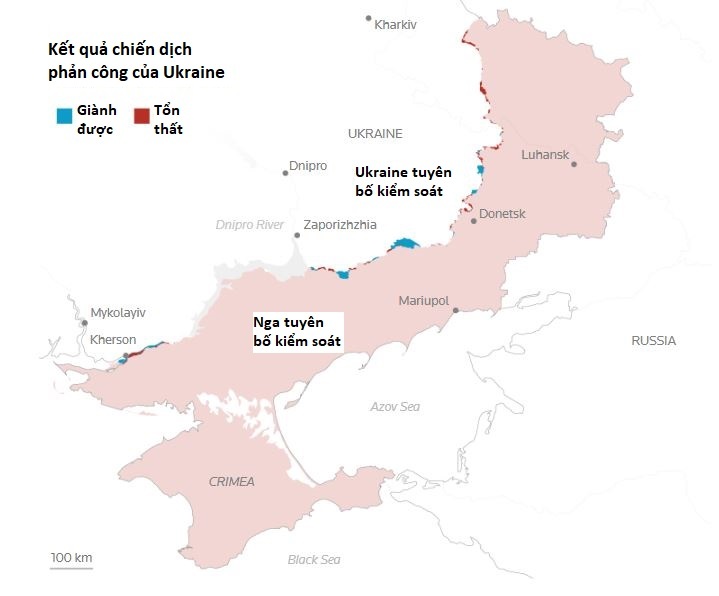
Results of Ukraine's counter-offensive campaign as of December 2023 (Graphic: Reuters).
However, Ukraine's progress in its counteroffensive has been minimal. Meanwhile, Russia has built the largest and most fortified defensive line in Europe since World War II, according to Reuters.
Despite Ukraine's counterattack, this defensive line has so far held firm. Furthermore, the initial prospect of a Ukrainian breakthrough to cut off the land corridor connecting Russia and the Crimean Peninsula is fading.
"If the counteroffensive unfolds under the right conditions, with a more strategic approach to training the Ukrainian armed forces in what they need and what Western military experts require, this operation could make a difference," said Franz-Stefan Gady, a senior expert at the International Institute for Strategic Studies.
However, not all the pieces seem to be falling into place perfectly. As a new winter of stalemate approaches, Ukrainian forces are facing numerous challenges that are keeping them bogged down on the front lines.
Challenges from the start of the campaign
Bakhmut, the bloodiest front in the Ukrainian conflict to date, was the decisive battle that led to the counteroffensive and impacted Kyiv's military campaign.
In March 2023, when Ukrainian forces were nearly surrounded in the city of Bakhmut, facing high casualties and dwindling ammunition supplies, there were many voices both domestically and internationally calling for Ukraine to withdraw its troops.
At that time, President Volodymyr Zelensky declared that Ukrainian forces remained determined to stay in Bakhmut to defeat Russian forces. Despite heavy losses suffered by the Russian army, Moscow still claimed to have captured Bakhmut in May.
Some experts argue that Ukraine's decision to remain in Bakhmut was justified given Russia's heavy losses and the disarray of the Wagner private military forces. However, other experts believe that Russia deployed inexperienced troops, forcing Ukraine to expend its more experienced forces in the battle for Bakhmut.
The decision to hold and defend the Bakhmut line tied down some of Ukraine's most elite forces, including the 24th Mechanized Brigade and the 80th Air Assault Brigade, during the planning phase for the summer counteroffensive.
This forced Ukraine to deploy less experienced units, including the 47th Mechanized Brigade, to undertake the difficult task of breaking through Russia's fortified defenses.
In the initial phase of the counteroffensive, well-equipped but inexperienced Ukrainian units engaged in attacks on Russian lines, but they quickly encountered Moscow's solid defenses. Some experts argue that Ukraine adopted an inconsistent approach, evidenced by a lack of communication, poor reconnaissance and targeting, and ineffective coordination.
This hampered the counterattack, and this is a mistake that often happens with armies lacking combat experience.
George Barros, an analyst at the Institute for the Study of War, told Business Insider that Ukraine's counteroffensive made no difference due to early misjudgments by Ukraine and its Western partners about Russia's defenses and the likelihood of success from NATO tactics and training.
Weapon shortage
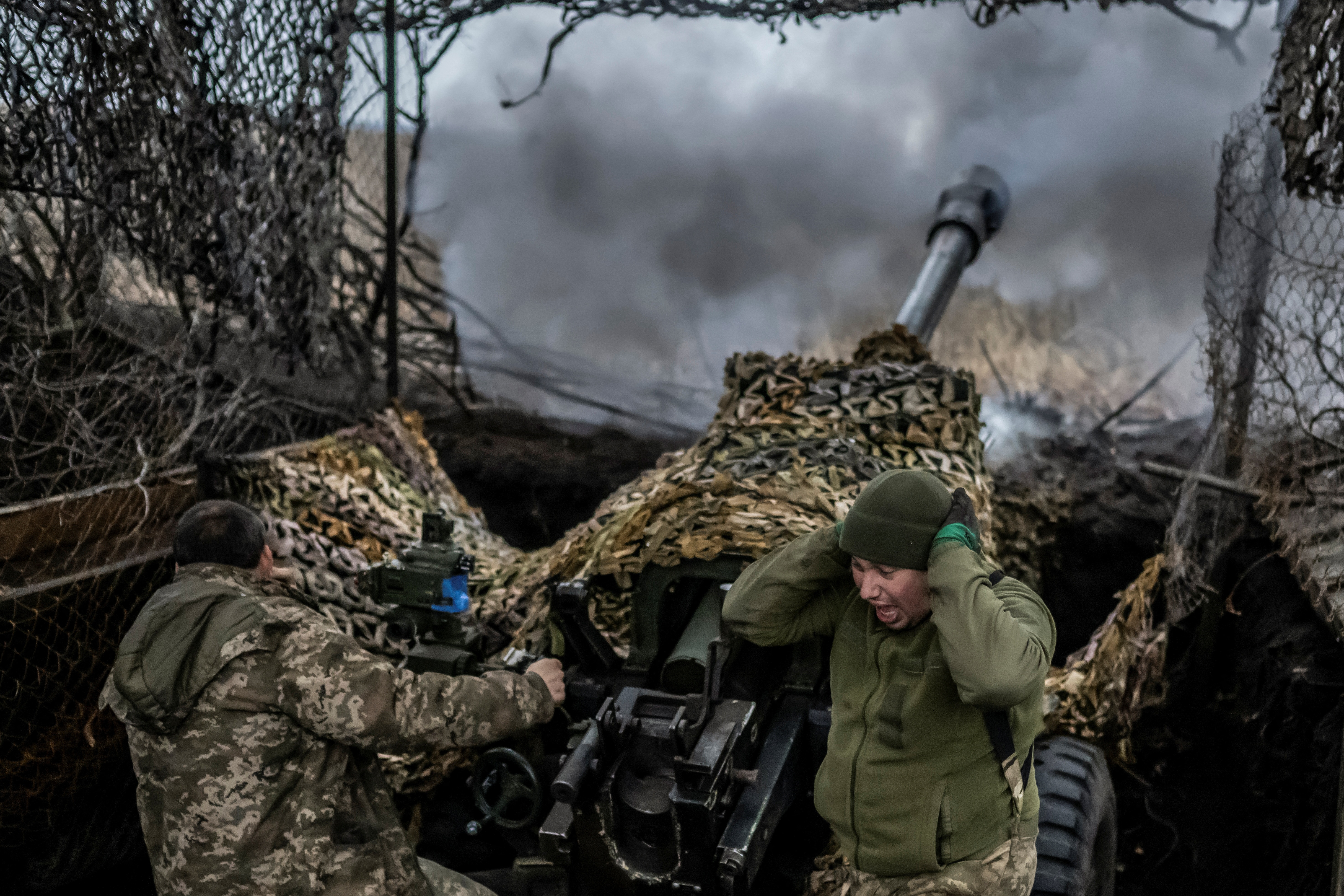
Ukrainian forces fire artillery in Donetsk (Photo: Reuters).
From the outset, Ukraine had a number of weapons available to conduct the counter-offensive. The High Mobility Artillery Rocket System (HIMARS), along with the M777 howitzer and counter-artillery radar, had a significant impact on the counter-offensive.
However, other assets and equipment, such as tanks and armored vehicles, were not really useful in penetrating Russian defenses. These vehicles faced minefields, anti-tank missiles, and Russian attack helicopters.
In addition, Ukraine also lacks essential weapons and equipment such as mine-clearing equipment and engineering vehicles.
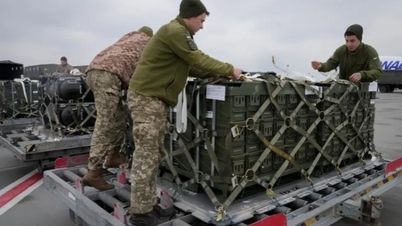
There are weapons and equipment that have been sent to Ukraine but are delayed, or Kyiv is waiting to receive them. For some critical weapons, transfers are often delayed due to time-consuming exchanges.
When asked by the Associated Press in early December last year about the results of the counteroffensive, President Zelensky admitted that Ukraine "did not get all the weapons we wanted."
Many analysts have criticized the U.S. and its allies for delays in supplying certain types of weapons that Ukraine needs.
According to Seth Jones, director of the International Security Program and the Transnational Threats Project at the Center for Strategic and International Studies (CSIS), it is clear that "concerns within the U.S. government about the risk of escalating the conflict and increasing the likelihood of Russia using nuclear weapons have not materialized."
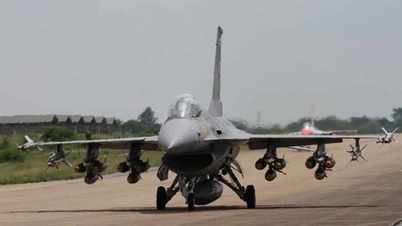
Regarding US support, Ukraine has only received M1 Abrams tanks and the Army Tactical Missile System (ATACMS). Meanwhile, training of Ukrainian pilots to use F-16 fighter jets has only just begun, so although Ukraine is eager to acquire F-16s, it will not receive these fighters until at least 2024.
Ukraine also has an air force, but it mainly consists of old Soviet-era military aircraft. This force is barely sufficient to suppress Russian air defenses, provide close air support, and conduct the ground attacks necessary to truly break through Russian lines.
Ukraine stated that a lack of air power has further complicated its counter-offensive efforts. Experts also pointed out that even the West would find it difficult to conduct such an operation without overwhelming air power.
Ukraine also faces challenges regarding ammunition, particularly the allocation of artillery shells to the front lines, even as Western partners increase production and supply of 155mm shells and controversial cluster munitions as a temporary solution.
Training and tactical challenges
In terms of training and tactics, several problems arose as Ukraine transitioned from Soviet-era weapons to sophisticated NATO weapon systems, while simultaneously undergoing intensive training in complex warfare and Western-style combined arms warfare within just a few months.
The results of the training courses were unclear. From the outset, the less experienced Ukrainian units were derailed, attacked slowly, and in some cases failed to take advantage of factors such as surprise, struggling to make the most of advanced American weaponry.
Just weeks after the counteroffensive began, Ukrainian forces cast aside Western training exercises, reverting to overwhelming firepower and infantry tactics as they sought to overcome Russian minefields.
When Ukraine's counter-offensive brigades began fighting in June 2023 after only a few months of training in combined arms operations involving the coordination of infantry, armored vehicles, and artillery, they encountered difficulties.
Some debate has erupted among experts and between Ukraine and its Western partners over whether Kyiv is spreading its forces too thinly across multiple axes of attack. Some argue that the dispersion of fighting power across multiple fronts could hinder the concentration of forces for a larger breakthrough, but one of Ukraine's challenges is determining where to attack and which Russian lines to breach.
Divide the troops along the long battle line.
The focus of Ukraine's counteroffensive is the Zaporizhzhia front, a battlefield considered by military analysts to be the most direct path to cutting off Russian-controlled areas in Ukraine.
Stretching 80km from the city of Orikhiv, through the city of Tokmak and meeting at the city of Melitopol, this route aimed to cut off crucial Russian supply lines to Crimea.
Although Kyiv has kept the ultimate goals of the counteroffensive secret, last August President Volodymyr Zelensky declared that Ukraine's counteroffensive would not stop until Kyiv regained control of Crimea. Russia claimed the annexation of Crimea in 2014, and the headquarters of Russia's Black Sea Fleet is located on the peninsula.
For many Western analysts, the key to Ukraine achieving its goals was a breakthrough along the supply routes connecting Crimea to Russia at Zaporizhzhia. However, Ukrainian forces were ultimately divided into three axes of attack, one of which was as far north as the city of Bakhmut in Donetsk, where Ukraine had to reinforce its defenses after Russia launched its offensive in October.
Russia's multi-layered defense efforts
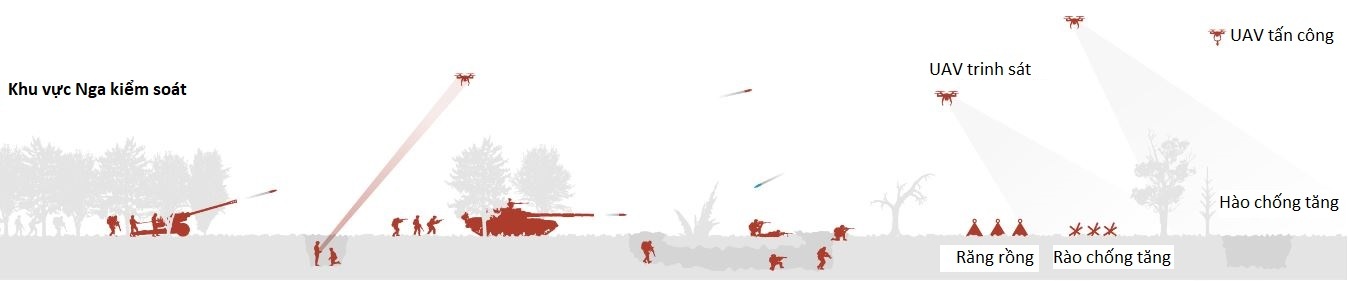
Russia is building a multi-layered defense system to counter Ukrainian forces (Graphic: Reuters).
The timing of Ukraine's counteroffensive was crucial, as it allowed Russia time to consolidate its front lines, particularly in Zaporizhzhia.
Ukraine delayed its counteroffensive for months before launching it. Kyiv trained its soldiers, amassed weapons supplied by the West, and developed a strategic plan. During this crucial period, Russia had time to erect trenches and lay mines along strategic areas on the front line.
Starting in late 2022, Russian forces, under the command of General Sergey Surovikin, began constructing defense systems. Moscow had ample time and resources to build multi-layered defense systems including extensive minefields, anti-tank trenches, trenches, and booby traps.
Based on intelligence gathered from satellite imagery, analyst Brady Africk at the American Enterprise Institute has identified a robust Russian defense strategy.
Expert Africk described the Russian fortifications between the front line and the city of Tokmak as dense and multi-layered, with anti-tank ditches, obstacles, fighting positions, and mines strategically placed in the trees and along key roads leading to the Russian-controlled southern region.
Furthermore, the flat, open terrain in the region makes it even more difficult for Ukraine to move its forces unexpectedly.
Slow progress
According to expert Africk, the slow progress of the Ukrainian army's counter-offensive has highlighted the high density of Russian-deployed fortifications in the area, as well as the limited resources Ukraine can utilize. After six months of fierce fighting, Ukraine has only advanced 7.5 km and reached the village of Robotyne.
Russia's fortified defensive lines are one of the biggest challenges preventing Ukraine from reclaiming vast territories controlled by Moscow. Russia has built and maintained robust defense systems with sufficient forces to prevent these lines from collapsing.
Russia's defensive line consists of multiple layers of barriers designed to hinder tanks, while a complex network of trenches and tunnels, as well as strategically camouflaged artillery batteries, tanks, and command posts, are also present.
This multifaceted defense strategy posed a significant challenge for Ukrainian forces attempting to break through the defensive lines. Furthermore, Russian artillery was continuously deployed to support the defense system.
As Russia countered Ukraine's counterattack, Moscow's forces also employed flexible defensive tactics. Russia withdrew from territories, then launched strong counterattacks as Ukrainian troops advanced and became vulnerable.
The densely mined area is constantly monitored.
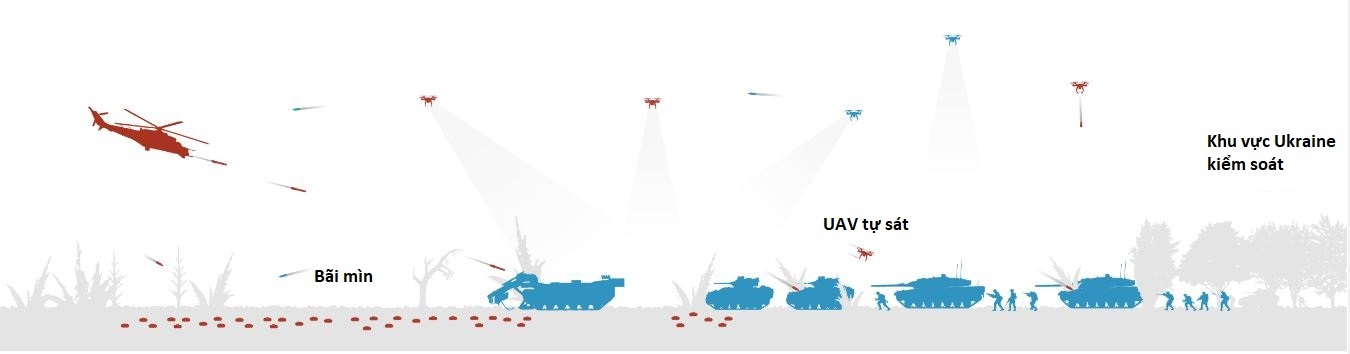
Russian minefields pose a major challenge to Ukrainian forces during their counterattack (Graphic: Reuters).
In front of their positions along the front line, Russian forces had deployed a formidable first line of defense consisting of a dense layer of anti-personnel and anti-tank mines.
Opening a path through Russian minefields has become one of the biggest challenges in Ukraine's counteroffensive, in terms of time, manpower, and equipment.
Ukraine has used Western-made mine-clearing vehicles, tank convoys, and armored vehicles to navigate the dangerous terrain.
However, the Ukrainian army's operations to clear paths through minefields are taking place under close surveillance by monitoring drones operated by Russia's new specialized drone units.
These drones meticulously monitor Ukrainian mine-clearing vehicles, providing information on them and alerting Russian artillery and attack helicopters. The increasingly sophisticated optics on these drones also mean they can see through traditional camouflage techniques such as smoke screens.
When tanks and mine-clearing vehicles at the front are targeted and destroyed, Ukrainian attacking troops in the rear will be trapped in a "destruction zone" of Russian artillery. If Ukrainian vehicles move around, they continue to run into mines.
Ultimately, the Ukrainian forces assigned demining tasks to smaller, slower-moving units, rather than deploying larger assault groups, to minimize the risk of casualties.
Despite few breakthroughs on the front lines, Ukraine's counteroffensive has achieved some modest successes. However, Ukraine's ultimate goal of regaining Russian-controlled territories remains unfulfilled. Furthermore, Kyiv continues to struggle to secure additional arms aid from the West as the conflict drags on.
A senior Ukrainian military commander said that frontline forces are facing a shortage of artillery ammunition and have scaled back some military operations due to a lack of foreign aid.
According to Reuters, Business Insider, Newsweek
Source




















































































Comment (0)