

The desire to be literate
Mo Chi Hamlet (La Hien Commune) is isolated in the middle of high mountains, rocky slopes, winding roads, and people's lives are still full of deprivation. To make ends meet, people here work hard day and night on their fields. However, since December 2024, when the literacy class was opened at the hamlet's cultural house, people here have not minded the long journey and rainy nights to come to class regularly with the desire to learn to read and write.
Ms. Hong Thi Hai (born in 2001) is a young mother with four small children. Previously, due to poverty and a difficult life, she had to leave school early without having time to learn the alphabet. Having married early and having many children, Ms. Hai almost stopped thinking about the day she would learn to read and write. So when she learned about the literacy class organized by Cuc Duong Primary School in the village, she registered to attend and brought her children along every class.
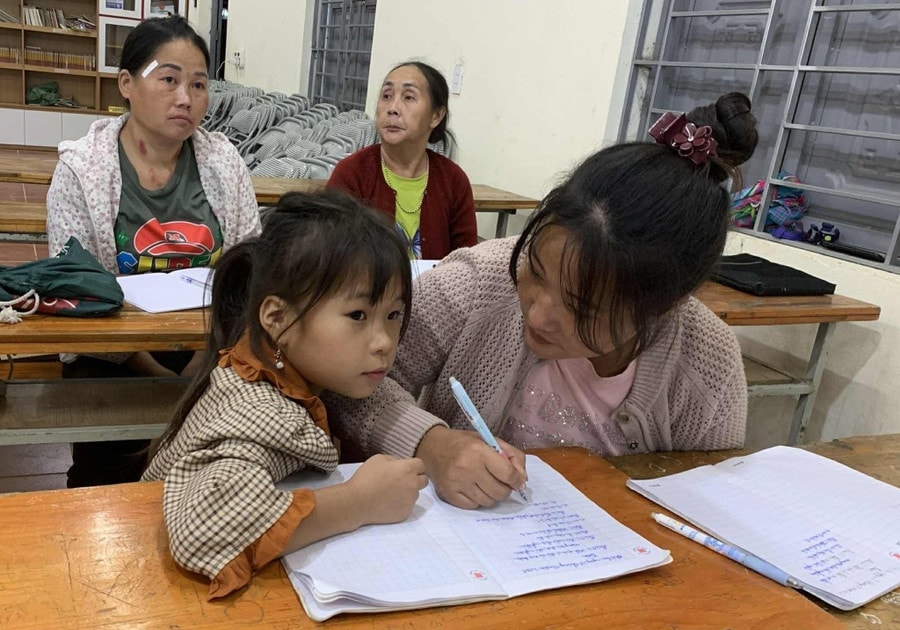
Ms. Hai shared: “I want to know how to read and write so that I can go to work, sign, take notes, and not have to rely on others. Now, not knowing how to read and write is very difficult, I am afraid to go anywhere. Knowing how to read and write will also give me more information to teach my children later.”
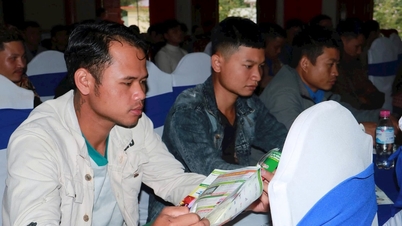
The literacy class at Mo Chi has 18 students, most of whom are Mong. Although they have long passed the age of going to school, they still choose to start over, patiently sitting with their notebooks, because everyone has a desire to learn to read and write, and more importantly, to open up new opportunities in life.
Like Ms. Hai, Mr. Duong Van Khin (born in 1985) is also a diligent student of the class. During the day, he works for hire, and at night he diligently goes to class to learn to read and write. He shared: There are days when I come home late from work, very tired, but I still try to go to class. Not knowing how to read and write is very disadvantageous, when I go shopping I cannot calculate, I have to ask others to write for me. Now I am determined to learn to read and write to be more confident.
According to Ms. Hoang Thi Bich Hue, a teacher at Cuc Duong Primary School, one of the biggest difficulties is that students here cannot attend school regularly because they are busy making a living. Many people say they “don’t have money for gas”, many people finish the first stage of their studies and then drop out to work as factory workers. She and the school understand that challenge, so outside of teaching hours, she often coordinates with the Village Chief and organizations to visit students’ homes to persuade and find ways to help them continue attending classes.
“We teach literacy, talk, share stories of everyday life, and examples of life changes after learning to read and write, thereby inspiring motivation and desire to learn for each student, especially older students. Teaching adults cannot be rigid, but must be soft, approachable, and have a variety of methods to help students absorb more easily,” Ms. Hue confided.
Journey of overcoming difficulties, surpassing oneself
Just like in Mo Chi hamlet (La Hien commune), Choi Hong hamlet (Trang Xa commune) or Vang Dooc hamlet (Nghia Ta commune),… the literacy classes have created a strong motivation for ethnic minorities and mountainous people to confidently rise up in life. To have the ability to read and write, students and teachers have had to overcome countless difficulties and challenges.
For many students, holding a pen is the first time in their lives. The first letters, though shaky and distorted, contain great pride. As Ly Thi Sau, a Hmong woman in Trang Xa, confided: “In the past, we were poor so we could not go to school. Now I can read my name, I am very happy.”
Or Ms. Sung Thi Ut in Nghia Ta, who used to have to rely on others to read her papers, now perseveres in going to class "despite the rain or wind, because she wants to learn to read and write so as not to be disadvantaged."
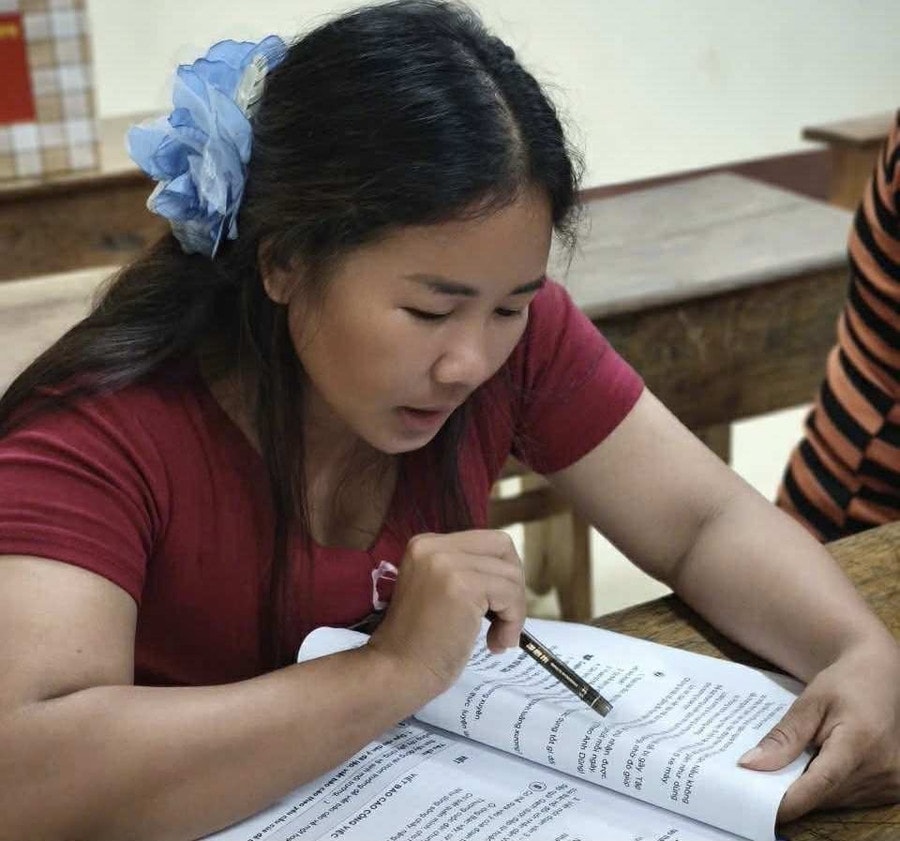
For teachers, it is a challenging but meaningful journey. Teachers not only teach letters, but also persevere through forests and streams to reach the learning location; create teaching methods from familiar situations such as calculating the amount of corn to dry, writing names in the shopping book, reading signs... to help adults absorb easily. Flexibility, dedication and timely encouragement have helped students become more confident and bolder every day.
According to the reporter, the result of the perseverance of the students and teachers is that 100% of the students in many classes can read and write simple sentences. More importantly, they have overcome their inferiority complex and are confident when signing, when transacting, when exchanging production, when interacting with strangers.
Along with that, thanks to literacy, many Mong women now know how to calculate when buying and selling, read medical instructions, and understand policies. Evening classes become a place for them to meet, exchange production experiences, and discuss how to grow corn, grow tea, raise pigs, and raise chickens. From there, the class becomes a place for people to exchange and share economic business experiences and motivate each other to improve their lives.
Implementing the National Target Program on Socio-Economic Development for Ethnic Minority and Mountainous Areas for the 2025-2030 period, Thai Nguyen province has synchronously deployed projects on education development and improving the quality of human resources in ethnic minority areas, notably Project 5 on education and training development. Within the framework of Project 5, Sub-project 1 has been effectively implemented by the province. Up to now, the province has invested in the construction of 44 school buildings, including boarding and semi-boarding schools for ethnic minorities, contributing to creating a spacious and modern learning environment for students in ethnic minority areas.
In addition, facilities serving digital transformation in education are also of interest, with 93 schools equipped with information technology infrastructure, serving online teaching and learning. In parallel with the development of facilities, the province organized 173 literacy classes, attracting over 4,000 ethnic minority people to participate. This activity not only contributes to improving the intellectual level of the people, expanding lifelong learning opportunities but also creates a foundation for sustainable socio-economic development for ethnic minority communities in the province.
Source: https://daibieunhandan.vn/thai-nguyen-xoa-mu-chu-de-dong-bao-dan-toc-thieu-so-vuon-len-trong-cuoc-song-10398209.html


![[Photo] Cat Ba - Green island paradise](/_next/image?url=https%3A%2F%2Fvphoto.vietnam.vn%2Fthumb%2F1200x675%2Fvietnam%2Fresource%2FIMAGE%2F2025%2F12%2F04%2F1764821844074_ndo_br_1-dcbthienduongxanh638-jpg.webp&w=3840&q=75)








































![[VIMC 40 days of lightning speed] Da Nang Port: Unity - Lightning speed - Breakthrough to the finish line](https://vphoto.vietnam.vn/thumb/402x226/vietnam/resource/IMAGE/2025/12/04/1764833540882_cdn_4-12-25.jpeg)







































Comment (0)