

The unpredictable nature of climate change is fueling extreme weather events, causing immense damage to people and socio-economic systems worldwide.
Horrific damage
According to The Guardian, citing a report by the International Chamber of Commerce (ICC), the total number of climate-related disasters increased by 83% between 1980 and 1999 and between 2000 and 2019. Approximately 4,000 extreme weather events across six continents between 2014 and 2023 caused significant damage, ranging from the destruction of homes, businesses, and infrastructure to the loss of human productivity. The report indicates that a total of 1.6 billion people were affected by extreme weather events, and also states that the death toll is expected to rise over time.
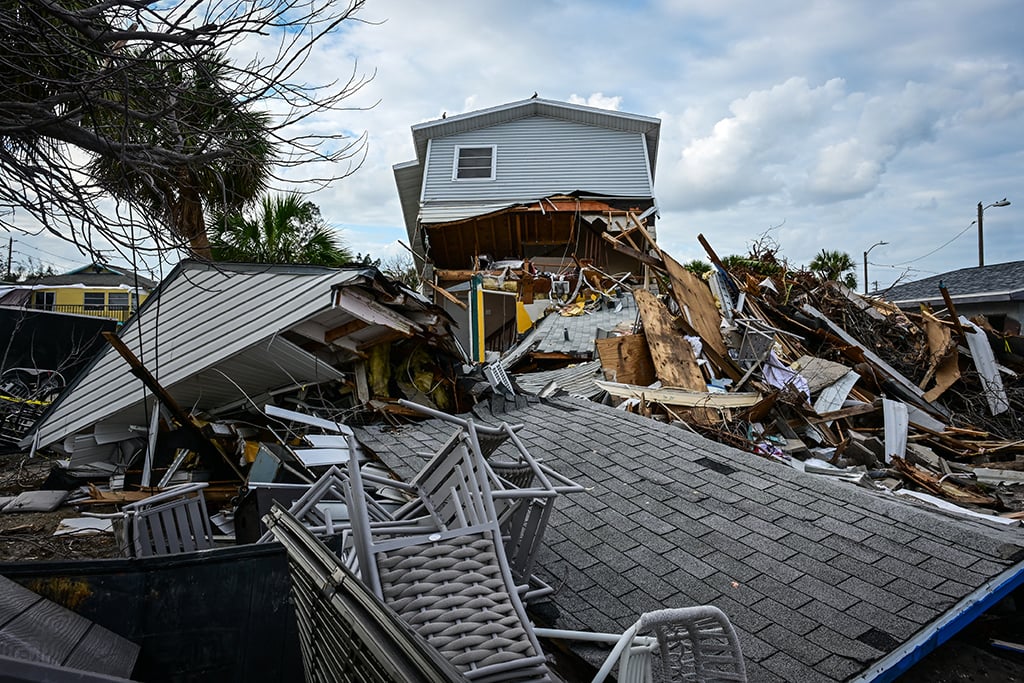
A scene from an area in Florida (USA) after Hurricane Milton swept through.
Economically, the total damage from extreme weather events related to global climate change is estimated at around $2 trillion from 2014 to 2023, equivalent to the losses during the 2008 global financial crisis. Considering the period from 2022 to 2023, global economic losses reached $451 billion, a 19% increase compared to the annual average of the previous eight years. According to the report, the US suffered the largest economic losses in the world during the 2014-2023 period, at $935 billion. Following the US, China and India recorded the second and third largest financial losses, at $268 billion and $112 billion respectively. Germany, Australia, France, and Brazil are also among the top 10 countries suffering the most losses due to climate change.
There will be more super typhoons like Yagi due to climate change.
According to the ICC report, the economic burden of climate change is uneven across countries. Economist Ilan Noy at Victoria University (New Zealand) commented: "In the long term, the losses in low-income countries are more devastating than in prosperous countries, where state support is stronger."
Previously, numerous reports also indicated that the global economy would suffer devastating losses due to extreme weather events. The Potsdam Institute for Climate Impact Research (PIK) estimated that climate change would cause damage equivalent to 17% of the world's gross domestic product (GDP), with estimated losses reaching US$38 trillion per year by 2050. Considering only developing economies in the Asia-Pacific region (excluding Japan, Australia, and New Zealand), if left unchecked, climate change could cause cumulative damage of 17% of the region's GDP by 2070. This GDP loss could reach 41% by 2100, according to a report by the Asian Development Bank (ADB) on October 31st.
"Open your wallets wide"
Simon Stiel, the UN's climate director, warned on November 11: "If at least two-thirds of the world's countries are unable to cut emissions quickly enough, then everyone will pay a heavy price."
Echoing this sentiment, ICC Secretary-General John Denton emphasized: "Clearly, the data from the past decade has demonstrated that climate change is not a problem of the future. The productivity losses caused by extreme weather events are being felt by the economy right here and now."
Korean kimchi is threatened by climate change in its home country.
Mr. Denton urged world leaders to respond quickly and in a coordinated manner to the economic impacts of extreme weather, asserting that "opening the wallet" for climate is an investment in a strong and resilient global economy where everyone benefits.
Azerbaijan's Environment Minister Mukhtar Babayev on November 11 called on private businesses to show more responsibility in responding to climate change. "Without the private sector, there will be no climate solutions. The world needs more money and needs it faster," Babayev was quoted as saying by The Guardian.
Opening of the COP29 Conference
On November 11th, the 29th Conference of the Parties to the UN Framework Convention on Climate Change (COP29) officially opened in Baku, Azerbaijan. The event brought together over 51,000 delegates. One of the focal points of COP29 is climate finance, where countries will discuss and determine appropriate financial figures to support poorer nations in responding to climate change. Therefore, COP29 promises to deliver decisive action to address the current climate crisis.
Source: https://thanhnien.vn/the-gioi-chiu-ton-that-khung-do-bien-doi-khi-hau-185241111225813102.htm


![[Photo] Prime Minister Pham Minh Chinh attends the Conference summarizing and implementing tasks of the judicial sector.](/_next/image?url=https%3A%2F%2Fvphoto.vietnam.vn%2Fthumb%2F1200x675%2Fvietnam%2Fresource%2FIMAGE%2F2025%2F12%2F13%2F1765616082148_dsc-5565-jpg.webp&w=3840&q=75)























































































Comment (0)