

The draft Law amending and supplementing a number of articles of the Law on Education, along with two laws related to education, were discussed by National Assembly deputies in their working groups during the afternoon session on October 22nd.
One of the new points in the draft law is the removal of the regulation on issuing junior high school graduation certificates, replacing it with the principal confirming the completion of the learning program.
Representative Dang Thi Bao Trinh ( Da Nang ) argued that the regulations on diplomas in the education system are a key aspect of this draft law, directly impacting the rights of students and the effectiveness of state management.
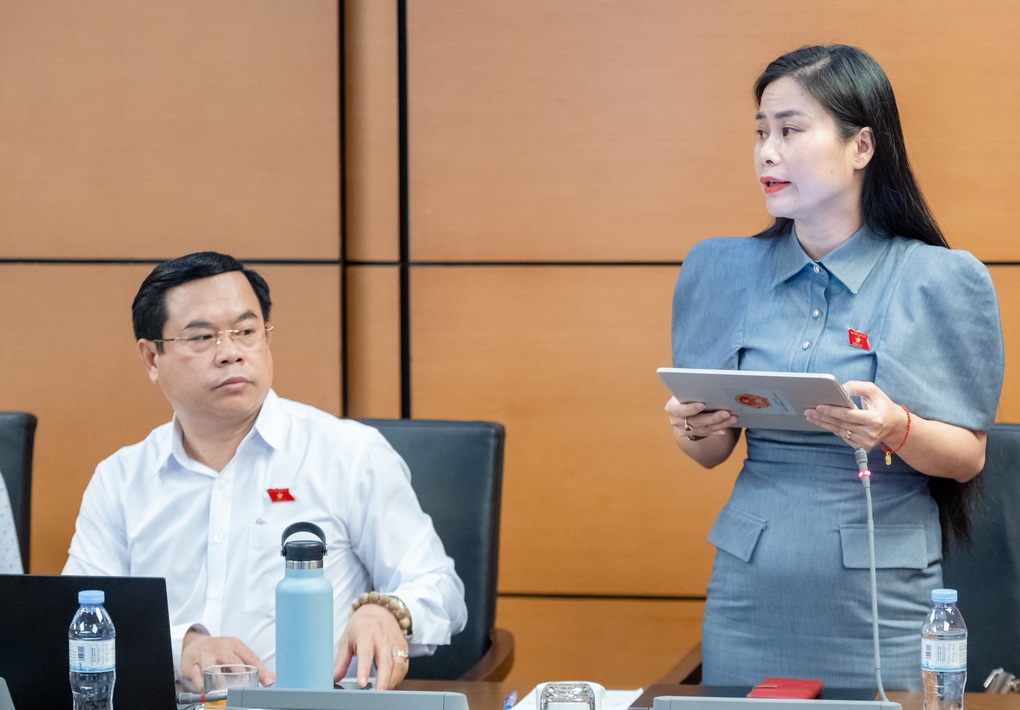
National Assembly representative Dang Thi Bao Trinh (Photo: Pham Thang).
The draft law stipulates that diplomas of the national education system include: high school diploma, vocational high school diploma, intermediate diploma, college diploma, bachelor's degree, master's degree, doctoral degree, and equivalent qualifications.
These qualifications, in paper, electronic, or digital form, are awarded to learners upon graduation from a level of education or completion of an educational program and achievement of learning outcomes.
While supporting the policy of issuing electronic diplomas, Ms. Trinh is concerned that managing electronic diplomas still poses many risks regarding security, data sharing, and authentication.
The female delegate proposed adding principles of confidentiality from management to authentication and sharing of digital diploma data, and clearly defining the responsibilities of all parties involved in exploiting, sharing, and using electronic diploma data.
"Cases of data leakage, modification, or trading need to have strict penalties," Representative Trinh suggested.
While supporting the abolition of the requirement for junior high school diplomas, the representative from Da Nang pointed out a contradiction in the draft law, which still stipulates that a junior high school diploma is a condition for further education.
Besides reviewing and standardizing the regulations in the draft law, Ms. Trinh suggested clearly specifying whether the confirmation of program completion should be in paper or electronic form.
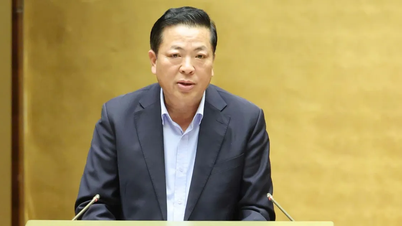
Citing examples from some advanced countries around the world, where students complete lower and upper secondary education without exams, only receiving transcripts, yet their educational quality remains high, National Assembly representative Quan Minh Cuong (Secretary of the Cao Bang Provincial Party Committee) argued that in our country, "too many exams are costly and too burdensome."

National Assembly Delegate Quan Minh Cuong, Secretary of Cao Bang Provincial Party Committee (Photo: Minh Chau).
"My personal view as a National Assembly representative is to reduce the number of exams and focus on improving quality," Mr. Cuong emphasized. The Provincial Party Secretary even pointed out the reality in Cao Bang: "They win very high awards in exams, but when it comes to the provincial education rankings, they always come last."
From there, Mr. Cuong emphasized that "there's no need to skim off the cream," but rather improving the quality of education is crucial, thereby creating the human resources and workforce to accomplish the tasks.
National Assembly representative Ma Thi Thuy (Tuyen Quang) also highly appreciated the regulations that both expand opportunities for lifelong learning, encourage diversification of educational pathways, and reduce exam pressure and unnecessary administrative costs.
However, according to the female representative, this could easily create a mindset of underestimating the importance of the graduation exam, affecting students' motivation to learn. Ms. Thuy also stated that the legal basis for the "certificate of completion of the general education program" is unclear.
"Can this certificate be used for registering for vocational training or for employment? If it's not clearly defined, it will cause difficulties in its application at the local level," the female representative stated.
Source: https://dantri.com.vn/thoi-su/thi-nhieu-qua-ton-kem-va-vat-va-giam-bot-thi-cu-di-20251022175231267.htm










![[Video] National Assembly passes the amended Civil Servant Law with 92.39% of delegates voting in favor](https://vphoto.vietnam.vn/thumb/402x226/vietnam/resource/IMAGE/2025/12/10/1765379039932_1-6690-3945-png.webp)

















![[Video] The craft of making Dong Ho folk paintings has been inscribed by UNESCO on the List of Crafts in Need of Urgent Safeguarding.](https://vphoto.vietnam.vn/thumb/402x226/vietnam/resource/IMAGE/2025/12/10/1765350246533_tranh-dong-ho-734-jpg.webp)





















































Comment (0)