

According to experts, with the current interest rate environment, borrowing 800 million VND would result in monthly payments of 9-10 million VND, which is suitable for someone with an income of 30 million VND.
I am single and currently have 1 billion VND in my savings account. My monthly income from both full-time and freelance work is around 25-28 million VND (potentially exceeding 30 million VND). I have never had any bad debt history, despite having 5 credit cards and frequently purchasing items on installment plans.
Instead of continuing to rent, I'm planning to buy a one-bedroom apartment by the end of the year. However, from what I've researched, I need at least 1.8 billion VND to buy an apartment in my current location (District 7, near Nha Be).
Should I borrow 800 million VND to buy my own house at this time? Given my current financial situation, will I easily get loan approval and will the interest rate be favorable? Thank you, expert!
Nhat Tan
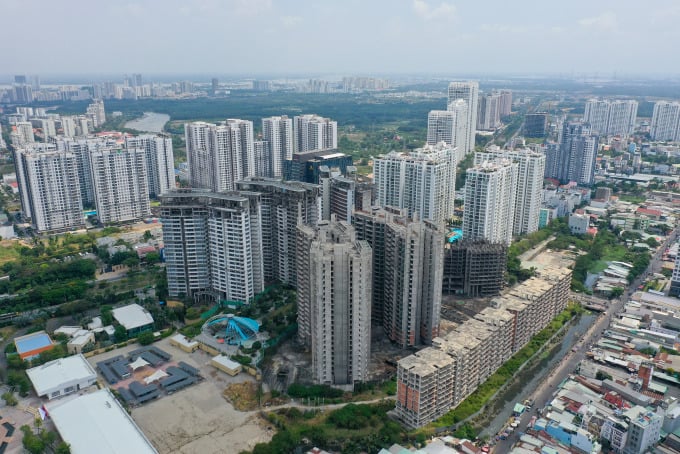
Real estate in the South of Ho Chi Minh City, February 2022. Photo: Quynh Tran
Consultant:
Before determining options and solutions for your goal of buying a home, you should prepare a comprehensive financial plan that includes financial protection measures to ensure this goal is achieved with the best possible and least risky approach.
First, you need to set up a short-term emergency fund. This fund should cover 3-6 months of expenses. You can calculate the amount of unemployment insurance benefits you might receive as part of this fund. Next, you also need to consider the future financial needs of dependents such as your parents over the next few years, for example, whether they will need your financial support.
Depending on the needs of your dependent(s), you should also consider purchasing life insurance to prepare for worst-case scenarios that could significantly impact your finances, especially if you decide to take out loans. You should also review whether you have any short-term financial goals, such as a marriage plan in the near future.
You didn't mention your monthly expenses, which is crucial information affecting your goal. You should track and assess your overall spending habits: how much you spend on essentials each month, how much you spend on leisure, and most importantly, you need to know your monthly surplus after expenses. Through this, you can better manage your finances to increase this surplus while maintaining your current lifestyle and achieving your home-buying goal.
Based on the information provided, generally speaking, you can use leverage at this time to buy your desired apartment . You might consider prioritizing borrowing money from relatives to buy a house (if possible). If you have to borrow from a bank, my advice is to approach large banks or branches of foreign banks to get lower interest rates than smaller banks.
Please note that, since you haven't specifically separated your salary and freelance income, I cannot accurately assess your loan eligibility at the banks mentioned above, as banks prioritize salary income over freelance income. Furthermore, you also need to assess the volatility of these income streams to mitigate risks.
Generally, banks will lend you up to 80% of the value of the collateral, and monthly payments cannot exceed 50% of your salary. Additionally, the bank will calculate the total credit limit of your five credit cards as part of your existing loan, thus reducing the maximum amount you can borrow for this home purchase. You should reconsider using five credit cards.
With current favorable interest rates, you would have to pay around 9-10 million VND per month for a 20-25 year repayment period, accounting for 30-35% of your income. This is still a feasible repayment ratio for some young people. In principle, in my opinion, to minimize risk, the amount you repay on a loan should not exceed 75% of your monthly savings. Therefore, if your current monthly savings are not more than 12 million VND, you should postpone buying a house to continue accumulating surplus funds, thereby reducing the amount you need to borrow.
Furthermore, I suggest you try to borrow for the longest possible term and choose a fixed-interest rate option for the longest possible period. For example, some foreign bank branches currently offer loans with a fixed interest rate of 8.5-8.6% for 60 months. Choosing the longest fixed interest rate will give you more control over your principal and interest payments compared to a variable-rate option, especially in today's volatile interest rate environment.
Finally, you should prepare contingency plans before borrowing. For example, if you are unable to pay the interest and principal, can your relatives help you with the payments? If so, you should talk to them beforehand.
A small note regarding using 5 credit cards: you should also carefully consider whether using credit cards for installment purchases is advisable, as the product price may already include a credit fee (10-16%) and whether a cash payment option might offer an additional discount. After consideration, if it's not necessary, you can reduce the number of credit cards you use.
Hopefully, the advice I've given can help you in some way with your decision-making. However, please note that the figures I provide are averages, hypothetical, and may differ from reality due to individual income and risk tolerance.
Nguyen An Huy
Personal Financial Planning Expert
FIDT Investment Consulting and Asset Management Company
Source link



























































































Comment (0)