

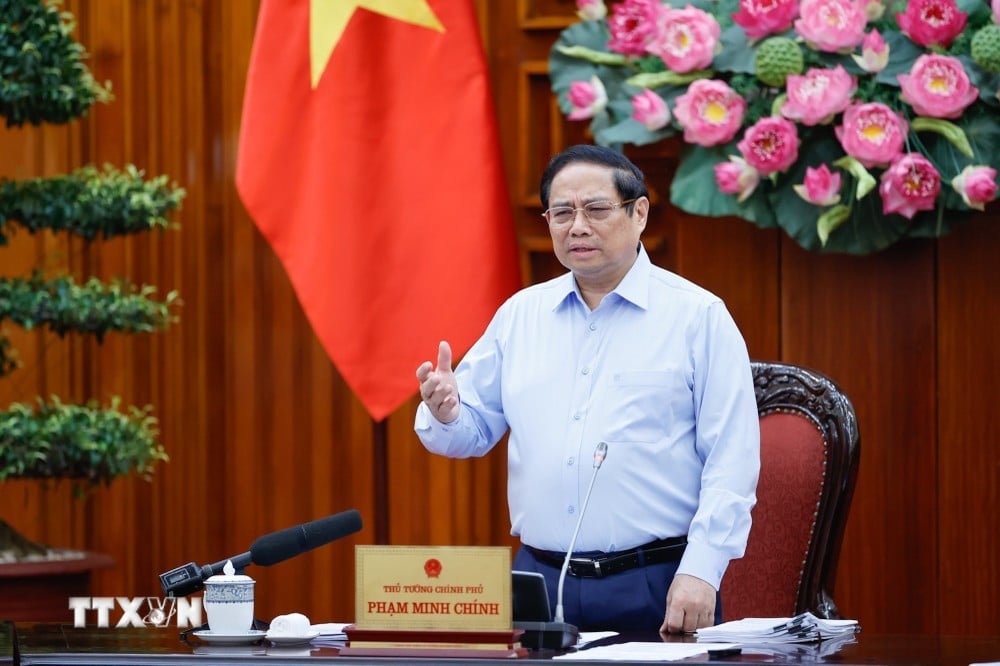
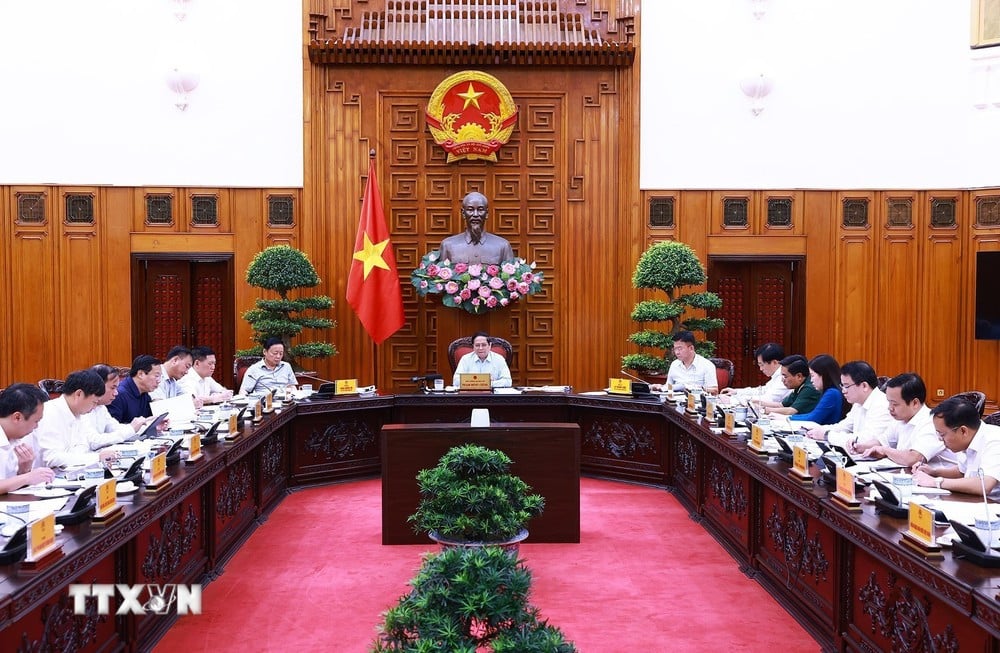
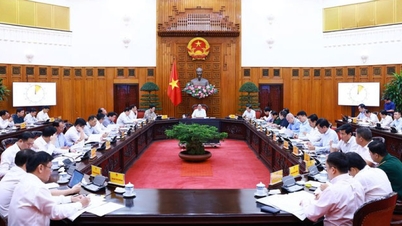
On August 20th, Prime Minister Pham Minh Chinh, Head of the Steering Committee for reviewing and resolving obstacles in the system of legal documents (Steering Committee), chaired a meeting of the Government Standing Committee with ministries and agencies on lawmaking.
Attending the meeting were Deputy Prime Ministers Tran Hong Ha and Le Thanh Long; leaders of relevant ministries, agencies, and government bodies; representatives of associations; and experts and scientists in the fields of finance, education and training, science and technology, etc.
At the meeting, the Standing Committee of the Government heard reports and discussed and gave opinions on the necessity of drafting laws and the policy contents of laws including: the draft Law on State Capital Management and Investment in Enterprises; the draft Law on Corporate Income Tax (amended); the draft Law on Special Consumption Tax (amended); the draft Law on Teachers; the draft Law on Digital Technology Industry; and the draft Law amending and supplementing a number of articles of the Law on Officers of the Vietnam People's Army.
After listening to reports, speeches from delegates, and directly giving feedback on the specific contents of each draft law, the Prime Minister highly appreciated the ministries and agencies for actively preparing the content, as well as their heartfelt, responsible, high-quality, and practical opinions…
The Prime Minister urged ministries and agencies to seriously and fully consider the opinions of delegates and finalize proposals for drafting laws, while also emphasizing several key guiding principles and directions in the process of developing draft laws.
Regarding the draft Law on State Capital Management and Investment in Enterprises, the Prime Minister requested a focus on removing difficulties and obstacles to effectively mobilize and utilize resources; and to inherit provisions in the current law that are still appropriate and have a positive impact.
"Whatever is mature, clear, proven correct by practice, effectively implemented, and agreed upon by the majority should continue to be implemented and legalized; it must be manageable but transparent, with clear roles, responsibilities, and expected outcomes," Prime Minister Pham Minh Chinh emphasized.
The head of government requested that the law be drafted in a way that promotes decentralization and delegation of power, coupled with resource allocation, improved enforcement capacity, clear definition of responsibilities for each agency and level, and the design of tools to strengthen supervision, inspection, and control of power; reducing administrative procedures, eliminating the "request and grant" mechanism, and minimizing intermediaries.
Furthermore, mechanisms and policies should be designed to unleash resources within enterprises; enhancing the autonomy and accountability of businesses. For state-owned enterprises, focus should be placed on key, essential, and strategically important sectors; specific regulations should be in place for enterprises in the defense and security sectors; and greater authority and responsibility should be delegated to representatives of state capital.
State agencies focus on carrying out state management tasks (developing strategies, plans, policies, legal frameworks, standards, criteria, tools for monitoring and inspection, rewards, and disciplinary actions)...
In the draft Law on Corporate Income Tax (amended), the Prime Minister requested that the law's design aim to broaden the tax base, ensure accurate, complete, and timely collection; combat tax evasion, especially in sectors such as e-commerce, food services, and retail; and promote electronic invoices, the application of information technology, and digitalization in tax management and collection. However, it must also create an environment that attracts investment and encourages business development, especially in priority sectors.
In addition, research should be conducted on decentralizing authority to the Government to promote dynamism, creativity, and flexible adjustments to suit the situation; resolving obstacles related to tax refunds and tax collection; reducing administrative procedures; and ensuring fairness and equality among businesses and economic sectors.
At the same time, tax incentives should be provided to suitable entities such as businesses building social housing; investment in science and technology, innovation, digital economy, green economy, circular economy, sharing economy, and knowledge economy should be encouraged; and established policies such as investment incentives should be further improved to avoid unnecessary disruption.
Regarding the draft Law on Special Consumption Tax (amended), considering that this law affects many industries, businesses, and people, the Prime Minister requested that it be refined in a way that ensures tax policies both promote production and business while limiting negative impacts on socio-economic development and the people, in the spirit of harmonizing the interests of the people, businesses, and the State; and guiding consumption in accordance with Vietnam's conditions.
Along with developing tax policies to encourage production and business for priority products and services and restrict those that are not encouraged, the Prime Minister requested that a suitable roadmap be developed, closely aligned with the situation, ensuring affordability and not affecting production and business activities; at the same time, measures must be taken to combat tax evasion, tax avoidance, smuggling, etc.
Directing the drafting of the Law on Teachers, the Prime Minister requested adherence to Resolution 29 of the Central Committee on fundamental and comprehensive reform of education and training and Conclusion 91 of the Politburo on continuing to implement Resolution 29; with a suitable and feasible roadmap and steps, and ensuring the necessary resources for implementation.
State agencies focus on performing state management tasks (developing strategies, plans, policies, institutions, mechanisms, legal frameworks, standards, criteria, tools for monitoring and inspection, rewards, and disciplinary actions)..., directly reducing the performance of specific tasks.
Furthermore, while inheriting relevant and positive provisions in current civil servant laws, we should continue to improve upon them without causing unnecessary disruption; and carefully assess the impact of policies that are subject to differing opinions and may generate additional administrative procedures and compliance costs in practice.
The Prime Minister emphasized that what is mature, clear, proven correct in practice, effectively implemented, and generally agreed upon should continue to be implemented and codified; for new issues that are not yet mature, unclear, or without regulations, it should be boldly piloted, learning from experience as it goes, gradually expanding, without striving for perfection or rushing.
The Prime Minister stated that it is necessary to amend and supplement specific policies for teachers to develop and improve their capacity and quality to meet the requirements in the new context, especially the Fourth Industrial Revolution; to attract talented people to the education sector, those who are dedicated to working in remote areas, border regions, and islands; and to have specific policies suitable for teachers at each level (preschool, primary, lower secondary, upper secondary, and university...).
The Prime Minister also suggested the need to promote maximum decentralization and delegation of authority in education management for teachers at the grassroots level, coupled with resource allocation, improved implementation capacity, clear definition of responsibilities for each agency and level, and the design of tools to strengthen supervision, inspection, and control of power; enhance public-private cooperation in teacher training; and facilitate teachers' practice within the framework of the law.
At the same time, minimize administrative procedures, eliminate the "request and grant" mechanism, and reduce compliance costs and inconveniences for citizens, businesses, organizations, and educators.
To further refine the Law on Digital Technology Industry, the Prime Minister directed that the resolution and conclusions of the Central Committee and the resolutions of the National Assembly and the Government on issues related to the development of the digital technology industry be fully and synchronously implemented, including Resolution 29 of the Central Committee and Plan 13 of the Politburo on continuing to promote industrialization and modernization of the country, Resolution 52 of the Politburo on some guidelines and policies for proactively participating in the Fourth Industrial Revolution, and Resolution 23 of the Politburo on the orientation for building national industrial development policies.
Emphasizing the need for a focused and targeted scope for the law's regulation, the Prime Minister requested continued refinement of relevant regulations on the digital technology industry, building upon existing regulations that have proven effective in practice; supplementing regulations to address legal shortcomings and obstacles, especially those arising from the practical management and development of digital technology in recent times; and reviewing and ensuring consistency and uniformity with related legal regulations.
In particular, it is necessary to clearly define the authority to review and approve controlled testing mechanisms for digital technology products and services in accordance with the policy of decentralization and delegation of power; to emphasize the responsibility of the agencies and individuals authorized to permit testing and of the organizations and businesses participating in testing; and to encourage and protect those who dare to think, dare to act, and dare to innovate for the common good.
In addition, there should be preferential policies to attract talent in the digital technology field; tools to promptly address emerging and emerging issues; and research into decentralizing some regulations to the Government to ensure flexible adjustments to suit the rapidly changing real-world situation.
The Prime Minister also gave his opinion on proposed policies related to crypto assets; promoting and encouraging the development, but also managing, of artificial intelligence and cloud computing...
Regarding the draft Law amending and supplementing a number of articles of the Law on Officers of the Vietnam People's Army, the Prime Minister clearly stated that the Law must institutionalize the Party's guidelines and policies and the State's policies on building the Vietnam People's Army, including building the officer corps; amending and supplementing regulations to overcome obstacles and shortcomings, ensuring suitability to practical realities.
Furthermore, the proposed law must adhere closely to and clearly reflect the policies approved by the Government; review and ensure consistency and uniformity with relevant legal provisions (Housing Law, Land Law, Planning Law, Labor Code, etc.); and ensure the rationality, feasibility, and effectiveness of the regulations.
Noting several issues such as preferential policies for military personnel, retirement age for male and female officers, social housing for the armed forces, etc., the Prime Minister requested active consultation with experts and scientists; strengthening policy communication to create high consensus; and effective coordination with relevant ministries, sectors, and agencies in the process of drafting and finalizing the draft Law.
Assigning the Deputy Prime Ministers to directly oversee the drafting of the Laws, the Prime Minister requested the lead agencies to fully synthesize the opinions of relevant agencies and organizations, incorporate valid feedback, and promptly finalize the draft Law documents in accordance with the Law on the Promulgation of Legal Documents to submit to the Government at the specialized legislative session in August 2024, and to the National Assembly for consideration and decision, ensuring progress and quality.
TH (according to Vietnam+)Source: https://baohaiduong.vn/thu-tuong-chu-tri-hop-thuong-truc-chinh-phu-ve-xay-dung-phap-luat-390831.html


















![[Photo] Prime Minister Pham Minh Chinh holds a phone call with the CEO of Russia's Rosatom Corporation.](/_next/image?url=https%3A%2F%2Fvphoto.vietnam.vn%2Fthumb%2F1200x675%2Fvietnam%2Fresource%2FIMAGE%2F2025%2F12%2F11%2F1765464552365_dsc-5295-jpg.webp&w=3840&q=75)













































Comment (0)