

Vietnam is a major rice exporter, however, the brand of Vietnamese rice in the world market is quite weak.
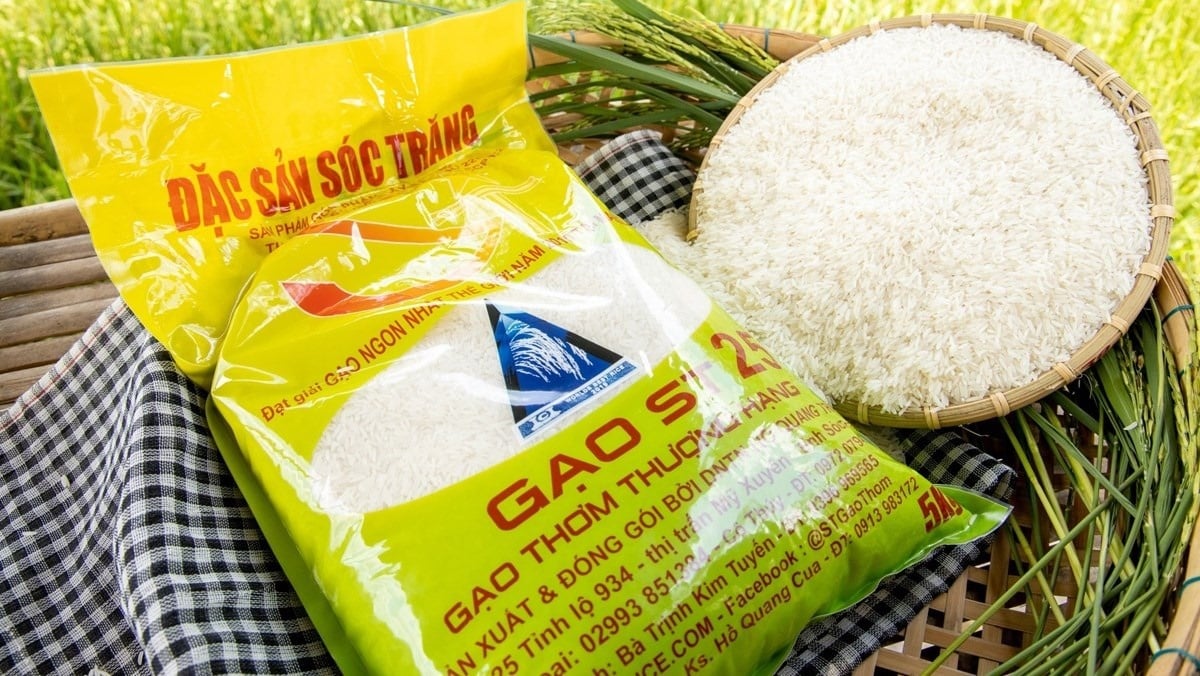 |
| Most of the rice exported from Vietnam to the EU is unpolished rice, lacking its own brand. |
Vietnamese rice has not yet established a firm foothold in the market.
Ms. Do Viet Ha, representative of the Vietnamese Trade Office in Germany, stated that some Vietnamese businesses in Germany import rice from Vietnam, but the volume is still limited. Many businesses mainly import rice from Thailand, India, Cambodia, or processed Vietnamese rice from Thailand to supply Vietnamese people in Germany. On the German market, rice originating from Vietnam has not yet established a firm foothold. Meanwhile, the demand for rice in the German market is relatively stable and trending upwards. Vietnam could increase its rice export value if Vietnamese rice exporting businesses build their own brands, export high-quality rice, and ensure compliance with EU standards for hygiene, food safety, and environmental standards. Clean, high-quality rice with attractive packaging will be the trend in the German and EU markets.
According to Ms. Tran Thu Quynh, Commercial Counselor of Vietnam in Canada, Vietnam is one of the top 10 rice exporting countries to Canada (after the United States, Thailand, India, and Pakistan), however, its market share is very small. Vietnamese rice has recently been highly appreciated by importers for its quality, but some importers are dissatisfied with the broken rice content (still around 5%), while other countries like Thailand have better milling quality and a broken rice percentage of almost 0%.
"The outlook for Vietnam's rice exports in the coming period remains very positive thanks to its price advantage compared to similar products from competitors. However, a significant difficulty for Vietnam's rice exports is the lack of branding, meaning consumers are not aware of the product and therefore cannot make informed choices. Vietnamese rice purchasing decisions are still primarily based on price rather than brand loyalty," Ms. Thu Quynh shared.
Mr. Pham The Cuong, Commercial Counselor of the Vietnamese Trade Office in Indonesia, stated that Vietnam consistently ranks among the top three rice suppliers to the Indonesian market. "In particular, the brand recognition of Vietnamese rice in the Indonesian market is not yet very clear. In many Indonesian supermarkets, Thai rice already has easily recognizable brands for consumers," Mr. Pham The Cuong shared.
According to Ms. Phan Thi Nga, Vietnam's Trade Representative in the Netherlands, Vietnamese rice currently has limited access to major Dutch supermarkets, and even in Asian supermarkets, the quantity is small. The reason is that Thai and Indian rice have entered the market much earlier, demonstrating consistent quality over a long period, thus establishing a strong foothold.
According to Ms. Nga, Vietnamese rice, which Vietnamese consumers in the Netherlands have reported to have inconsistent quality and higher prices compared to Thai and Cambodian rice, has led many to switch back to Thai rice after trying it once or twice due to its consistent quality and better price.
Removing obstacles
Mr. Pham Thai Binh , General Director of Trung An High-Tech Agriculture Joint Stock Company, said that most Vietnamese rice exported to the EU is raw rice and does not have its own brand. After importing Vietnamese rice, businesses will repackage it with their own labels and branding before selling it to consumers, commonly under brands such as Golden Lotus, Buffalo, and Green Dragon.
Currently, some Vietnamese businesses are focusing on brand building, such as Loc Troi Group Joint Stock Company, which recently completed the export of nearly 500 tons of rice under its own brand – “Com Viet Nam Rice” – to the European market. Mr. Nguyen Van Hieu, Export Director of Loc Troi Agricultural Products Joint Stock Company, said, “The “Com Viet Nam Rice” brand has been exported to France, Germany, and the Netherlands. This rice brand will continue to be developed in the US market and other EU countries in the near future.”
Several other units have also built brands, such as ST fragrant rice in Soc Trang and Hong Dan red rice in Bac Lieu, but these are still small-scale and fragmented. According to Mr. Le Thanh Hoa, Deputy Director of the Department of Quality, Processing and Market Development (Ministry of Agriculture and Rural Development), since 2018, the announcement of the Vietnam Rice brand has encountered some difficulties, leading to delays in implementation. The Ministry of Agriculture and Rural Development has submitted to the Government a plan to resolve these obstacles and effectively utilize the Vietnam Rice brand.
Accordingly, the Ministry proposed assigning a public service unit to manage and use the rice trademark. Based on Clause 4, Article 87 of the Intellectual Property Law, the condition for the unit assigned to grant the trademark use is that it must be an organization with the function of controlling and certifying the quality, characteristics, and origin of the rice, and must not engage in the production or trading of that product. Mr. Le Thanh Hoa stated that the Ministry of Agriculture and Rural Development could choose to submit a draft decree to the Government on the Regulations for the Use of the Vietnamese Rice Trademark. Based on that, the Ministry of Agriculture and Rural Development will issue a Circular specifying the regulations for the use of the rice trademark, ensuring compliance with Decree 63/2010/ND-CP on administrative procedure control and the Law on the Promulgation of Legal Normative Documents.
Source link
































































Comment (0)